A Balinese County Fair
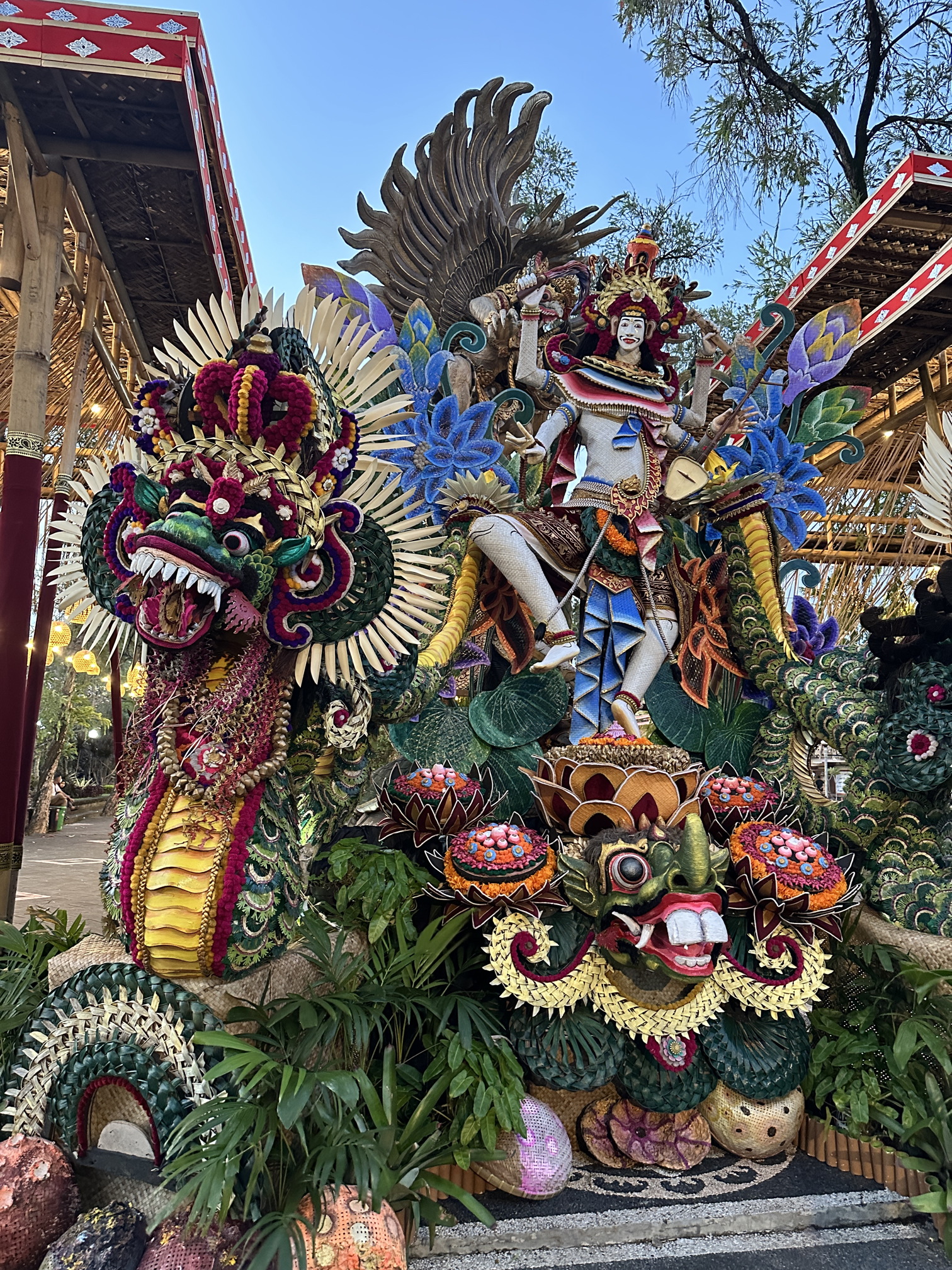
All unbeknownst, we arrived in Denpasar in the midst of their annual month-long art fair, Pesta Kesenian Bali. It takes place on the grounds of the Taman Werdhi Budaya Art Centre, which was purpose built as a cultural center in 1973. In 1979 it became the host of the inaugural arts festival, which has been held annually ever since.
The festival features arts, crafts, traditional and modern performances, plenty of food, a night market, and a midway. It is ridiculously well attended, and has the vibe of a county fair. But it’s Bali, so everything about it is beautiful. We went our first night, and it was so much fun we spent the next two evenings there, as well.

Grounds
To call the grounds rich is to diminish them, but there are only so many superlatives to throw around. Close your eyes and spin, and when you open them you’ll be staring something marvelous in the face. It’s dense.
This is just the entrance gate.


It’s not at all clear how much of the decorative infrastructure is reused vs. what’s created fresh each year. Some of the more elaborate constructions seem to be made of ephemeral materials, but even if some pieces are reused, they’re all beautifully maintained, and certainly look brand new.
This is just one of the stages.


But wait. There’s more.


As promised, there’s even a midway, as part of the stalls that make up the market area.

And plenty of food stalls. We were there three nights and ate dinner in the stalls every evening. The cuisine has a distinct top note of ouch. I believe they use the chilis in surgery instead of anesthesia, to distract from the pain. When we are given the option of pedas (spicy) or not, we choose not.


Performance
We saw dance and music performances every night, and got a crash course in Balinese gamelan music, which is both offered on its own and accompanies the dance. I kind of wasn’t expecting to like gamelan, as it doesn’t use a Western tonal scale, and operates, in my mind, in the same taxonomic space as Chinese opera. Which sounds to me like cats desperate to convince you of something very, very important.
I may have to revisit that bias now, as I truly loved the gamelan music. It has the manic, coked up energy of a Raymond Scott Looney Tunes score.
Gamelan is not, as I had ignorantly thought, an instrument, but a style of music. While there’s the odd flute or string, the vast majority of the instruments are percussive: drums, xylophones, gongs, and metallophones (tuned percussion). That’s a gangsa metallophone on the right.

While this isn’t the craziest music we heard, it’s the craziest we recorded.
But that wasn’t our first exposure to gamelan music, which came on our first night, in an outdoor arena that seats 6,000, but had plenty more standing.

What we didn’t know we had walked into was some sort of weird all-female gamelan orchestra battle of the bands, featuring dozens of women in identical outfits, like a Bizarro Tommy Dorsey orchestra.


They must have been local celebrities, because each band had a cheering section with fans waving flags the same color as their outfits. The whole thing had the energy of an Iggy Pop performance, the ambiance of a World Cup match, and the choreography of a Busby Berkeley jam. It was enchanting.
Then there was this, and whatever was making those weird harmonics. I thought it was singing, but Dorothy thought it was flute and strings. We both thought it was wild.
Topeng Dances
Topeng is a masked dance that is found throughout Indonesia, not just in Bali, with roots that stretch back to 850 AD or earlier. While they originally focused on nature and ancestors, the introduction of Hinduism to Indonesia added the Ramayana and Mahabharata as source texts for new dances. Still, many dances represent archetypal characters more than structured narratives.


Here’s the blustery guy arguing with another character. This went on for so long, without dance or music, that we had to leave. I’m sure it was funny if you spoke Indonesian, but that left us out.
We think this character is Patih Keras, a high-ranking court official. But that doesn’t get us anywhere near understanding the narrative of this dance. This clip is long, as I wanted to capture an entire performance, so feel free to bail. I certainly wanted to, or have magically sprouted a tripod. On the other hand, it does an excellent job of capturing the sonic range of a gamelan orchestra, which can go from eerie to frenetic, delicate to thunderous, and every stop in-between.
In this particular case, the music is sinister and the dance is a little creepy, making a compelling combination. The dancer’s fine body control is something to behold.
Ramayana Dance
While the Topeng trended more folk dance, there was another troupe that focussed on Ramayana dances. Knowing that didn’t make them any easier to understand, but there was at least some familiarity. The Ramayana has been a consistent through line during our time in Southeast Asia.


We think these dances had something to do with trickery, abduction, and, shall we say delicately, seduction. But only because that seems to be what the entire Ramayana is about. This may have been about a lovely picnic.
Again, the body control is very hard to wrap your head around.
This dance, though, was the bomb. We were totally not expecting saucy drag. Shockingly, Googling “ramayana saucy drag” brings back nothing, when it should most assuredly be bringing back this.
More Ramayana…
This performance was less dance, more play, and was played very broadly. So broadly that I tagged it as commedia dell’arte when I filed the photos. It’s still from the Ramayana, and appears to involve giants, or giant hermits, kidnapping fairies, or little girls, or princesses. And impertinent men hitting on saucy wenches. Or something. There was much declaiming.


The Crafts Mall
And this is where our dreams came true, and the reason we didn’t bother trying to fabric shop on Jalan Sulawesi. This was a selection of artisans so perfectly curated that we didn’t have to go anywhere else to find the very best artifacts. They had conveniently all been brought into one place, seemingly just for us.
The indoor mall had a large open courtyard, with a side gallery featuring a series of four rooms with textiles and jewelry.


Crafts
The courtyard had all sorts of things, from housewares to sculptures in a variety of media. For whatever reason, what leapt out was one woman who hand painted baskets, purses, fans, and wall hangings, using canvas and reed. Dorothy picked up a swell fan.


Jewelry
There’s a famous silver village, Celuk, just half an hour from Denpasar, that had been on our list. But since it seemed like every major Celuk jeweler had a booth in the craft mall, no need. I bought a ring and we both bought earrings.
The four large side galleries were all set up identically: three walls of textile makers, the fourth wall and the center island for jewelers.


And… Ikat!
We’d done a good job picking up display quality textiles on our day trips to Tenganan and Sidemen, but we needed things that could be cut up and made into garments. We only have so much wall space, but I wear shirts every day.

As with the jewelry, it seemed like every artisanal ikat maker was represented at the craft mall, so it was an incredible one-stop shop. We bought fabric each of the three nights we attended the fair. They started to recognize us.
The range and selection was astonishing, and rewarded three nights of viewing. Every time we went back we saw amazing things that we’d somehow overlooked on previous visits. I’m glad we took the time to go slow and dive deep. Our wardrobes will thank us.


One of the most amazing things we saw was ikat with figurative, brocade-like designs. I understand how that’s theoretically possible, but it still doesn’t seem practically achievable. The technical complexity is just through the roof.


Here’s another thing that should be impossible. That hand-woven stripe on the right isn’t pieced in. It’s woven on the same loom as the ikat. Then just to show off, it shifts back to ikat. Insane.

But this is going to end up exactly where you thought it would: with loot. We bought us some fabric.

Rang-Rang ikat from Nusa Penida, an island off Bali that we thought was just for snorkeling. Now we feel foolish to have missed it. 
Rang-Rang is characterized by the open floats that are part of the design. 
From Cepuk. 
Also from Cepuk. 

An endek, or weft, ikat. 

I picked up a couple of endek ikats for myself. 

Dorothy had to get one of the impossible figurative ikats, and she chose these birds.
I have to blame Dorothy for the fact that I’m a fabric slut. I can’t imagine that I’d have wound up in that place without her influence and guidance. My world is profoundly enriched by that, as it is by her in so many, many ways.