Batik-apalooza
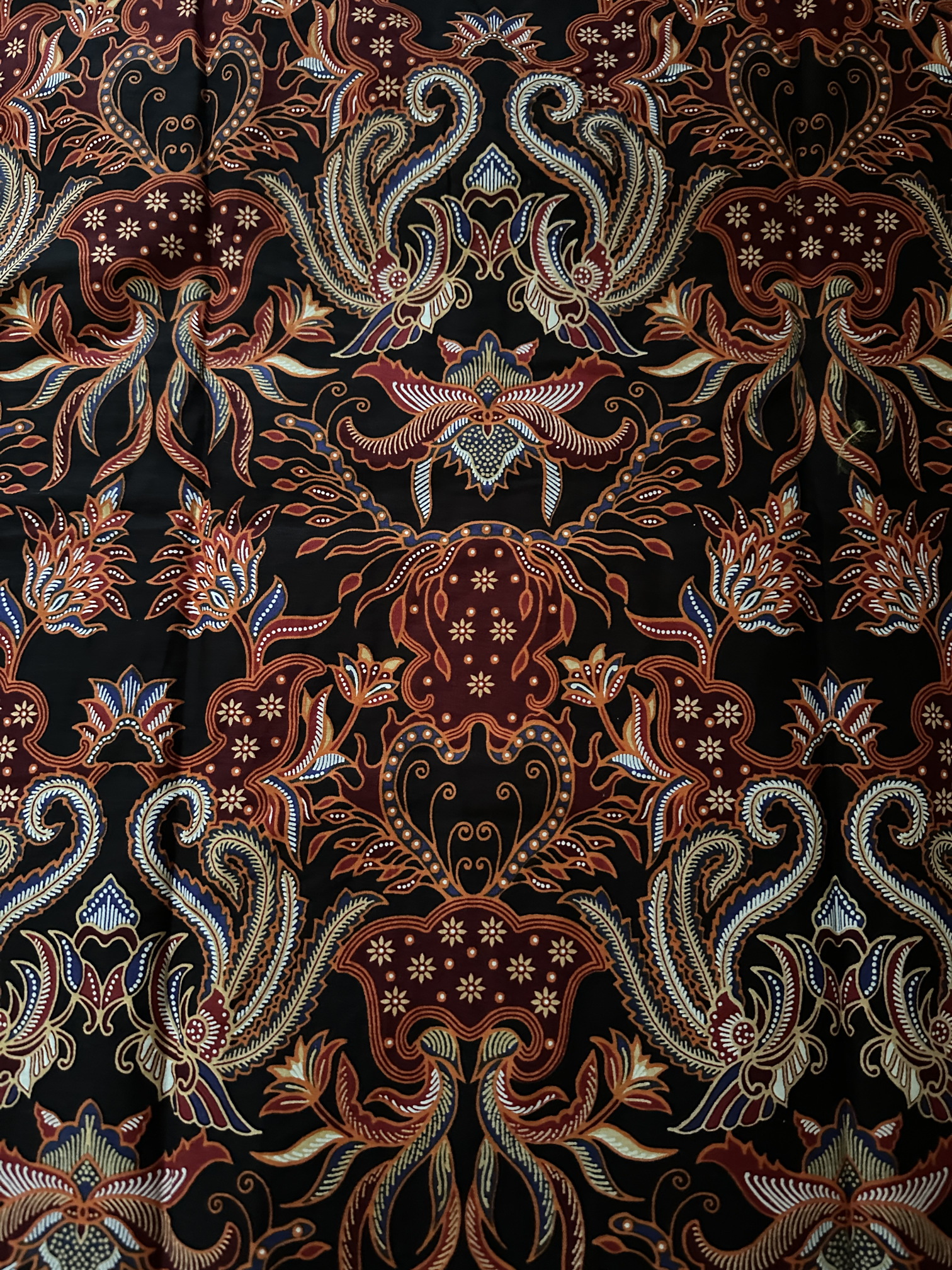
Bali’s ikat fabrics are gorgeous. Subtle, rich, intricate, implausible in their craft. In counterpoint, Java’s batiks are the bumptious clown car to Bali’s sleek Formula 1 racer. Loud, intense, riotous, overstuffed… As we looked around and got our bearings, Dorothy was all, “What’s up with that?” I, on the other hand, was certain I’d come home.
Batik is a particular flavor of wax resist dying, which has been a thing since ancient times, having been practiced in Egypt, southern China, India, and different parts of Southeast Asia. Javanese batik techniques are the most sophisticated of the various flavors, although it’s impossible to put a precise date on their origins. UNESCO estimates that the local traditions are over a thousand years old.
One of our very first stops in Yogyakarta was Malioboro Street, the downtown batik mecca. Half the stores sell batik, the other half sell bakpia, little cakes filled with sweet flavored mung bean paste, and the final half are snack emporia. Yep, come to Escape Velocity for the highfalutin Latin plurals. Stay for the math jokes.
Batik Junwita
The very first shop we visited on Malioboro was Batik Junwita. We were not prepared. Batiks come in several flavors, the primary distinction being true batiks, which are made by hand by applying wax as a dye resist in various layers, and prints, which mimic batik patterns but are printed commercially. Shops that sell printed batiks look much like other clothing stores, but louder. There will be a rack with a particular design in multiple sizes, and if you see something you like in a print you can ask and they’re likely to have it in stock in other sizes.
But real batik fabrics are hand made, one at a time, so literally every garment and piece of fabric in these shops is unique. If it doesn’t fit, too bad, but more to the point, it’s actually disorienting to be in a retail store with zero duplication. The range of choices in any one shop is dizzying, and there are hundreds of these shops all over Yogyakarta, a lot of them on Malioboro. It’s impossible not to get swirly eyes. Here’s Junwita. Quite the introduction.


One of the hallmarks of the shirts, even inexpensive shirts made from the printed batik, is the insane precision in the cutting and assembly. You can see it here on a shirt from Junwita, with the placket matching the pattern practically to the centimeter. The pattern tends to repeat in perfect symmetry on the back in a single piece. It’s stunt sewing at its finest.

Creative Batik
As I mentioned, Dorothy wasn’t bowled over by the batiks at first. A little loud and unsubtle for her tastes. Precisely why I loved them so. But then we found Creative Batik, which happened to be less than five minutes by foot from our apartment in Kotagede. It hadn’t come up in our research ahead of time, we just saw a sign for it on the corner. If we hadn’t been neighbors we’d have never found it.
This was the sweet spot Dorothy and I are always seeking: traditional techniques and motifs mixmastered through a modern sensibility. We seek that out wherever we go, and we found it in Yogyakarta, by accident, practically next door.


Here are the clothes we got at Creative. I picked out three pieces of fabric they made into custom shirts for me, and then bought another off the rack when I picked them up. The base price of the shirts, including the tailoring, was $32.


Batik Sastronegoro
A high end shop that we’d read about while doing our homework was Batik Sastronegoro, near the Taman Sari craft village. We went one evening, and, as has happened repeatedly here, the place didn’t seem to exist. We careened about looking for it and got picked up by a fellow who asked where we were headed. He promised to take us to Sastronegoro so we followed him. What could possibly go wrong?
Well, it was dark, and we were wandering through tiny lanes and alleys, and while we currently outnumbered him, who knew how long that would last? Long enough, as it turned out, to arrive at a house where he knocked on the door. When they opened it up, it was… a batik shop. A closed batik shop that they opened for us.
It took a few minutes to piece it together, but Batik Sastronegoro had closed, and the family that operated it had reopened as Batik Tulis Griya Sentong. The guy who picked us up was a friend of the family, so he knew where to bring us.
Sastronegoro had a long, multi-generation tradition of producing beautiful, highly detailed work, and they were incredibly generous with their time and attention.


Dorothy and Nef both bought heirloom pieces, done by the clan’s grandmother about forty years ago.

Dorothy’s piece was tagged as Kupu Gebel. 
Kupu means butterfly, and gebel refers to the technique of cramming the dots of wax psychotically close together, as in the large central butterfly. The more rationally placed dots in the smaller butterflies are referred to as ceceg. 
Nef’s piece was tagged Daun Pepaya Granit. 
Daun Pepaya is papaya leaf, and granit refers to the dots surrounding the main design elements.
But that wasn’t the end of the evening’s adventure, although it would have been enough. Our guide, in walking us back to the street, gently suggested that we might want to visit his father’s workshop. Not having been shanghaied so far, we figured we should say yes. New experiences, new adventures!
This was another form of batik that we’d seen in some shops, but nothing we’d looked at carefully. Whereas the fabric batiks were almost entirely abstract, some artists specialized in using batik as a technique for figurative illustration. Fabric paintings, basically.


Galeri Batik Jawa
We had one more place on the list we’d compiled from advance research: Galeri Batik Jawa, which specialized exclusively in indigo. We were surprised at how rich they were able to make a monochromatic palette look. We were expecting to be interested, but not enchanted. Silly us.


Babaran Segaragunung Gallery
One last, unintended batik adventure was in store. We were in Yogyakarta during their annual art extravaganza, ArtJog. The main event is at the national museum, but there are small galleries all throughout the area putting on ArtJog adjacent shows with local artists. We made our way to several, one of which was focused on textile arts. We didn’t know what that meant exactly, but shouldn’t have been surprised that it meant batik.
Which we discovered when we were finally able to get there. The producer had sent me a Google Maps link to the location, but you can’t put that directly into the ridesharing apps here, Grab and Gojek. So I entered the name of the gallery into Gojek manually, and it popped up as a destination. It dropped us off at what turned out to be the studio for the gallery, not the gallery itself. The people working there were mystified by our presence.
Having figured out the error, all I had to do was get Gojek or Grab to pick us up and take us to the right place. Which they’d have happily done had any cars been in the area, but we were in a noticeably non-urban location. We timed out on searches on both apps, and weren’t keen on the 45 minute walk to the gallery. Completely doable in the worst case scenario, but the day was already getting hot, and we’d trekked Parambanan and Borobudur the day before, so we weren’t feeling so fresh.
I reached out to the producer on WhatsApp and asked if she could send a car from her end, where they’d be more likely to be clustered. Her affirmative manifested in about ten minutes as a scooter carrying these two gentlemen.
The fellow in the back introduced himself as the gallery’s curator, and the gentleman in the front was one of the artists. That fellow, Lejar Daniartana Hukubun, had quite a story to tell.

After a little back-and-forth with the producer, it didn’t seem like a car would be forthcoming. I checked Grab again, and there was a car in the area. Our new friends clearly didn’t trust us to negotiate the taxi successfully, so they instructed our driver to follow their scooter. It only took an extra hour, but we finally made our way to the gallery.
There was a main gallery with major pieces that weren’t for sale. There were variations on batik as a technique that ranged from subtle to graphic.


The rest of the gallery was a little more like a store, but not one that seemed to have any experience actually selling things. Every time we asked the price of something either someone had to be called or intense head-to-head conversations occurred.


These two pieces were by the same fellow who did the blue pieces in the gallery. We would completely have bought one, as they were objectively spectacular, but they were so big, we couldn’t figure out how we’d display one. We were very, very sad to leave them behind.


The rest of the story there was about Lejar Daniartana Hukubun’s work. He’s written a story about the fuckery being perpetrated by the Indonesian government on the indigenous Malind tribe of Merauke in Western New Guinea. Shockingly, that fuckery is about land and resources. Lejar didn’t say, but we strongly suspect the Malind are his people.
Lejar has told this story in a book, in videos, in a modernized take on a Wayang puppet show, and in his own artworks, in both batik and illustration.

Lejar is one of the most genuinely happy people we’ve ever met. 
A massive batik featuring one of the characters from his story. 
When he came to meet us on his scooter he brought a partially done batik. I don’t know if he always travels with it or if he brought it to keep us entertained while we figured out how to get to the gallery. 
His art was available as postcards, prints, and originals. The remaining wall space in our apartment dictated postcards.
But of course, this all resolved in shopping. Given that they had sent ambassadors to rescue us, it was the least we could do. After much careful consideration, Dorothy settled on a positively stunning silk batik scarf. The ability to produce batik on silk at all, let alone at this level of detail and precision, is kind of mind-blowing.


Other Batik
Dorothy bought interesting, less elaborately produced fabric in other shops, too.

A rayon print from Batik Srikandhi, not a true batik. But also $7.50. 

This came from Malioboro’s tourist superstore, Hamzah. Not to keep harping on price, but this piece was $10. It’s a print, not a true batik, but still. 
From Batik Ambo. 
The printed William Morris style piece from Batik Adiningrat was $8.
I found some full-on batik t-shirts at nDalem Mbah Bei in Taman Sari, but that was the only place I saw them. You’d think they’d be an obvious thing, but for whatever reason they’re rare. T-shirts with batik prints are in souvenir shops everywhere, but real batik, not so much.


And one final trip to Malioboro netted me a couple of last-minute keepers.


And here is my personal wall of regret, shirts I loved but didn’t get, either because they didn’t quite fit or I was very briefly overcome by common sense. After all, I bought more shirts in Java than in all our travels to date, I think. To say nothing of the ikats I got in Bali. Not to lapse into jargon, but I lost my shit here. Still, these are the ones that got away.


But Wait, There’s More…
One of the things Dorothy and Nef were most excited about in Yogyakarta was taking a batik class together. They took a two-day intensive class in Oaxaca on natural dying, and they were looking forward to learning enough batik technique to bring it home and use it on their own projects.
The challenge was finding a class geared towards practitioners, not ladies-who-lunch looking to make their own souvenirs. There’s a ton of those sorts of tourist enrichment activities here, from batik to silver to cooking classes. The trick is finding the classes geared to the serious student.
We thought we’d ask our new best friends at Creative Boutique, and to our delight they offered their own classes. They were four person classes and they only had one other attendee, so we bought the fourth seat and burnt it, just so we weren’t waiting for a random fourth to pop up. Or not pop up, and miss the whole thing.
They asked if I wanted to take the seat, since we were paying for it anyway, but I explained that my hands were like mittens, and I’d only hold everyone back. Having seen the pictures and heard what actually transpired during the class, that was a great call. That experience would have made me cry. And not in the good way.
The basic batik process is simple, in a sense. What makes it hard is the skill required to do it well. It’s a form of resist dying using wax as the resist medium. There are many ways to create a resist, from practical, like wax or paste, to physical, like tie-dyeing or shibori, where the knots in the fabric create places the dye can’t reach.
In batik, you apply wax to fabric and then dye it. The dye color doesn’t take wherever the resist has been used, so those areas are undyed. After dyeing, the fabric is boiled to remove the wax, and the process is repeated as many times as necessary to create the finished design. The more colors in the design, the more times the fabric has to go through the process. And the more time consuming and costly it is.
Tulis is the term for applying wax by hand. Tulis literally means handwritten. It can be applied by brush, but is most often applied with a small pen, called a canting, that has a reservoir for the molten wax. The wax can also be applied with a copper stamp called a cap. Dorothy has had a cap for years, as it’s a beautiful artifact in its own right. The C in Indonesian is a ch sound, by the way, so that’s tjan-ting and tjap.

Dorothy and Nef had originally wanted to learn both methods, at least until the teachers explained how the cap is actually done. Getting the wax onto the stamp in exactly the right amount, consistency, and temperature is hard enough, but then you have to turn it upside down without dripping and apply it to the fabric by hand, without any sort of jig to align it properly to the previously placed stamps. You could make a mistake on the final stamp and ruin an entire piece.
The canting takes enough precision on its own to be daunting, so the executive decision was made to skip the cap and stick to the tulis.


The goal was to come home with reusable knowledge, not just an artifact. Mission accomplished. Also, Dorothy and Nef were consistently awestruck at the batiks we saw after they took the class, burdened as they were by understanding just how very hard it is to execute with the level of precision on display.
Wow, such a rich meander through the world of batik! I did a tiny bit of it (on t-shirts) in high school with the brass canting tool and drippy wax , and I love fabric, so this was a fun read!
Hey, congratulations on returning to the land. Starting a new chapter is always a big deal.
Dorothy has also played at batik, and even has an electric canting tool, but being able to learn from masters was a big deal for her. Can’t wait to see what she does with this knowledge.
Always lovely to hear from you.