Ramayana Ding Dong
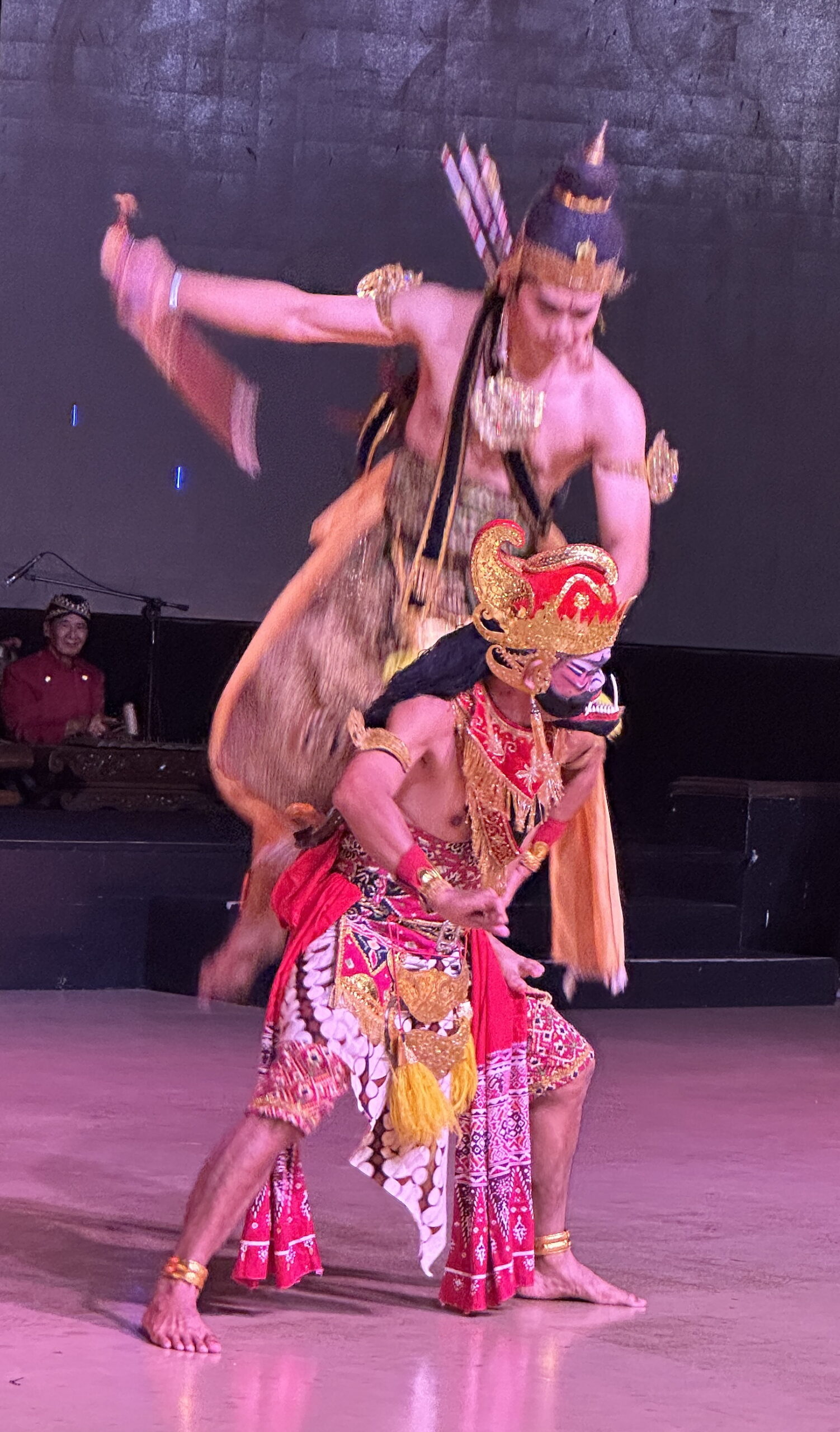
Dance and performance have been recurring themes all throughout Southeast Asia. From Cambodia’s post-genocide recreations, to Vietnam’s water puppets, to Bali’s gamelan-fueled Ramayana tales, we’ve sampled performance at every stop.
Wayang Orang Sonobudoyo
We’d yet to see a shadow puppet performance, so I contacted the Sonobudoyo Museum, which stages performances of both live dance and shadow puppets. I specifically asked about the shadow puppets, and was given performance information for the Wayang Orang performance. Which I didn’t notice was one of the live masked dances, not the shadow puppets, which is Wayang Kulit. So we still haven’t seen the shadow puppets.
Which is sad, but it’s not like the dance is annoying. Plus, we’ve seen so many renditions of the Ramayana, we felt like we knew all the main story beats and could take it in like a local. But the Ramayana is big and wooly. It’s about 1,700 pages, or about 1.5 LoTRs, which is the preferred unit of measure for sagas. There’s a lot going on, and while it’s fundamentally Rama’s story, it doesn’t really progress in a straight line. Performances are, by definition, excerpts, so our previous experience didn’t wind us helping us out. This was a chunk of the Ramayana we’d never seen before.


Still, the fancy printed program had plot synopses for each of the seven scenes, which should help. Or, as it turned out, not. Here’s the outline of the evening’s performance from the program.
Queen Sukmengkara, a female rakshasi, is deeply enamored with Arjuna and will go to great lengths to win his love. Her feelings are so intense that even amid royal affairs, she remains entranced by Arjuna’s handsomeness. Witnessing this, her loyal minister, Patih Surawati, reminds her of her duties and offers to act as an envoy to propose to Arjuna on her behalf. Overjoyed, Queen Sukmengkara immediately sends Patih Surawati to Ngamarta to propose.
Meanwhile, in the kingdom of Ngamarta, the Pandavas are engaged in a meeting when Patih Surawati suddenly arrives with the proposal. The unexpected request shocks the court and enrages Princess Srikandi, who then challenges Patih Surawati to a duel. A fierce battle ensues, but the power of Queen Sukmengkara and her minister proves overwhelming for Srikandi and the Pandavas.
Following the advice of Bathara Kresna, Werkudara is sent to summon his wife, Dewi Arimbi, to confront Queen Sukmengkara. With her extraordinary strength, Dewi Arimbi ultimately defeats Queen Sukmengkara, restoring peace and harmony to the kingdom of Ngamarta.
All well and good. But only tangentially related, it seemed, to the action on stage. To be fair, this first scene wasn’t actually part of the Ramayana. It was a bonus dance of young women coming of age. With birds on their heads. As they do.
Sorry for all the videos of the backs of people’s heads, btw. We were all of four rows back, but the seats weren’t raked. Bad theater hygiene. Bad.
The Ramayana started for real with what the program notes tell us is the Queen mooning about Arjuna to her rakshasi, shape-shifting evil demon warriors. Here, they appear to have shape-shifted into women with adorable kitty heads. Except for the actual demon, who apparently can’t be bothered to make the cat face.
We couldn’t map this to any part of the narrative as presented in the program. It appeared to be an opportunity for this delicious boy to hold very, very still so he could be stared at. And drooled over. There was definitely drool in that room.
Stabby McCatFace and Normal Lady have a mano-a-mano. We had no idea who these characters were, or what their relationship was to the plot outline. Doesn’t matter. No one doesn’t love delicate lady fighting.
The two champions square off. Mighty blows are struck.
The coup de grâce.
The final battle. Between a different pairing of Stabby McCatFace and Normal Lady. Because it never gets old.
It was all silly fun and we had an excellent evening out. Even though we never did get to see our shadow puppets.
Prambanan Ramayana Ballet
We had already been to Prambanan, as part of our day trip to Borobudur. What brought us back for a return visit was an outdoor ballet extravaganza staged in the shadow of the temples.

I’d attend an autopsy in that setting, but even that wasn’t an option. The major storm we’d enjoyed earlier in the day had subsided, but the grounds were soaked enough that the evening’s performance was moved to the indoor theater. Sad. Indoors or out, however, the audience still gave its all. We definitely felt out of place, unmasked as we were.

Still, this was the part of the Ramayana we were most familiar with from previous performances, which provided, as you might guess, absolutely no help in following the dance, because the story is so bonkers. Graciously, supertitles were projected onto a screen, so we had a boost. Let’s walk through it.
First this, which just seemed like a prelude with bows, no arrows. An amuse-bouche before the main action.
Rama, his wife, Dewi Sita, and his brother, Lakshmana, are wandering the Dandaka forest, having been banished from their kingdom for, the evidence suggests, excessive gorgeousness. A beautiful golden deer frolics in a clearing in the forest, and Dewi Sita, enchanted by it, begs Rama to chase it down and kill it. Because that’s what you do to things you admire. Or fear may be more beautiful than you.
Rama takes off to chase the golden deer, leaving Lakshmana in charge of Dewi Sita. Here we have the Dances With Deer interlude.
Soon, however, Lakshmana hears Rama calling for help, and leaves to come to his aid, but not before encircling Dewi Sita in a magic spell that will keep her safe as long as she stays inside it. You can see where this is headed.
However, it’s all a plot by the evil demon Ravana, who intends to kidnap Dewi Sita. Cause she pretty. The golden deer was his henchman Maricha (all the demons are shapeshifters) and Rama’s distress call was Ravana imitating his voice. The demons are also voiceshifters.
Ravana performs a seductive interpretive dance intended to attract Dewi Sita, which, him being a horrific demon and all, fails to close the sale.
So he comes back shapeshifted as a beggar and tricks Dewi Sita into leaving her protective circle. Which wasn’t truly all that hard. Dewi Sita is very, very pretty, but a little simple.
However, a bird creature demigod named Jatayu has been flying through the sky, in the carefree manner of bird creature demigods, and makes the mistake of witnessing the kidnapping.
Ravana isn’t pleased, and dances with the bird god until Jatayu is mortally wounded. Meanwhile, Lakshmana catches up to Rama and they figure out they’ve been had, so they race back to the clearing and find no trace of Dewi Sita. What they find instead is one of Ravana’s demon pals, looking to finish them off. I love both the demon’s dance and Rama’s insouciant sash flipping.
Our hero prevails, and the dying Jatayu appears. Sadly, he has to spill to the boys before getting to enjoy his dramatic death.

The brothers do what any of us would do in the same circumstances. They ignore the bird guy and call the monkey king Hanuman for assistance. Hanuman responds, as any of us would, by performing a spirited monkey dance.
Meanwhile, Ravana is still trying to woo Dewi Sita, with what appears to be some playful butt touching. Curiously, this does not work. Enraged, Ravana attempts to kill Dewi Sita, as one might, but is held back by Trijata, a demon he has tasked with taking care of Dewi Sita during her captivity. I’m not at all sure what’s going on here, but there’s a clearly complicated dynamic amongst these three. Everyone appears to have feelings.
Hanuman then makes himself very large, takes a single step to Lanka, Ravana’s island kingdom, and confirms Dewi Sita’s presence. There is much warring and fighting, culminating, as you knew it would, with a Boss Battle.
I just want to observe, by the way, that the bad guys all seem to be Gentlemen of a Certain Girth. Not just these two performances, but in most of the dance/Ramayana retellings we’ve seen all across Southeast Asia. I can’t even hazard a guess what it might signify culturally, but I also noticed it in the Ramayana carvings at Prambanan, so it’s at least an old trope. I guess they just like their antagonists built solid.
It all takes a year before Rama is able to rescue Dewi Sita. On being reunited, however, Rama expresses his concerns over how she’s spent the last year. Or as the supertitles so delicately put it, he “doubts her purity.”
Really? Your wife is kidnapped by a demon and when you finally rescue her, you wrinkle your nose and declare, “Eww, you got demon stank all over you. I think you fucked that dude.” What a douche.
Never one to pass on a challenge, Dewi Sita declares that she will prove her chastity by… setting herself on fire. Jesus, these two deserve each other.

However, the fire doesn’t burn her, as the fire god Agni protects her and delivers her back to Rama, vouching personally for her chastity. Which is good enough for Rama. Dewi Sita, firmly on brand, conveniently forgets that her husband was ready to let her die in flames because he didn’t trust her. She has her man back, so… happy ending? As close as the Ramayana gets.

Whew! The happy couple reunites and… curtain. Metaphorically.

During the curtain call we’re told that we may approach the cast for pictures. I’m old, so I didn’t understand that this meant a selfie scrum. I was somehow able to negotiate the crowd and get photos of our delightful principals that didn’t include a leering geezer spoiling the view.


Our story ends, as all good stories do, with merch. Dorothy got to this shirt before I did. She is clearly the hero of this epic journey.
