We Owe It All To Sir Stamford Raffles…
Borobudur : Java :: Angkor Wat : Cambodia. You’ll thank me when you next have to take the SAT. What I mean is that both temples are so iconic that, even if you can’t name them, once you see pictures you’re all, “Right. That place.” They’re also alike in the sense that they’re each part of a larger local landscape of holy sites in which they have a context. Angkor Wat has Bayon and Ta Prohm, Borobudur has Prambanan. And they’re all really fucking old. But Borobudur and Prambanan are older.
We booked a dedicated car and driver for the day. Neither site is that far from Yogyakarta, but the ride-sharing apps don’t work in the hinterlands. First stop: Prambanan.

Prambanan
As part of our package we were offered sunrise at Prambanan, which is supposed to be magnificent. It also requires cooling your heels for a couple of hours until the temple opens to the public. We enjoyed sunrise at Angkor Wat. We good.

Prambanan is Angkor Wat’s little brother, the second largest Hindu temple in Southeast Asia. It was originally built in 856 and was dramatically enhanced in 930. Sadly, it only survived until 1006, when a massive earthquake reduced everything to rubble. It wasn’t until 1930 that restoration began under the Dutch. They don’t get enough credit for their good works. It wasn’t all slavery and extraction.

According to our guide, Prambanan was also an answer track. Borobudur was constructed between 778 and 850. You’ll note that Prambanan was started just six years after Borobudur’s completion. The local Hindus were apparently dismayed by the massive Buddhist temple in their backyard, and built a response, not to be outdone. It turns out they were slightly outdone after all. Borobudur is the largest Buddhist temple in the world. Prambanan is the largest Hindu temple in… Java.
The restoration work is massive, ongoing, and mind-blowing. They are able to reassemble temple structures, from the mountains of rubble, using about 70%-80% of that structure’s original stones. That just boggles. I am boggled. Still, only 22 of the estimated 240 temples in the Prambanan complex have been restored. It’s the archaeologist’s Full Employment Act. But what they’ve been able to do so far is spectacular.

As a Hindu complex, Prambanan is devoted to the Trimurti: Brahma, Shiva, and Vishnu. They each get one of the three largest temples, and a satellite temple for their preferred mode of transportation: Brahma’s swan, Shiva’s bull, and Vishnu’s garuda. Vishnu clearly has the best ride.


Each of the three main temples also has inner sanctums, shrines with unlit statues. I think the dark definitely contributed to the ancient vibe. Very Indiana Jones.


Prambanan is also adorned with stupas, like the ones at Borobudur. Except they’re not stupas at all, they’re called ratna, and are completely different. They just look a little alike. While Borobudur’s stupas specifically contain statues of Buddha, the Hindu ratna are a purely decorative architectural element with religious significance, rather than a niche. They still look cool.


More Ramayana, Please
Prambanan is known for its bas-relief panels that retell a core part of the Ramayana, from the abduction of Rama’s wife Sita to Rama’s killing of the demon Ravana. This is the precise part of the story portrayed in the Prambanan Ballet’s performance. 72 consecutive panels across the three main temples are ordered so that you traverse them clockwise, or Pradakshina, always keeping the temple to your right.


More Stuff Carved Into Stone
In addition to the Ramayana panels, Prambanan is chock full o’ delicious sculptures and carvings. As you would expect.


We were offered a short walk to another part of the complex to view a Buddhist temple, but since we were headed for the largest Buddhist temple on the planet we chose to preserve our legs. On our way back to our ride, we passed a cassowary in a cage. Does there need to be a reason? You’re so literal.

Borobudur
Prambanan is a complex made up of hundreds of individual temples. Borobudur is a single gargantuan temple, filling the horizon and inspiring legitimate awe. As the design spec foretold.

As was the case with Prambanan, Borobudur was lost for centuries. Construction was completed in 850, but the temple fell into disuse by the 1500s, abandoned as Java’s cultural center shifted east and its religious center shifted towards Islam. It was eventually covered in volcanic ash and reclaimed by the jungle. Until a white guy discovered it!
In a brief interregnum sandwiched between Dutch fuckery, the British owned Indonesia. It only lasted a few years, from 1811 to 1815, but that was long enough for Sir Stamford Raffles, the very model of a modern Major-General (it’s actually hard to believe that Sir Stamford Raffles isn’t a Gilbert & Sullivan character), to stumble on Borobudur and, to his credit, recognize that some work needed to be done.
Actual restoration wasn’t commenced until 1907, under the kindly Dutch. That stabilized the structure, but the restoration that gave us the Borobudur we see today didn’t start until 1975, culminating on completion in the temple being deservedly named a UNESCO World Heritage Site in 1991.
The Buddhists, god love ’em, are geometry geeks. Borobudur is in the precise shape of a big fucking mandala, with four entry points in the cardinal directions and concentric levels rising through the three zones of consciousness: Kamadhatu (the realm of worldly attachment) at the lowest level, Rupadhatu (having transcended desire but still possessing an earthly form) in the middle, and Arupadhatu (the transcendence of earthly form) at the top, crowned by the central sphere representing Nirvana.

Experiencing Borobudur is to rise metaphorically through the zones of consciousness and arrive at the summit. Which is the closest to enlightenment I’ll ever get.

Even before entering the temple, the views from the outside are ridiculous.


One may experience the lovely grounds as one likes, but the ascent to Nirvana requires special shoes. Street shoes are verboten, to preserve Borobudur’s steps. These uncomfortable slides are gift with purchase. They wouldn’t take them back.

And there are plenty of those steps to reach the peak, around 150 in total.


The payoff is obviously the summit, but there’s plenty to see as you ascend through the various zones of consciousness. Borobudur boasts 2,672 relief panels, almost four contiguous miles of carving. Nearly 1,500 of those panels are a single narrative (the remainder are decorative), telling the story of Sudhana, a human who falls in love with Manohara, one of the Kinnari bird ladies. Why not?


To say nothing of the various non-relief statues and carvings.


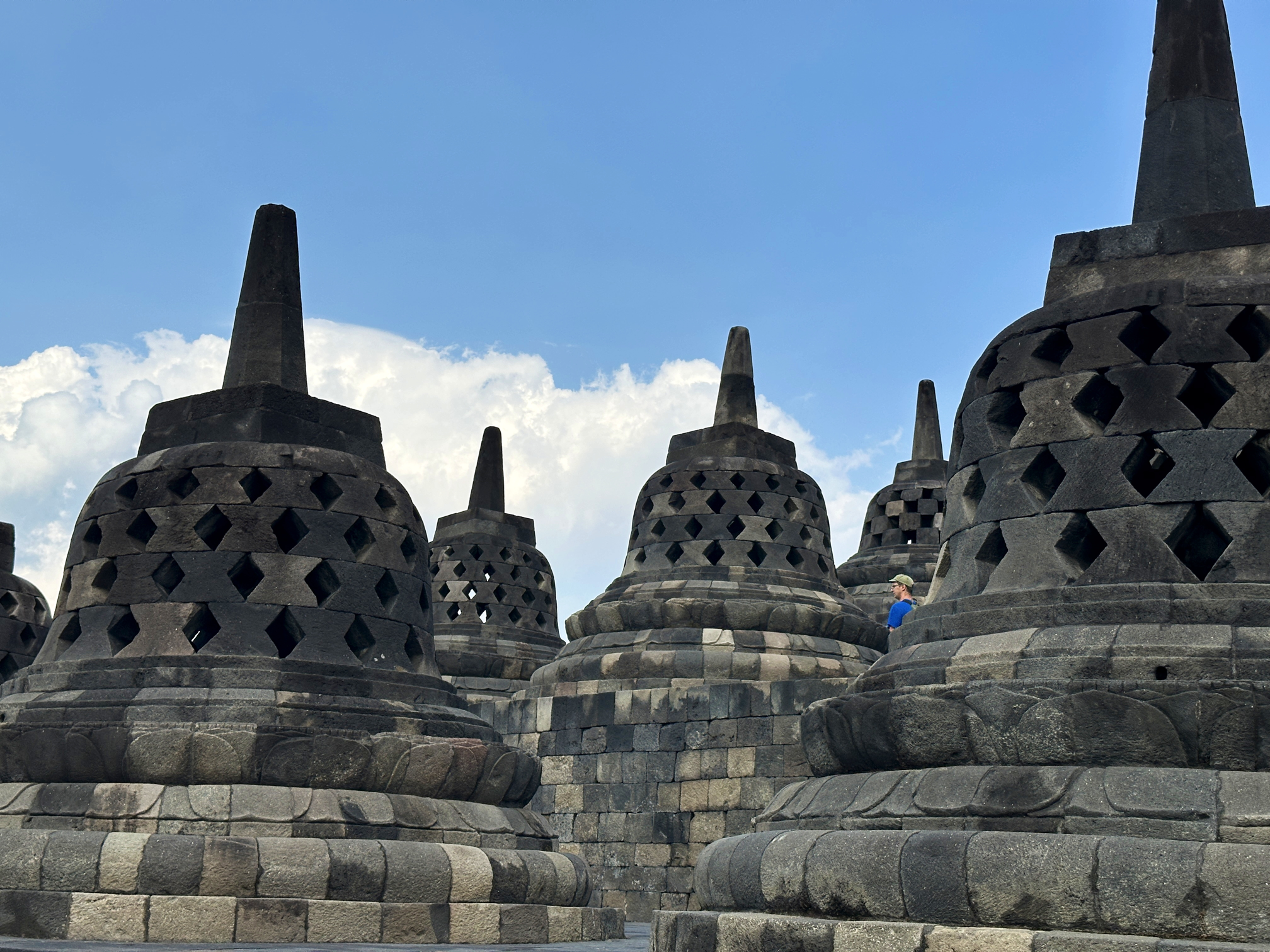
But you came for the Stupas of Nirvana, and I have been denying you. They are everything they are advertised to be: beautiful, resonant, and deeply imbued with meaning and intention. They are simultaneously soothing and thrumming with power and energy. Nirvana is, as it turns out, a perfectly lovely place to spend an afternoon.


The stupas also provided ample opportunity to witness firsthand how Instagram has destroyed our culture. We spent most of our time up there maneuvering to get photos that didn’t include tourists taking selfies. Except for this. Because it’s perfect. Nirvana, one might say.
When you upload to YouTube there’s a checkbox that says the video is safe for children. I clicked yes, but I’m truthfully torn. I don’t think this is suitable for impressionable eyes.
As we descended back to our mortal forms we were both exhilarated and exhausted by our day. How tired were we after Borobudur? I’d found a roadside attraction on our route: Bukit Rhema Gereja Ayam, the abandoned Chicken Church, and convinced our driver to take us there.

When it came time, we just couldn’t. Perhaps this is proof that we’re too old to keep doing this. Not enough in the tank for the Chicken Church. Time to hang ’em up.