All Market, No Flea
My grand tour of the highlights surrounding Bangkok continues. Today’s edition is all about markets, the Maeklong Railway Market and the Damnoen Saduak Floating Market. Both of these markets were interesting not because of the goods for sale but because of their physical setups.

Maeklong Railway Market
Our story starts, as all good stories do, at the Maeklong Railway Market. Specifically, on the train that goes through the market. We took a bus to the train station. Which was this:


The train stopped right outside a center where monks are trained to meditate. No, Monk U. 
The windows were all open on the train, which made the ride breezy and pleasant. 
Most of the economic activity along the train corridor was salt harvesting. Salt water is let into ponds through locks, which let the water evaporate when they’re closed. 
Our guides: NJ in front, Tum Tum in the middle (and no, she’s not a character from Small Cabin of Uncle Thomas. How dare you!), and some guy who joined us on the train and could snap that fan like a weapon. 
SRO, after the next stop.
I am reasonably sure that when I am happy or amused I smile like a normal person. At least no one’s said anything. But when I am asked to smile for a photograph, that thing where you don’t know what to do with your hands happens to my face.
I may need to practice smiling in the mirror, so I can learn to simulate a human expression. This is why, despite the clamor for more selfies, there are so few pictures of us on the blog. In my case, at least, it’s because smiling makes me look like I’ve had a stroke. Dorothy, on the other hand, has lots of practice smiling and reliably crushes it. I just think she considers it none of your business.

The market is known locally as Talat Rom Hup, meaning the “umbrella pulldown market.” That’s because the market spreads out right to the train tracks, and everything needs to be pulled back when the merchants hear that lonesome whistle blow.
It’s remarkably similar conceptually to Hà Nội’s Train Street, where a train goes through a canyon of cafes built right up to the tracks. Nothing needs to be pulled back there, however, so long as you keep your hands inside the cafe at all times. Even though we were walking distance to Train Street in Hà Nội’s Old Quarter we affirmatively declined to visit, as it seemed like nothing but a mindless Instagram opportunity. Absent Dorothy’s more rarefied perspective, I appear to be precisely the kind of schmo who does stupid tourist shit. Who knew?
Pulling into the market was, I have to admit, pretty entertaining. People crowd the tiny space left between the tracks and the shops to wave at the train. We on the train return the gesture by crowding at the windows and waving back. It is silly fun.


Here’s what it looks like after the train pulls out: Awnings are dropped over the tracks, and merch is moved right back up to the brink.

While I found the setup adorable, the market itself was meh. The larger market, away from the train tracks, is one of Thailand’s largest fresh seafood markets, but the market right on the tracks is clearly meant for the train tourists. It’s full of the same goods you can get in any market in Bangkok, a mixture of food and tourist schlock. Since we were discouraged from bringing fresh seafood onto the bus for the next leg, there wasn’t much on offer that was of interest.
Damnoen Saduak Floating Market
Next up: A floating market. We’d been to Kompong Khleang in Cambodia, which is a floating market on a lake, served with a side dish, like all of Cambodia, of genocide. Damnoen Sadauk is in a canal system, more like the one in Xochimilco just outside of Mexico City. The canal system in Xochimilco was built when artificial islands, chinampas, were created by piling mud on top of rafts, letting them sink, and doing it again until the rafts became anchored by the trees growing on them. This system is over 1,000 years old, and is why Xochimilco is a UNESCO World Heritage Site.
Damnoen Sadauk, on the other hand, was manufactured by decree. The 20-mile long main canal was built in 1868 to connect up a pair of rivers. Locals dug about 200 extra canals for fun, creating the Floating Market district. By the mid-60’s the market had largely been replaced by roads and stores, but it lives on. Damnoen Sadauk was built in 1981 specifically as a tourist attraction. It is not a UNESCO World Heritage Site.


Typical Thai traffic, even on the water.


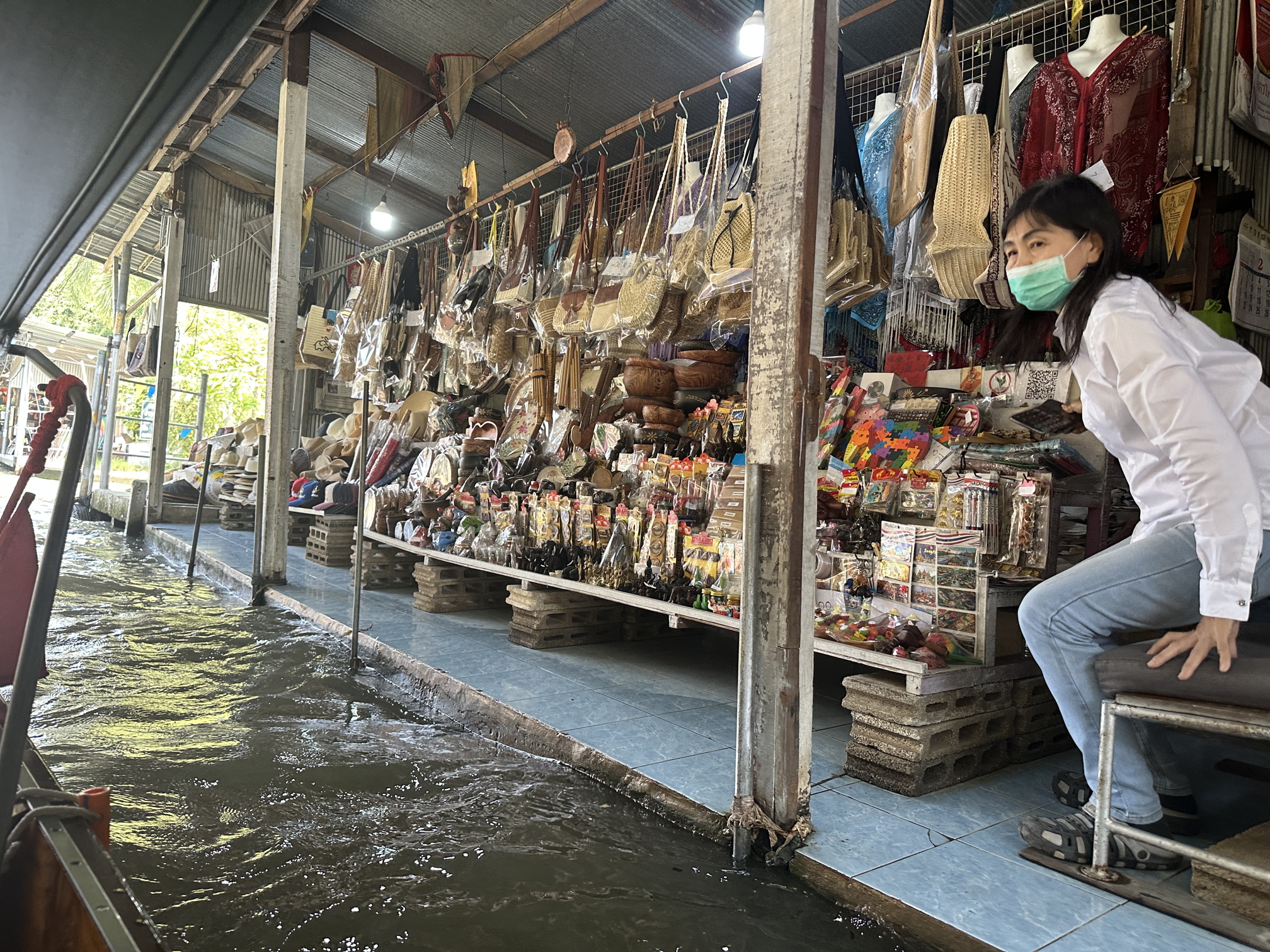
You should notice something right away. This is the opposite of what you think of as a floating market. You’d expect that boats will be plying the waterways hawking their wares to tourists on other boats. Here, the goods were all on the land side of the canal and the floating part was the customers in boats. See something you like and your skipper will pull over for you.
The weird side effect of this was that the shops were actually all on land that just happened to front the canal. So while you feel like you’re in the middle of this entire aquatic experience, just behind the Potemkin facade of merch booths is a parking lot with buses and roads and shops that don’t front the canal. It was disorienting to walk to our bus and feel like we were going behind a movie set.
A panoply of tourist goods.
Proof positive that I’m just another fucking tourist. I had my picture taken holding a lemur named Mai Tai.


The best part of this is that when I saw the lady with the lemur (and the man with the enormous albino snake, which I was not motivated to hold for a photo op) I texted one of our guides to ask whether it was ok (I know, for example, that you’re supposed to leave the elephants alone) and how much I should expect to pay for a photo?
She answered that the lemur whisperer would ask for 200฿ (about $6 USD), but I should bargain her down to 100฿. I had no intention of bargaining over a couple of dollars, so this is how the negotiation went:
Me: How much for picture? Her: 200 baht. Me: OK. Her: No, 150? OK, 100. OK?
It felt like she wanted me to have the bargaining experience but didn’t trust me to hold up my end, so she did all the work herself. Talk about a service-oriented economy. Also, honestly, the highlight of the experience, which was otherwise very, very touristy. There’s a reason we don’t tend to do that sort of thing, but that’s what I get for taking off and leaving my Jiminy Cricket behind. Being a real boy is hard work.