Mỹ (other) Sơn
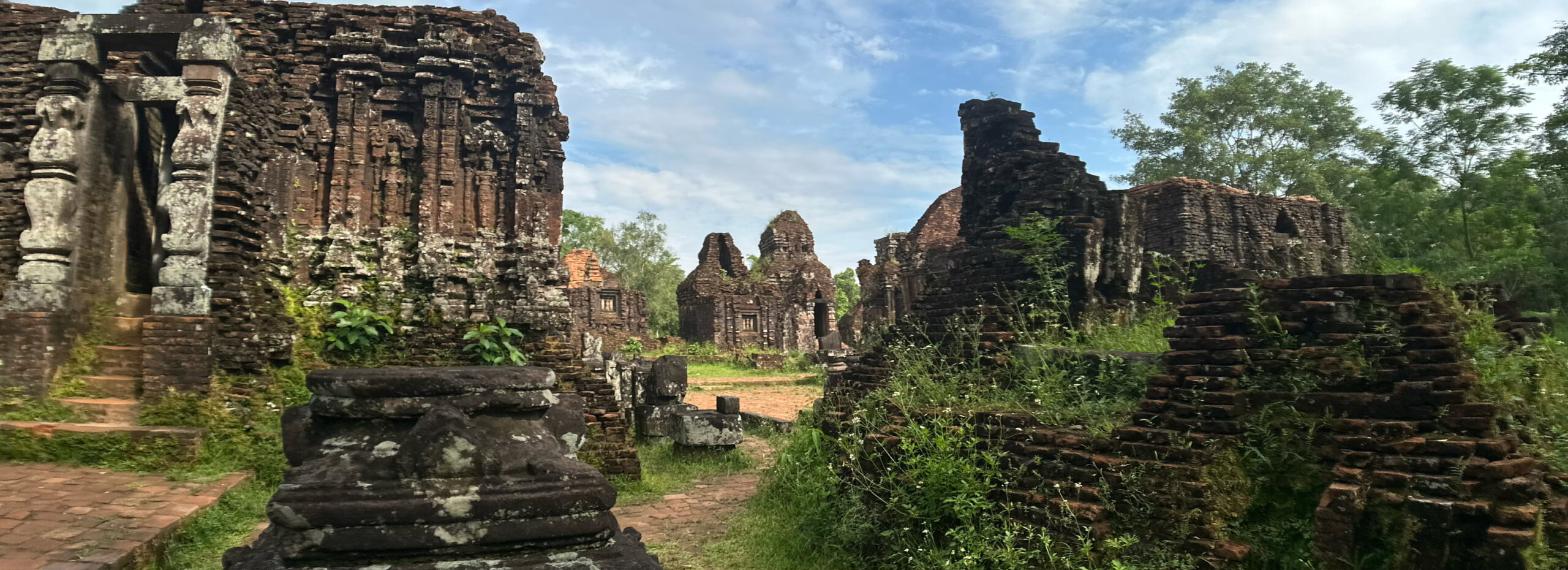
Don’t think for a moment that Cambodia’s Angkor-era ruins are the only dead things in Southeast Asia. There’s us, of course, but there are also spectacular ruins of the pre-Angkor Champa kingdom that dot Vietnam. One of the most impressive of those ruins is Mỹ Sơn, an hour’s drive west of Hội Án.
While the Champa kingdom goes all the way back to the 2nd century, Mỹ Sơn dates from the 4th to the 13th centuries. Still, take that, 12th century Angkor Wat. On the other hand, Angkor Wat wasn’t blown to bits by the US in the Vietnam War (or the American War, as it’s called here). Many of the temples, including the largest one, were destroyed in a single week’s bombing in 1969. But the Taliban were barbarians for destroying Afghanistan’s Bamiyan Buddhas. Thank goodness we’ve permanently conquered The Moral High Ground.
That history is one of the reasons we took a tour group to Mỹ Sơn, despite our profound distaste for them. When we were doing the research for the trip one of the admonitions we’d read was to make sure to stay on the paths, as there were still unexploded bombs in the area. Okey doke. Maybe a guide isn’t such a bad idea.

The setting is beautiful, with the jungle kept barely at bay. It reminds me of Tikal’s eerie jungle/ruins vibe, or Ta Prohm’s Lara Croft stage set.

I especially enjoyed the entrance sign. While I know the first part as, “Take only memories, leave only footprints,” this was my first exposure to the warning not to kill. It’s like when you check into a hotel and on the dos-and-donts list is a restriction on having monkeys in your room. You just have to wonder what happened that made that warning necessary.

The ravages of the American attack were everywhere to be seen. In bullet-pocked walls, bomb fragments, and even in recovered American bombs.


The American attacks on Mỹ Sơn came to life most vividly through our tour guide, who had been working for the Americans in South Vietnam as an interpreter. This was a notable exception to the rule about listening to Grandda’s war stories. We didn’t want them over so we could go back to our video games, we wanted him to go on and on and on. I wasn’t expecting a living link to that history.
He told harrowing stories of coming into Mỹ Sơn after the bombings, with colleagues blown apart by bombs that hadn’t gone off on impact. Sadly, either his English or his memory, or both, were a little faulty, as we couldn’t quite follow his post-war chronology. Either he or his brother spent eight years in prison for collaborating with the Americans. Either he or his brother were taken to the US before returning to Vietnam. Which may or may not have been when he or his brother was imprisoned.
The specifics mattered less than the general arc, which was that the American fucking lasted long after they left. As colonialism do.
But the what was left of the buildings was splendid. Unless noted, these are all from the 7th-9th centuries. They show their age, in all senses.


Due to sheer age, and the odd bomb, many of the facade sculptures are in poor condition. But there’s more than enough left to grasp how much character the carvings have, and how splendid this must have been in its time. These all date from the 7th-9th centuries.


While I’m not a big fan of tours, this one came with a Malaysian family currently living in Sri Lanka. On the one hand. we had the opportunity to discuss those locations for future travel, which was helpful and informative. On the other hand, I was kidnapped.

Stockholm Syndrome, plain and simple.

There is absolutely no documentary evidence that I picked up the little terrorist and carried her. Those are unsubstantiated rumors, and I refuse to lend them credence by stooping to refute them.