Bali? Hi!
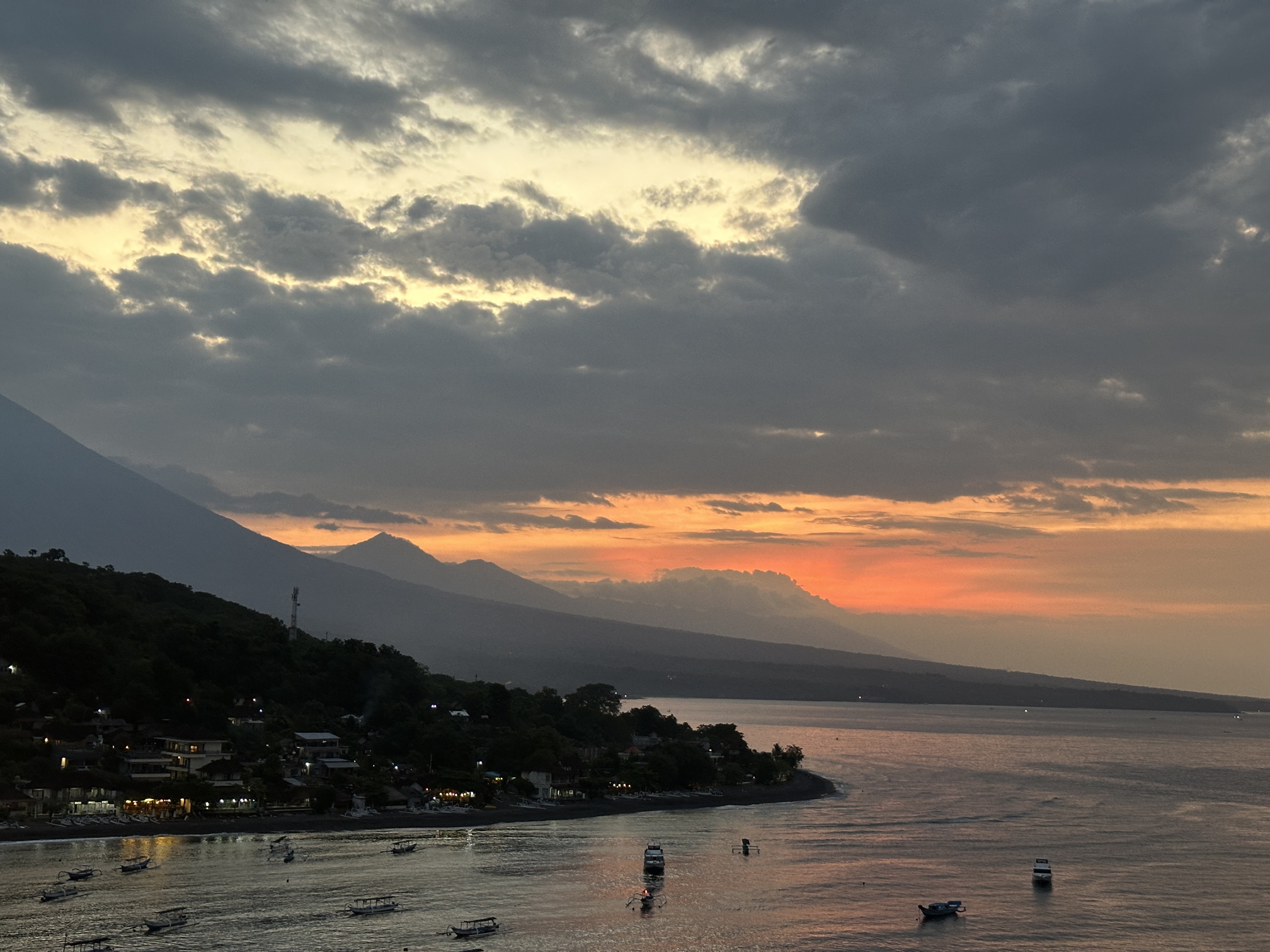
Bali, land of deep, resonant culture, jaw dropping natural splendor, and breathtaking coral extravaganzas. Also, land of wellness centers, yoga retreats, and invasive tourists. Getting the one without the other is a challenge, happily accepted. Said the invasive tourists.
After much searching, we found Amed, a quiet beach community in East Bali known for its accessible snorkeling. It’s one of the few places on the planet where you can walk into the water and swim a reef, perfect for those of us not up to the rigors of, you know, actual swimming.

Technically, I am a NAUI-certified scuba diver. Realistically, I received my certification when I was twelve and haven’t exactly kept up. I have a memory of being competent in the water, but now I can’t quite figure out what prevents drowning. Are you supposed to just naturally float? Tread water the entire time? Swim uphill to keep from sinking? I see people do it, and it’s just baffling.
Bali Fun Facts™, or The Parade of Ignorance
Bali is not a country. It’s an island in Indonesia. Bali is not one of the Spice Islands. They are also a part of Indonesia, but you can’t name a single one of them. While Indonesia as a whole is Muslim, hosting the largest Muslim population on the planet, Bali is Hindu and marches to its own offbeat drummer.
While Bali is a single island, the nation of Indonesia is home to… well, nobody knows exactly how many islands. Everyone has agreed to the oddly specific count of 17,508, while also agreeing that the correct number could be anywhere between 13,000 and 25,000. The count of inhabited islands is… about 6,000. Or 922. Or 10,000. Is mystery. Wrapped in rising sea levels.
In an unforeseen plot twist, Bali and Indonesia were not primarily fucked by the French. Say hello to the Dutch East India Company. Although Napoleon did have control of Indonesia for five years, because if there’s one thing the French can’t stand it’s being shut out of fuckery. Not to be overlooked, the US supported an Indonesian dictator because he was anti-communist. Did not see that coming.
In fact, our Southeast Asia tour has been a cavalcade of nations willing to overlook American sins in the service of being gracious to American visitors. I get the self interest of tourism-based economies, but most of the tourists we’ve seen seem to be European or Australian. They could easily shun Americans without tanking their tourism industries. So, points for being nicer than we are.
On the other hand, there’d be no tourist economy anywhere on the planet if they locked out the citizens of countries that had fucked them. Easier just to open their doors and our wallets. It’s like reparations.
I still say they’re nicer than we are, but that’s an admittedly low bar to clear.
Our Homestay
Our homestay in Bali feels like we’re living in a jungle next to a farm. Or farms. I think that’s because we’re living in a jungle next to a farm. Or farms. The grounds here are lush and full of tropical flora as well as a rich ecosystem of birds, bugs, reptiles, and cats. The farm(s) next door is (are) chockablock with chickens, roosters, pigs, geese, cows, and goats. Who all appear to be early risers.
And that thing about roosters crowing at dawn is bullshit. They go off all day and night.

Our bungalow at Kirana Homestay. 
Bedroom. 
Bamboo bathroom. 
Modestly functional kitchen. The only hot water in the unit comes from the shower head. 
The seating area, outside on the patio, which is where our fresh breakfast is served. In the mosquito evenings we bring table and chairs indoors. 
The tropical grounds. 
Our cat, Kucing. Which is Indonesian for cat. Perhaps a little too on the nose.
Here’s a panorama of the grounds, with the morning soundtrack. It’s almost like you’re here with us.
We have our very own house gecko, a robust Tokay named Gary. We learned in our Hội Án apartment that geckos make sound, which was new intel. But Gary makes a decidedly louder call, somewhere between a fart and a squeaky toy, than our petite Vietnam gecko. We have one of the smaller ones, here, as well, named Larry, but Gary rarely cedes the mic.
A couple of times when Gary has been inappropriately obtrusive we’ve played this audio and it’s shut him up. Game recognizes game. Even, apparently, if it’s the same game. We won’t tell if you don’t.


Breaking Waves In The Hot Sun
Our homestay is across the street from the beach, a mere five minute walk to the water. The beachfront is littered with resorts with swimming pools and palapas for shade. The closest one to us is the Seamount, which has an outdoor shower for cleaning the black sand from our feet and a ridiculously warm pool.

Our first day here we were good citizens and paid for a day pass to the pool and the lounges, 50,000 rupiah ($3) each. Now we feel like regulars. We walk to the beach, swim, come back through Seamount’s pool area, wash our feet and rinse the salt off. Maybe we take a quick dip in the pool, maybe not. A couple of times we’ve drafted behind a group of guests moving from beach to pool and just blended in. But there are 24 hours in a day, and we did buy a day pass, so we figure we’re good until we’ve used up all 24 hours.
The beach in Amed is blessed with beautiful, volcanic black sand beaches. There isn’t a definitive count of black sand beaches around the world, but it’s a countable number. 20? 40? So it’s our first, and an unexpected treat.
The beach here is known for, aside from the black sands, a few things. First, it’s known for its very, very calm, clear water. The surf here ranges from pacific like a sheet of glass to adorable Shetland breakers with tubes scaled for a Surfer Barbie. Perfect for just bobbing. We’ve found that a morning bob is dramatically enhanced by an afternoon bob. There is no shortcut to this kind of knowledge. You just have to put in the hard work.

The other thing it’s known for, as noted earlier, is how close the coral is to the shore. There are multiple spots right on our beach where you can walk into the water with a mask on and be swimming in the equivalent of an aquarium in short order, no boat necessary. We’d read that about Amed, which is why we landed here, but that scarcely prepares you for the experience.


Unsurprisingly, given the quantity of black volcanic sand on the beach, there is a volcano nearby, Mount Agung, which looms over both beach and town. Its last major eruption started in 2017 and ended in 2019. So, yeah. Active.


Amed is a traditional beach village with a main drag following the shoreline. Officially, Amed is Bali’s second largest city, but they got there by cheating. They added six other adjacent villages to Amed and called it Amed. Right. The Greater Metropolitan Amed Conurbation. But Amed proper, pretty small.
The Neighborhood
Most of the shops along Main Street are dive shops, small restaurants (warungs), spas, and tour providers, with a smattering of minimarts, produce stalls, and retail sarong and authentic! cowrie bracelet shops. The closest thing to a central market is in a village three kilometers away. There’s not much by way of art or handicrafts or culture, which is fine. We’re here for the fresh fish, both as companions and entrées.


There’s plenty of neighborhood just off Main Street. Walking the residential streets provides a beautiful window into daily life here, as well as gorgeous views of the jungle vistas.

One of the things we noticed is that vernacular residential architecture is structured around compounds with multiple, discrete buildings. A kitchen, a common room for dining and gathering, a residence/bedroom for each couple, and a temple for the ancestors.
We obviously weren’t invited into anyone’s home, so the most we were able to see from the street were the temples. Echoing the larger compound, each temple had specific altars for each ancestor. Designs ranged from humble to ornate, but all of them were well cared for and well maintained. The daily connection to the ancestors is a real thing here, and kind of cool. Sam and Ruby are now hereby notified that we expect no less than altars tended daily when we’re gone.


We also learned that they use bamboo for everything here.

Other Things We’ve Seen In The Neighborhood
JFC: Jaya Fried Chicken. It’s really good.

This is a thing we haven’t seen anywhere else. Yet. Manufactured products and snacks are made in a string of connected packages. They’re perforated, so the bottom one gets torn off to sell. The benefit of this arrangement is that you just toss them over a string or a piece of bamboo and they display themselves. They don’t need counter space or a fixture, and it’s easy for customers to see what you have on offer. Very clever merchandising that benefits everyone.


Reggae Bars
For reasons necessarily opaque, Amed is flush with reggae bars. We met a guy in Hội Án who was also on his way for a brief stay in Amed, and he said he had a reggae bar he loved, and maybe we’d see him there. Not even close to enough information to locate him, even if we’d wanted to. Which we didn’t. There are a lot of reggae bars here. OK, not dozens, but way more than should be plausible outside of Jamaica.
Which is more than a little cognitively dissonant, as the Rasta religion forbids alcohol. No problem for the flexible Balinese.
One of these joints, Rasta Bar, is right next to the Seamount, where we swim, and I have to confess that it’s not at all unpleasant to bob in the ocean to the hypnotic reggae rhythm. Perhaps it’s that Bali and Jamaica share a laid back island vibe, but it almost makes sense.
But not the karaoke reggae bar. That’s just wrong.


You can join us for drinks on the beach at Rasta Bar, and enjoy the slinky reggae vibe.
Balinese Hinduism
Hinduism first came to Bali around the 1st century, but it didn’t stay put. Balinese Hinduism adds a soupçon of Buddhism to Indian Hinduism and wraps it around a meaty core of traditional Balinese animist beliefs, arts, and rituals. That was fine for centuries, but then it got weird, thanks to the Indonesian government.
On independence from the Dutch in 1945, the new constitution enshrined freedom of religion as a core right. However, Islamists took control of the Indonesian Ministry of Religion in 1952, and severely restricted what could legitimately be considered a religion that citizens had the right to practice. Aimed specifically at Bali’s Hindu population, the new rules required that a religion must be monotheistic, have a Holy Book and a prophet, and have a codified set of religious laws, among other strictures.
Having none of those things, the Ministry of Religion declared that Balinese Hinduism wasn’t a real religion. To which Balinese Hindus replied, “OK, we have all of those things. Now leave us alone.” So Balinese Hinduism is technically monotheistic and practically polytheistic. This makes Balinese Hinduism, in a roundabout way, much like Santeria, which coated Yoruban beliefs with a thin veneer of Catholicism, so no one got huffy.
I don’t know if the 1952 regulations were ever rescinded, but as a practical matter Balinese are still very much practicing their bespoke brand of Hinduism, seemingly unfettered by the long arm of the state. We spoke to one of our drivers about the differences between Bali and the rest of Indonesia, and he offered up a list of behaviors that would be unacceptable under Muslim law, such as premarital sex and drinking. It’s no wonder, I suppose, that Bali is Indonesia’s party capital.
Canang Sari
Canang sari, set outside of homes and businesses every morning, are a small but lovely manifestation of Balinese Hinduism. From simple to elaborate, they are sometimes tucked into altars, but are often just left on the sidewalk. They are a deeply felt thank you to Sang Hyang Widhi Wasa, the supreme being in Balinese Hinduism (or at least the one they picked to mollify the Muslims), for the gifts of peace, prosperity, and the harmony of the universe, weaving the ineffable into a daily ritual.


Penjor
Penjor flank the entrances to homes and businesses, and line the streets. Like the canang sari, they are devotional pieces dedicated to Sang Hyang Widhi Wasa. Unilke the canang sari, they are not a daily ritual, but are for special occasions and ceremonies, acting as a spiritual conduit connecting the mortal and the divine.


They are made, as a thank you, of the natural products that sustain Balinese life, such as bamboo, coconuts, bananas, and sugarcane. We saw many penjor with sprays of seeds attached all up and down, to also provide sustenance to bird life. While you can have them professionally made, people here take pride in making their own.
This is yet another example of the ways in which a shopping culture, as opposed to a making culture, impoverishes its inhabitants. It’s hard to put your soul into an Amazon cart, and lord knows I’ve tried. But when you make things, you have an incentive to make them well and make them beautiful. And then you’re surrounded not just by beauty, but by meaning. Or you could be surrounded by receipts. That’s OK, too. God loves all his children.
Bedogol
Another visual representation of Balinese Hindu beliefs is the presence of fierce gate guardians at the doorways to temples and homes. These Bedogol, or Dwarapala in Original Hinduism™, are always in pairs surrounding the gate. The right hand Bedogol represents active energy and masculinity, while the left hand Bedogol signifies passive energy and femininity. The one is good for strength and protection, and the other provides intuition and gentleness. Together, they keep their charges safe from evil creatures and bad vibes.
I’m sure our Homeowners Association couldn’t possibly object if we put a pair in the hallway around our door. Who doesn’t need evil kept at bay?


Murder Most Fowl
There are a ton of free range chickens and roosters here, but also a surprisingly high population of caged roosters. There are shops that make and sell rooster cages, and then there are all the places with the caged roosters. It’s a thing. A weird thing.
It turns out that cockfighting is an ancient ritual connected to Balinese Hinduism. I told you the Balinese had made up their own brand of Hinduism, but you didn’t believe me, did you?
The roosters are caged because they’ve been trained to fight and aren’t safe wandering loose. And also because they’re super valuable. They start at 1,000,000 rupiah (about $60) and go up from there with pedigree and wins in the arena.

Cockfighting is actually a religious obligation at Balinese festivals and ceremonies. The losing rooster’s blood is meant as an offering to placate evil spirits. Legally, cockfighting is permitted in Bali only as part of religious ceremonies. And, hey! No gambling!

But we saw way more caged roosters than temples on their own could possibly have required. 100% there is non-religious cockfighting and gambling. We are shocked — shocked — to find that gambling is going on in here!
It’s also yet another layer of feigned compliance on the part of the Balinese. “Sure, we’ll be Hindu. We just need to add a few local spices. You need us to be monotheists? No problem, we’ll just pick one of our gods to be the Kahuna. We can only cockfight in the temple? You like our new temple?” Culturally they’re made of jello. Push on it and it seems to give, but the moment you let up it pops back to its original shape. They are Jedi masters of the Okey-Doke.
Roosters!
It’s hard to get a good look at the caged roosters, at least partially because it feels dangerous to get too close, but the loose roosters are spectacular. I know nothing about rooster genealogy, which I’m sure comes as a shock to y’all, but there seems to be a stunning range of rooster morphology on display here.


By The Way…
I got scuba-certified at twelve because my parents, Jackie and Stan, decided they wanted to dive and it became a family affair. It was a ten-week class, mixed between classroom (gas physics) and pool. The first three weeks in the pool were all swimming exercises, but we were permitted to put on scuba gear in week four and just sit underwater in the shallow end, to get used to the equipment.
At which point Stan stood up and tapped out. Give him credit for knowing himself. He found the experience claustrophobic and unsettling, and couldn’t think of a reason to shoulder past that.
Jackie and I continued, but I failed the final swimming exam. I did fine on the classroom test, and Jackie passed everything, but the swimming exam was hard. Among other soul crushing tests, you had to: swim two lengths of an Olympic pool underwater on a single breath; tread water for seven minutes with your arms out of the water, only legs; swim multiple laps, I don’t remember the actual number, in full gear, but only using your snorkel. They weighted you so you had negative buoyancy and had to swim uphill while someone walked at the edge of the pool and randomly poured buckets of water into your snorkel, to simulate all of your failed relationships waves. It was a lot, for a twelve-year-old.
I was technically too young, as thirteen was the NAUI cutoff, so I shouldn’t have been surprised to fail. But I was humiliated. It took me two more tries, but I did finally pass.
When I was thirteen and on our North American wanderjahr, we wound up in Acapulco, where Jackie and I took a dive boat together. We were the only certified divers aboard, so the guide provided training to the others: “OK. Exhale on the way up. Do you know what urchins look like? Great. Don’t touch them.” And off everyone went to enjoy their new skills. It really made me appreciate all the hard work I’d put in.
Then I touched an urchin.