Huế To Go
We had one last road trip in us before leaving for Indonesia. The Imperial City of Huế was a convenient three-and-a-half hour bus ride from Hội Án, and an easy decision. A provincial capital since 1687, Huế was the imperial capital of Vietnam during the Nguyễn dynasty from 1802 to 1945. A quick three-day-two-night jaunt would give us enough time for the highlights: the Imperial Citadel and the Museum of Royal Antiquities.

Our sleeper bus was the most modern, tricked out sleeper we took. It was especially comfortable when we finally figured out that you could raise the seat backs, and not have to spend the whole trip supine.

We picked a hotel literally across the street from the Citadel and a five minute walk from the Antiquities Museum, so we were well situated to make the most of our brief time in Huế.
The hotel was surprisingly luxe. The first surprise was that it was hidden behind an unprepossessing facade down an alley, and the second was that it was only $35/night. That that’s a splurge is how this whole adventure works.


The atrium with the pool in the center. 
The pool was truly a highlight. The expected warm water, given the climate, but the unexpected… 
Spitting dragons. 

No self respecting hotel in Vietnam is complete without koi. 
And if you were wondering what happened to the Wurlitzer company, this reception desk altar should put your mind at ease.
The Museum of Royal Antiquities
We debussed, checked in, got lunch, and walked to the Antiquities Museum. We planned on spending the next full day at the Citadel, so we wanted to make sure we didn’t miss the Museum.
As its name implies, the museum specializes in Nguyễn era artifacts, serving as a satellite to the Citadel across the street. And like a lot of museums we’ve seen around the world, this site’s building was as much a part of the display as its holdings. Long An Palace was built in 1845, early in the Nguyễn empire. It was destroyed in 1885 by, wait for it… French soldiers, and then rebuilt and restored in 1909 on its current site, just outside the Citadel.
The Palace was used as a resting place for the Emperor to refresh and recharge after official ceremonies, and it is ridiculously, painfully beautiful.


Even more astounding is the interior. The space is majestic and regal, and it was impossible not to feel just a little bit unworthy inside, like we were transgressing a boundary we shouldn’t have crossed, like we didn’t belong. The peek behind the imperial curtain was thrilling.

The collection of imperial artifacts, however, is every bit the match for the space in which they’re displayed. The collection stands up to the Palace itself, in its glimpse into a life of incalculable luxury and splendor. “It’s good be king” is a joke, but it’s not a joke here. The Museum of Royal Antiquities reminded me of nothing so much as Topkapi Palace in Istanbul, in its window into an opulence unfettered by constraints of money or propriety.
The artifacts are exceptionally well selected but, shall we say, lightly curated. If there was date information at all, it was no more precise than the century. Sometimes materials were listed, often not. The whole approach to provenance seems to be, “We found these in the Citadel. Now shut up and enjoy them.”
Okay. I can do both.


This piece had the most thorough provenance, unsurprisingly, as it’s a National Treasure. It’s the tiny throne of Emperor Duy Tân, who was seven years old when he was invested in 1907 by the French, who had just conveniently had his father declared insane. His reign lasted ten years before the French deposed him for not being as docile as hoped. Specifically, by trying to lead a rebellion against them.

He wound up leading a fascinating life, including working as an officer of the Free French, battling the Vichy regime. But the pictures of him as Boy King are haunting. There was an altar room to him in the Citadel, but no pictures were permitted. I scraped this from his Wikipedia page, where he’s giving off a distinct blink-twice-if-you’re-unsafe-at-home vibe. As all of the photos of him at that age do. Kudos to him for pulling a real life out of this twisted shit.

And of course, Dorothy found textiles. It’s what she do.


Unfortunately, none of the Imperial gowns were properly dated. They were all noted as between 1802 and 1945, the dates of the Nguyễn dynasty itself, with no more precise attributions offered.
Outside the Long An Palace, a smaller building housed artifacts from the Champa kingdom, dating from the 10th to 12th centuries. It was a small collection, distinguished by the incredible physical integrity of the artifacts. It’s hard to believe sandstone sculptures have lasted this long and look so good.


The Imperial Citadel
The Imperial Citadel, as all good citadels must be, is surrounded by a moat, with gates on all four sides.

The Citadel is also known as the Imperial City, because it’s both. As a citadel it boasted a six mile long moat around its entire perimeter and almost seven foot thick ramparts. And as a city, its almost four square miles held not only the emperor’s family, but also the mandarins and functionaries necessary to keep the wheels of the empire properly lubricated.

Here’s the main gate, Ngọ Môn, as well as a couple of the side gates.


It was hot the day we visited, over 90 degrees, but worse was the humidity. The air felt gelid, as if you had to physically part it to move forward. We noticed little trams driving about the grounds and accosted the first empty one we saw. The driver said it would cost ₫400,000, or about $16 USD, for the two of us to be driven around for an hour. That sounded simultaneously like highway robbery and salvation, so we hopped aboard. She drove us to the highlights, stopped while we explored, and dropped us off an hour later, to the minute, at the gate closest to our hotel. Worth every penny.
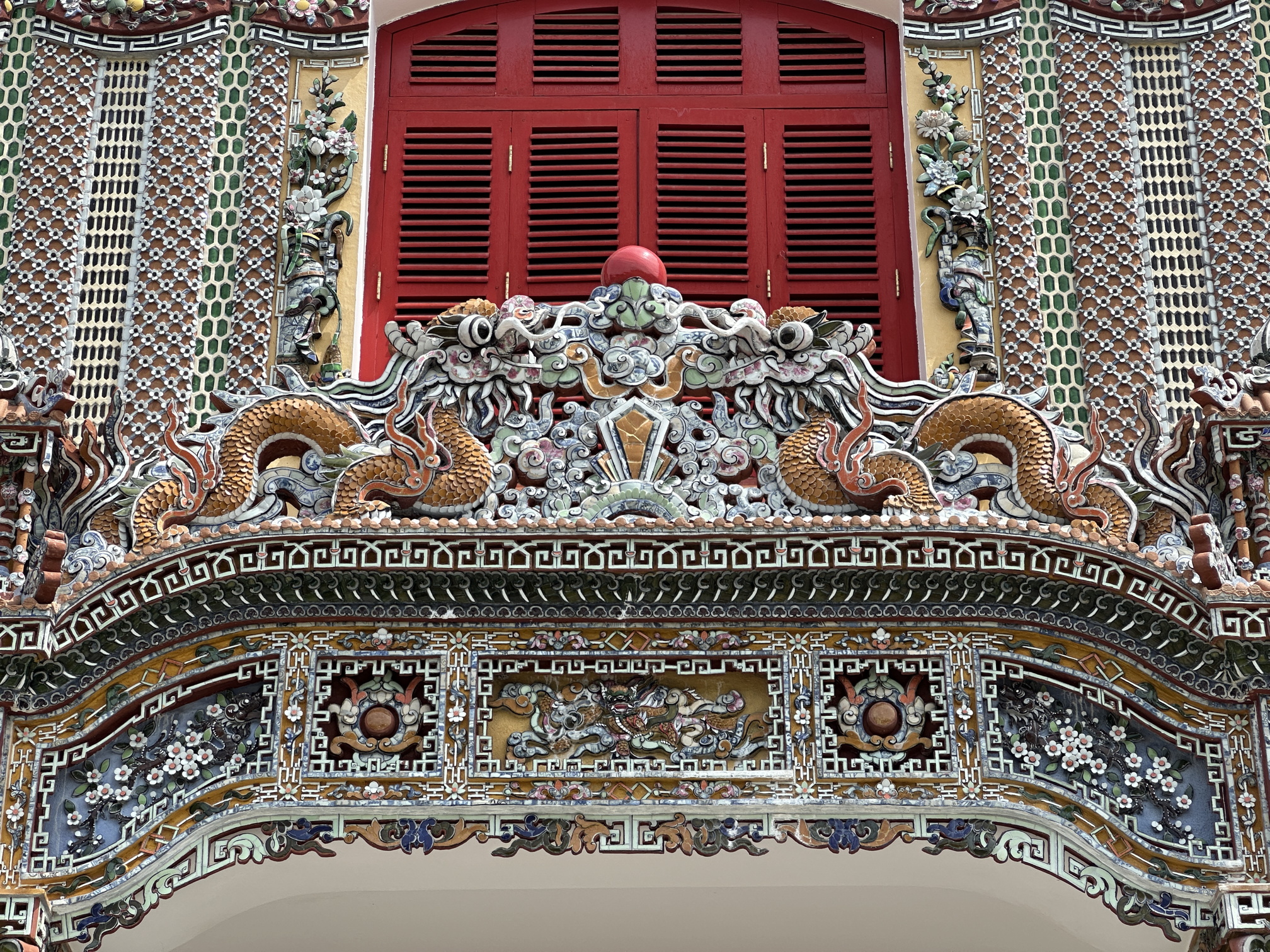
Among the many, many palaces in the Citadel, Kiến Trung truly stood out. It’s a modern (completed in 2023) recreation of a 1923 structure that was destroyed by the Viet Minh during the resistance to French occupation in 1947. So… authentic? ish? But beautiful and ridiculous all at once, as its exterior is extravagantly mosaicked. I’m glad we came after its completion.


Here’s a news item about the restoration from 2023, before the work was complete.
In fact, restoration at the Citadel is an ongoing process. It’s part historical site, part tourist attraction, and part archeological dig.

Another standout was the Thái Hòa Palace, the Palace of Supreme Harmony. Built in 1805 at the dawn of the Nguyễn dynasty, it was one of the very first buildings in the Imperial Citadel. Its grand scale, both inside and out, hints at its uses, as it was the site of official state functions. From coronations to New Years to the emperor’s birthday, any ceremony of note was staged at Thái Hòa.


These next two scenes didn’t make sense until we saw this costume rental shop just across the street from the Citadel. People rent costumes and do the tour in dressup, just like renting the Hmong costumes and touring Cat Cat Village in Sa Pa. Kinda weird. Especially in the heat. 

The Queen Mother had a private residence, with its own lovely grounds.


The Citadel also has its own theater, the Duyệt Thị Đường, dating back to 1826. It’s still in use today.


The Thế Miếu Temple holds the 9 Dynastic Urns. They were completed in 1835 and are considered the most valuable bronze artifacts in Vietnam. Each one depicts a specific emperor and different geographic and cultural components of the country, representing both the continuity of the Nguyễn dynasty and the richness of the country as a whole.


The Citadel offers up treasures pretty much wherever you look, both indoors and outdoors.


Out And About
Aside from the Museum and the Citadel, we did get outside and see a few things.

We strolled the Perfume River at night. 
And walked past the spaceship that appears to have landed on the river. 
We saw the local version of the narrow tube houses of Hà Nội. 
We strolled past one of Huế’s malls and were, as we so often are, enthralled by graphic design. 
And desperately wanted these… chips?
In retrospect, we didn’t give ourselves enough time in Huế. We hit the Citadel and the Museum, as planned, but there was so much else of interest that we didn’t have time to see.
There are seven mausoleums for Nguyễn era emperors ringing the city, each more over the top than the last, and we weren’t able to visit a single one. There’s the Perfume River, so named for the delicate aroma caused by upstream orchards dropping their flowers into the river in the fall. We saw it, but didn’t have time for a boat trip. We missed the stunning Bạch Mã National Park. There’s more than one wiggy pagoda. We could have spent a week in Huế, but didn’t. Our loss.
But what we were able to do was more than enough to make the trip worthwhile. The Imperial Citadel and the Museum of Royal Antiquities were plenty rewarding.