Java Jive
It’s an hour-and-a-half flight from Denpasar to Yogyakarta, and about that long by cab from the airport to our Airbnb in the Kotagede neighborhood. Let’s orient ourselves.

Yogyakarta is pronounced Jogjakarta, and is commonly referred to just as Jogja. The J-Y shift is a Dutch hangover. Don’t worry. It’s the only one. The Dutch were otherwise stellar stewards of their benighted little brothers. BFFs, really.
Jogja is also, and this was a surprise, a monarchy. They have their very own sultan! While a few other areas in Indonesia have their own sultans or local rulers, Hamengkubuwono X is the only one with official state power. As sultan, he is the Governor of the Special Region of Yogyakarta. This arrangement is payback for the then sultan’s support for independence during the post WWII revolution.
Kotagede
This time around we’re not in the throbbing heart of the city center, as we so often are. Instead, we’re in Kotagede, Jogja’s old city. Kotagede means Great City, and it was the capital of the Mataram sultanate, dating back to the 16th century. The Matarams were the precursor to the current Yogyakarta sultanate, having lost power through Dutch fuckery. Kotagede is renowned as a craft center, and has been a major locus of silver artisans since Mataram times.
Our Apartment
The apartment is comfortably appointed, if a little charmless. There’s a thorough selection of kitchen appliances, a dining table (which has been in short supply during our Southeast Asia run), a comfortable seating area, and three (!) bedrooms. That last is important because my sister, Nef, is joining us for four of our six weeks in Jogja, so she gets the upstairs bedroom and some privacy. We get to use the extra first floor bedroom as a closet. It’s nice to not trip over our stuff.
There are a lot of nice, small touches. They provide water, in five gallon bottles with a dispenser for hot and cold. There are balconies on both floors. There’s a washer and more than enough drying racks. And this is the first place we’ve ever been that’s provided enough hangers.
We are suffering a quirk of Southeast Asia, which is that they use duvets instead of top sheets. Which makes zero sense, since the weather is way too hot for duvets. We’ve managed this in the past by pulling the duvets out of their covers and using those as top sheets, but the duvets here don’t have covers, so there’s nothing to strip off. We visited several department stores and figured for six weeks it was worth it to buy a top sheet and just leave it behind, but there were no top sheets to be found. We are sleeping under a rotating layer of lovely Balinese ikats.
The bathrooms here are a challenge. The only hot water is from the two showers, but at least there’s a faucet, so you’re not holding a basin under a shower head to get hot water to wash dishes, like we did in Amed. And the only actual sink is in the kitchen. So the bathrooms are more like 3/4 baths, with just a shower and a toilet. We renovated ours by moving in an outdoor table and placing a plastic basin there for a faux sink. We’re survivors.


The biggest challenge was how shockingly dirty the apartment was. We spent our entire first day doing nothing but cleaning. It was everything. Floors, walls, toilets, dishes, cookware… I spent over an hour on the refrigerator alone. It’s fine now, and we’re not using their cleaner. There’s no point. We haven’t said anything, as it’s not like there’s something they can do. It was dirty and now it’s not, so problem solved. Also, they’re really nice people, and we don’t want them to think we’re weirdos. There’s been the odd plumbing problem, for example. and they’ve been great about getting someone over right away.
And we are completely not being weirdos. Every place we’ve been has required some cleanup on move-in. That’s a normal and expected part of the Airbnb experience. But what we faced here was a level of filth we’ve never encountered before.


The Neighborhood
Kotagede’s streets are narrow and recursive, circling back on themselves not unlike the souks in Marrakech’s Medina, but without the density. They’re perhaps more reminiscent of Gunajuato’s narrow, winding streets, but without the mountains. It makes exploring the neighborhood feel like an actual exploration.

An actual street in Kotagede. 
A very tidy neighborhood right near us. 
An exceptionally creative use of broken roof tiles. 
Lots of lovely architectural details. 


We stopped to inspect these, because they are bizarre and compelling. Thank goodness we did, or we’d never have noticed the tasteful panties added to the specimen on the left. 
Red bamboo! 
We think this is an outdoor lamp, but we know that’s it made from a 5 gallon water bottle. And that it’s amazing. 
The horses haul tourists downtown during the day, but are stabled in Kotagede. We hear them clopping down the street early in the morning and late at night. 
I’m sure there was some ostensible reason for this adorable parade, but I think it was staged for our entertainment. 
Grilled corn from a street vendor near our apartment. 
The front of an excellent bus… 
And its equally compelling backside. 
Our first night here we went to dinner at a neighborhood institution, where a waitress frog marched us to a photo because, she said, it’s what all the foreigners do.
The vernacular building design here is completely different than in Bali. There, homes are built around open courtyards, almost Mexican or Moroccan style, and the ubiquitous black volcanic rock is a common material. In Java, peaked, tiled roofs are constructed over wood-framed buildings. A completely different look, but every bit as beautiful.


While that’s the archetype, there are other interesting things going on here. This street is Between Two Gates, and features traditional Javanese Joglo houses.


Masjid Gedhe Mataram Kotagede
Kotagede is also home to Mataram’s historic mosque, first established in 1575. The current iteration is a rebuild from 1926 due to a fire, but there are clearly still structures from much, much earlier.
At the ticket booth there’s a separate price for wedding party photography, which made sense once we were inside. It was almost impossible to take a step without unintentionally photobombing a bride and groom posing together.
The site is full of beautiful historic structures.


And sweet architectural details.


The highlight, without question, was the Pasarean Mataram, the final resting place of the royal family of the Mataram Sultanate. All of them. Going back to the 16th century. I am disinclined to credit the spiritual, but let’s just say there was a vibe to this place. It was an indoor mausoleum, and pictures were not allowed. I even searched the interwebs for something to scrape, figuring they’d have let in a journalist at some point, but nothing. Not, of course, that a photo would have communicated what it was like to be in that space. It was truly beautiful. I felt things.
This is from a neighborhood cemetery, but the style of the aboveground crypts is typical Javanese. The royal crypts are fancier, of course, but the design is pretty much the same.

Appropriate dress to enter was both required and supplied, for a donation. Leading to a rare sighting of a mating pair of Waldos.

Taman Sari Water Palace
The Taman Sari Water Palace was built in the 1750s by the first Yogyakarta Sultan, after the Mataram’s fell. It was meant to be a place for the sultan to relax after a series of wars. It’s a modest site, but it has some beautiful structures.


Taman Sari’s highlight is the bathing pools, which is where the sultan did much of his relaxing. He would leer out of an upper floor window watching his concubines bathe. But not in a creepy way. They were his concubines, after all.
When he made his choice he would throw a rose down to her to indicate his favor, and she would get to spend the night with him in one of the upper chambers, in a bed heated by charcoal braziers underneath. That’s just a win for everyone.


Shopping
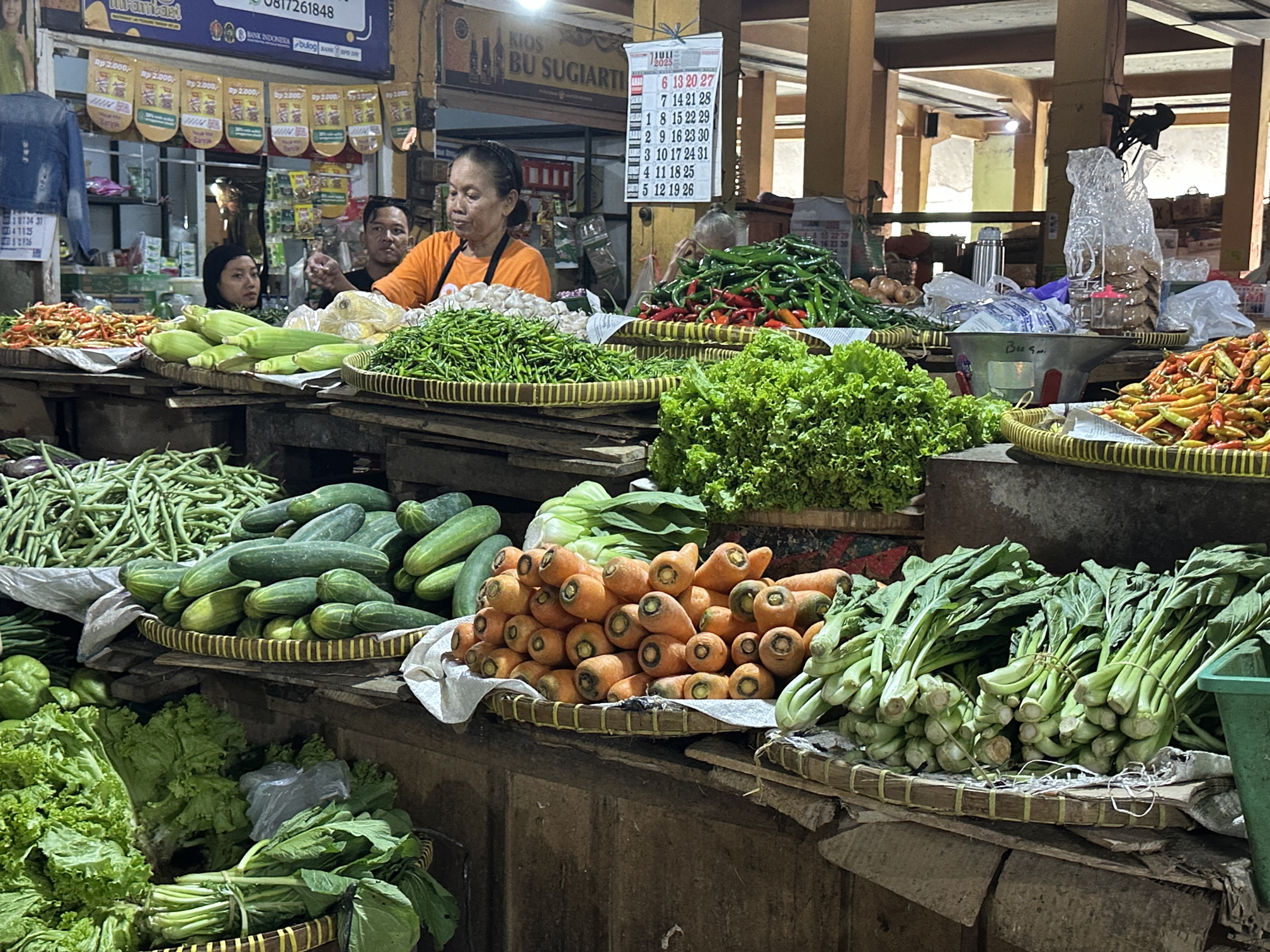
Pasar Kotagede, a traditional covered market, is just a few minutes walk from our apartment. There’s an even bigger version, Pasar Beringharjo, downtown. It was massive, covering several square blocks, and has… everything. Groceries, handicrafts, electronics, an entire batik market…


Supermarkets were a different thing. It took us multiple attempts before we found something usable. The first two we went to were Carrefours, whose local brand is TransMart. Which led to this:

As it happened, the first TransMart we went to was being renovated so hard it was no longer a store. They were doing the same thing to the second TransMart we went to. Then we went to a third supermarket, based on a google search, and it was just a jacked up Quickie Mart. I finally asked our host, and on our fourth attempt we found a real supermarket. Although it took a fifth store before we were able to locate pickles. Vlasic is everywhere, if not in every store.
Downtown’s Malioboro street is chockablock with batik shops, but it also seems to be snack central. There are snack shops that seem like the modern equivalent of the riches of the Silk Road. Rendered in snacks. These photos are all from the same shop!


Dining
Eating is a form of shopping, and we enjoyed an evening at the Alun Alun Kidul Night Market, a nightly cultural institution.


The high point was these hollowed out cars that had been transformed into glowing pedicabs. I know, we should have taken a ride. Stupid, stupid, stupid.


We also dined at Omah Duwur, a lovely Dutch era restaurant with magical grounds, right in the neighborhood.


We’re back in a Muslim country and are once again immersed in the call to prayer. There were places in North Africa where competing mosques reduced the overlapping calls to prayer as noise, but there were also places where a single mosque’s call rang clear and sounded like music. There must be a lot of mosques here, since we’ve yet to hear a distinct call. Here’s what it sounded like while we dined at Omah Duwur. Hard to peel it back and hear how many mosques are at work here, but it seems like a lot.
The Javanese have done to Islam what the Balinese did to Hinduism, mixmastering it with their traditional belief systems to make a bespoke religion that’s all theirs. We’ve had several people say, “We’re Muslim, but not like [waves hands] them. You know, that whole Sunni/Shia thing.” They really want us to know they’re the chill Muslims.
To be fair, this is a thing.

But our very best meal was when we backslid (all the way to grade school) and had dessert for lunch. But look what we were up against. We never stood a chance.


And here’s how Bear In Bathtub met his end. Oh, she’s a savage one. Although I suppose that bringing a hammer with your dessert is technically foreshadowing.
Graphic Design & Packaging
This is always one of my favorite reports. I absolutely adore local graphic design, and Java has seemed denser in entertaining graphic presentation than many of our destinations. There’s a lot to love here.

A local mall mascot. 
Another mall mascot, the traditional paunchy, middle-aged Javanese Spider-Man. Such a cliché. 
Not even all of the Upset Duck variants. 
Riding the razor’s edge separating adorable and terrifying. 
Who doesn’t want a bag of cheesy mess? 
That seems like saying the quiet part out loud. 
Likewise. 
It’s the comma. That makes it a sentence, but I can’t resolve it into meaning. By all means, comment below. 
Nope. No idea. Local cartoon characters? 

Nice rooster. 
A bag of Klin! 
I’d almost feel bad putting one in my mouth. But just for a second. 


Just a lovely logo and design. 


Little bags of tea. 
That little dude looks tweaked. Which definitely makes me want to try these. 

I mean, if they say it, it must be true. 
This appears to be the mascot for the Yogyakarta airport, as he was seen partying all over the place. 
This counts. Doesn’t this count? Best slides ever.