Like Etsy IRL
Java has been a thicket of arts and crafts. Silver, glass, weaving, painting, basketry, leather, puppets… Java has had the richest mix of crafts of anywhere we’ve been, on a par with Morocco or Oaxaca, which is no small thing. We’ve been lucky to have had enough time to both intentionally explore and randomly stumble across the wonders on offer here. Which makes you pretty lucky, too, you armchair travelers. Strapped in?
Silver
Kotagede has been a silversmithing center for hundreds of years, dating back to the onset of the Mataram empire in the 16th century. They are known, as they have been all along, for incredibly delicate and detailed filigree work. Impossible to count, and no one seems to have made the effort, but the eyeball test suggests easily more than 100 silversmiths just in Kotagede, let alone the rest of Yogyakarta.
Our first stop was Bagus Silver, a little shop we just wandered into at random. It was the first silver we’d seen, and we were quite taken.


Then we found the big kahuna, HS Silver, a shop that has been operating since the 1950s. Part of their manufacturing operations were onsite, which they walked you through, which was pretty entertaining. But the shop was the highlight. The quality of their fine filigree work was head and shoulders above the other shops we visited.
They’re a nearly vertical operation, short of actually owning a silver mine. The raw silver comes from Western Java, but after that HS does everything else. They smelt it themselves, so they can control the mix, adding just 2% copper into the silver. The highest government designation is .925, but HS silver is 98%.
They cast their own silver bars, and extrude it into the thin sheets they use to create fine wire of different gauges. The frames are slightly heavier than the interiors, and they even use silver powder to solder the joins.


It doesn’t seem like human hands should be able to do anything both this precise and tiny.
Another level of precision that seems ever so slightly inhuman.
The massive showroom, unsurprisingly, was the standout. The range and the quality were truly impressive.


As is well documented by scientists, tourism is an extractive process, and we extracted happily and thoroughly.


The Taman Sari Tourist Village
You can enter the Tourist Village from the street, but the heart of it is right off the Taman Sari Water Palace. It’s a residential complex that has some complex relationship to Yogyakarta’s Sultan that we couldn’t quite tease out. Some people seem to live rent free in exchange for using their homes as shops, and the Sultan wanted to take some of it back to create luxury housing but the peasants revolted. All told to us anecdotally in broken English, so details are hard to pin down. Wikipedia was, sadly, of no use.


Regardless, the village has quite a few little shops spread about, all, for the most part, combination workroom and retail. We got to watch people work and then buy things from them. Buying things is what we do best.
Waroeng Loekis
The very first shop after entering from the Water Palace is Waroeng Loekis, full of outrageous paintings and painted t-shirts from a painter and his wife. Really lovely people, and work that’s whatever the superlative of vibrant is. Vibrating? When I came back with Nef she had to get a t-shirt, too. Different art, but we’ll definitely have to avoid wearing them at the same time. Or not.


Voice of Jogja
The shop right next door was also t-shirts and prints, but it couldn’t have been more different. Here, the designer took traditional characters from the Ramayana and did them up as classic comic book superheroes, à la John Buscema or Bernie Wrightson. This is a documented sweet spot for us, the modern twist on traditional techniques and motifs. The artist’s goal was to recontextualize the old stories for a younger generation, to make them relevant and keep them a part of current culture, not just the dusty past. Check!


Of course, I bought a couple of shirts. They heat transfer on premises, so I picked the size and shirt color and they did the transfer while we were there. I picked two that focused on the Punakawan characters the Indonesians inserted into their tellings of both the Ramayana and Mahabharata. They decided the stories wasn’t funny enough, so they added four characters for comic relief. Semar, parent of the other three Punakawan: Gareng, Petruk, and Bagong.


Diva Galleri
Our final stop was a little shop we found by accident. It looked like a coffee shop from the outside, advertising Kopi Luwak, but we’d already done the civet dance, so we were prepared to pass it by. But a peek inside revealed… puppets! And masks! And batik paintings!


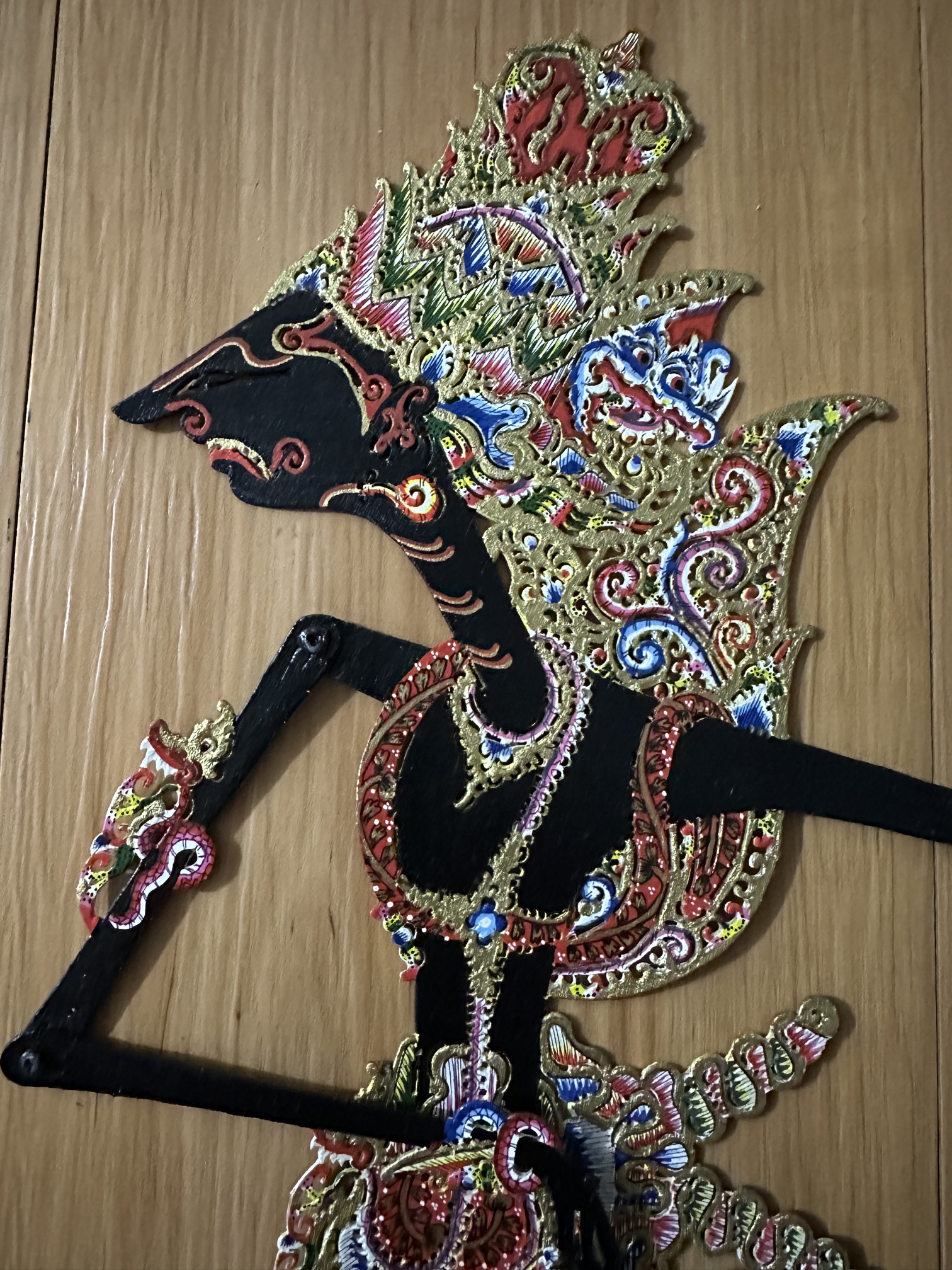
We walked away with an absolutely stellar Wayang puppet, Kamajaya, the god of love. He came as part of a matched pair with his wife, Kamaratih, but he was a little expensive so we split the lovers up. He’s made of painted water buffalo leather and his central support is a piece of carved water buffalo horn. The shop proprietor made all of the puppets.


Wayang Kulit Gift Shop
We went to a performance of the shadow puppets, the Wayang Kulit. Or that’s what we thought. As it happened, through a little cross-cultural miscommunication, we saw the Wayang Orang instead, a masked dance. No puppets. But the gift shop at the performance space had the puppets, so we spent quality time there pre-show.


We didn’t understand at first that Sulistyo, the enthusiastic guy showing us around, was actually the master puppet maker. He made all the puppets for the Wayang Kulit and all the puppets in the shop. We thought he was just really into it, but it was great to pick up pieces directly from the creator. I felt better about separating Kamajaya and Kamaratih, knowing that we’d created space for our very own Krishna, the god of protection, compassion, tenderness, and love. That’s two gods of love! In one house! Three, counting me.


Side note: The first two sentences I taught Sam were “I am the God of Love,” and “Stop that or I’ll tell my real daddy.” The first was a reliable ice breaker on the subway, and the second turned out, when deployed in the field, to be much less amusing than I’d imagined, and was quickly taken out of rotation.
Lurik
While batik is the star of the show in Java, there’s a completely separate weaving tradition called lurik, which simply means stripes. There’s a hotbed of it in the Bantul neighborhood, right next to where we’re staying in Kotagede, so we massed the troops for a field trip. The goal: two workshops and a store.
Dibyo Lurik
Our first stop was Dibyo Lurik, a small workshop with a single weaver onsite. They work with other weavers, which they’d have to, as this one poor woman could produce only seven meters of fabric in a full day.


After marinating in batik’s riot of color and pattern, the austere beauty of the lurik felt like a palette cleanser. I wasn’t expecting to be enchanted by subtlety, but there you go. The very definition of travel being broadening.


I checked prices as we were looking through the goods, and reported that the lurik was 350,000 rupiah/meter, about $20. Not an unreasonable cost for artisanal hand-loomed fabric, but a substantial amount regardless. It turns out that I couldn’t process what I’d actually been told, which was 35,000 rupiah/meter, because $2/meter for this fabric was literally incomprehensible. We loaded up.

Tenun Lurik “Kurnia”
Our next stop was what seemed to be the largest lurik producer in Bantul. Where Dibyo Lurik had a single loom and a very tired woman, Tenun Lurik “Kurnia” (tenun means weaving) had several rooms full of active looms.


The work at Kurnia was even more beautiful than what we saw at Dibyo.


Ardjo Lurik
Our final stop was a little shop, Ardjo Lurik. The shopkeeper was napping when we arrived, but got up and opened up for us. She doesn’t weave lurik herself, but uses what’s produced in the neighborhood for her own creations.


Baskets
We’d birddogged a shop called Mercia Natural Baskets, but what we didn’t know was that it was in the center of an entire basket district. We went to visit a store and had fallen into a field trip, all unbeknownst.
The basketry came in all shapes and sizes, but the most spectacular form was, hands down, lampshades. They existed in every combination of refined vs. rough, symmetric vs, asymmetric, organic vs. abstract. The range was dizzying, and the saddest part was that there was not a single piece of a scale that permitted bringing it home. Oh, we discussed it, we strategized, we planned. And while theoretically possible, we abandoned our schemes and settled in to just enjoying them for themselves, and not as potential loot.
Still. We are Olympic-level looters, and it hurts to be thwarted. We are bad at unrequited.
Here’s an overview of the extraordinary range.


And some standout individual pieces.


Glass
Nestled into the basket district was a lone, dusty outpost of the glass arts. We’d seen their specialty before, at a shop in Ubud in Bali. Glass vessels are slumped over natural wood so the two pieces fit together perfectly. It’s a lovely effect, but what we saw in Bali was much more modest in scale, more tumblers-on-coasters than the sculptural pieces on display at Deco Glass.


Parri Genuine Stingray Shagreen
We’d gone to several of the small exhibitions ancillary to ArtJog, Yogya’s annual art show, and this one found us out in the hinterlands at an eco-spa and restaurant called Yabbiekayu. Nef found a table with little stingray leather bracelets, which turned out to be the merch outlet of a real store. It’s not like we had options at that point. We had to go.
First, let it be said that the stingray skins are ethically sourced. They’re not endangered, nor are they harvested for their skin. They are fished for meat, and before the owner/designer had his epiphany to use them for luxury leather, the skins were just trashed. So, recycling. Super green.


Whew! That’s a lot. It’s one of the reasons we’ve found Indonesia so compelling. In our ongoing game of Would You Live Here, Indonesia gets an upvote for its accessible language, it’s ridiculously low cost of living, its friendly folk, it’s delightful beaches, and it’s rich cultural offerings. We’ve loved Indonesia, and we only just scratched its surface.