The Temples of Ayutthaya
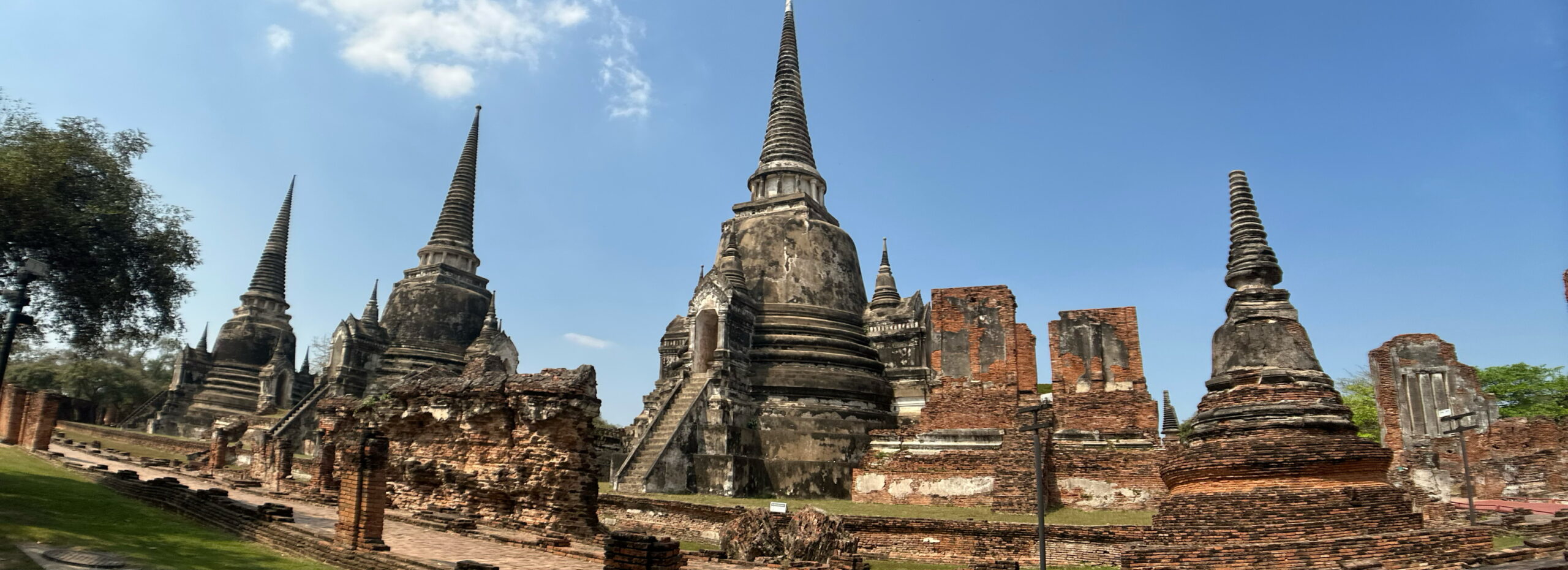
With only a month in Bangkok, time’s a-wastin’. Bring on the day trips.
For those of you who have been following all along, you know we’re not big fans of tours. For the most part we prefer to make our way on our own. Because we’re rugged individualists. Or maybe because most of the tours involve a lengthy stop at an expensive souvenir shop that kicks a percentage of sales back to the tour operator. We’re too old to waste time.
There are exceptions. Like Mỹ Sơn in Vietnam, whose website cautioned visitors to stay on the paths to avoid triggering an unexploded bomb, the gift with purchase so graciously left by the US of A. That seemed like a good place for a guide.
No bombs here, but the solo math favors the tours. With two of us, a pair of tour tickets comes close to paying for a car and driver to just take us where we want to go. Not the case alone, so I’ve booked a handful of tours to make sure I see the sights. First stop: the temples of the ancient kingdom of Ayutthaya, an unsurprising UNESCO World Heritage site.

The Ayutthaya Kingdom was in charge from 1351 to 1767, and is considered the precursor to the modern Thai state. Siam, by the way, is what farangs called the country. They called themselves Tai, and the post-Ayutthaya capital of Bangkok was known as Krung Tai (Tai Country). So they’ve been calling themselves Thai since long before we named cats for them.
The city of Ayutthaya, including the temple complex, was built on top of an ancient Khmer city dating back to about 850, when it was known as Ayodhya. We know that from historical records, as there don’t appear to be any Khmer-era ruins left behind. Ayutthaya was destroyed by the Burmese army in 1767, because that’s just what people do. But before that it was one of the most prosperous cities on the planet, with an estimated population of 1,000,000 in 1700, which made it one of the largest cities in the world at that time.
The city was built right on the banks of the Chao Phraya River, which runs all the way into Bangkok, making it relatively easy to move down river and establish a new capital, Krung Thep, when circumstances required. Like LA (legal name El Pueblo de Nuestra Señora la Reina de los Ángeles de Porciúncula), Krung Thep is a nickname, its formal name being Krung Thep Mahanakhon Amon Rattanakosin Mahinthara Ayuthaya Mahadilok Phop Noppharat Ratchathani Burirom Udomratchaniwet Mahasathan Amon Piman Awatan Sathit Sakkathattiya Witsanukam Prasit.
There will be a quiz.
The tour operator issued a warning about my knees prior to the tour. Probably not just my knees. Knees in general, which were deemed an unacceptable accessory for the temples, so long pants would be required. When I boarded the bus our guide, Henry, pointed right at my knees, and I assured him that I had brought long pants to cover the offending joints.
As we pulled into our first stop, I unfurled and donned the elephant pants I’d been forced to purchase at the Temple of the Emerald Buddha, double bagged over my shorts. I couldn’t help but notice that three of the gentlemen on our tour were wearing shorts, with knees fully exposed. A direct affront to the Buddha. I kept waiting for Henry to do something. Or for us to reach the temple where they cared.
By the time we hit the third of our four temples, I just sat down on a bench, stripped them off, and stuffed them back in my bag. I’m sure the locals had never seen a farang molt. But I’d had enough, enough I say.
Too hot for double bagging. Or even single bagging, if the one bag was long pants.
Wat Chaiwatthanara
We stopped at four temples on our tour, first stop Wat Chaiwatthanara. Like many of Ayutthaya’s temples, it was built in the ancient Khmer style, including the traditional Khmer prangs, distinctive decorative spires.
The contrast to the temples in Bangkok, Wat Pho and the Temple of the Emerald Buddha in the Grand Palace complex, was striking. Although the Bangkok temples, at over 300 years old, aren’t exactly spring chickens, they have both been scrubbed to a New Temple sheen. Ayutthaya’s temples, thanks to the Burmese army, are legitimate ruins.


You can really see the decorative detail, even if the cladding is missing. 


The partial Buddhas were a recurring, haunting theme across all of the temples we visited. 
This one was in a protected niche, so survived comparatively intact. Who doesn’t love they a goofy Buddha? 
The memorials to Queen Sirikit are, literally, everywhere. 
Right on the Chao Phraya River.
Wat Mahathat
Wat Mahathat is best known for a tree growing around a Buddha head. The story has it that the Burmese Army, them again, desecrated a 1600-vintage statue by lopping it’s head off. The head lay on the ground in the ruins until a bodhi tree grew up around it, its roots cradling the head and keeping it upright, yet never covering the face, which would be sacrilege. Bodhi trees, apparently, know better than that.
Plus, more Khmer-style temples.


Wat Phrasisanpethi
Temple #3 on the hit parade.


I’d passed this by before something caught my eye. On close inspection, this had been a Buddha. You can see the shape of the crossed legs below the torso. 
This was right at the bus drop-off. Thank goodness no one in our group tried to engage. I would definitely have intervened. There are ethical elephant sanctuaries in Thailand. This is not one of them.
Wat Lokaya Sutha
There were a few tiny ruins, but this was all about the big Buddha. At 137 feet long and 26 feet tall it’s only slightly smaller than Wat Pho’s massive golden Buddha. It dates back to the beginning of the Ayutthaya Kingdom, but the brick and mortar structure has obviously been well loved.


Here’s a thing I wasn’t expecting. One of the apparent side effects of the solo travel is a hunger for human interaction. There were about thirty folks total on the tour bus, from all over: Russia, Portugal, Israel, India, Latvia, and Cleveland. I had actual conversations with about fifteen of them. But not in a desperate way. I’m sure I came across as exceptionally stable. It was, in many ways, the highlight of the tour.
Of course, that probably shouldn’t have been the highlight. We’ll see on subsequent tours if that was a notably lively group, or if the tour itself just wasn’t so much. Or if I’m just that emotionally needy.