Doi Inthanon
There appears to be something I haven’t done in Chiang Mai, some last adventure that will round out the entire experience. I’ve squeezed the lemon pretty thoroughly here (which is probably why I feel pulped), but I just know I’ve missed something that will leave me reeling with regret once I figure it out. Or maybe I have four days left before leaving for Malaysia and desperately need to keep moving in a fruitless attempt to fill the emptiness inside me, a void that hungers but can never be satisfied.
Or maybe a trip to Thailand’s highest spot, The Roof of Thailand, just sounds fun. Rumor has it there are waterfalls involved. Reason enough right there.

Doi Inthanon (doi is mountain) is named for King Inthawichayanon, whose given name at birth was Inthanon. He died in 1897, the last king of Chiang Mai, and his ashes are housed in a stupa at the highest point in Thailand. Improbably, Doi Inthanon is part of the same range that includes Everest, which, at 29,000 feet towers over Doi Inthanon’s 8,415 feet.
But before we reached the Roof of Thailand, there would be trekking and waterfalls.
Wachirathan Waterfall
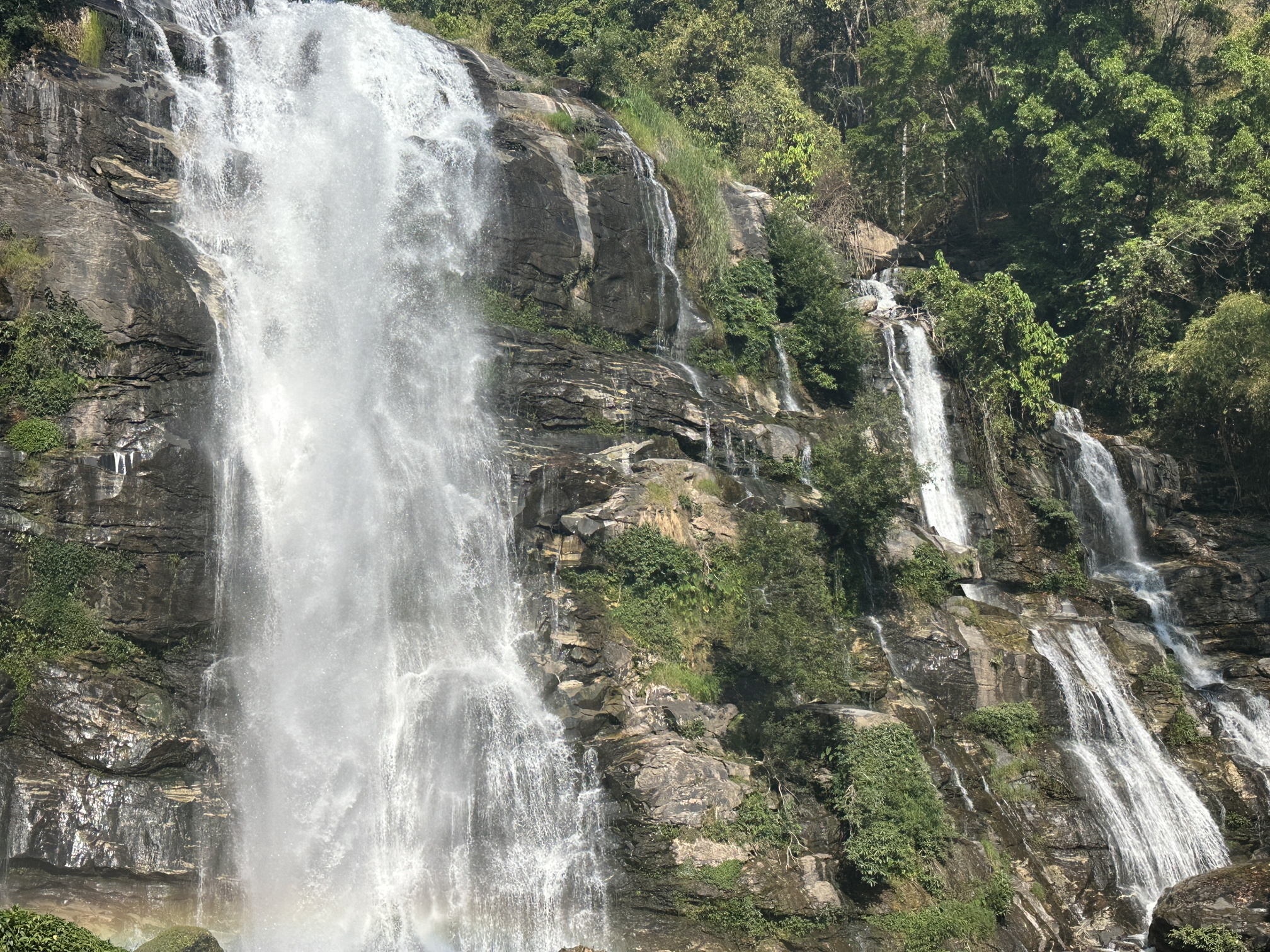
Our first stop, inside Doi Inthanon National Park, was Wachirathan Waterfall. At ~250 feet, Wachirathan isn’t Thailand’s tallest waterfall, but it may be the most powerful. The volume of water is truly impressive.


There’s some rainbow action in the video, too.
Trekking
Back in the van, which held a dozen of us plus guide and driver, to our next stop, the Pha Doc Siao Nature Trail, a three kilometer trek that started at over 4,000 feet. I kept asking the others whether they felt the altitude when they tried to, you know, take a full breath while hiking, but all I got was pity. Bastards.
I wasn’t sure whether the end of this hike was Thailand’s roof or only its mezzanine, so nothing to do but carry on and avoid, if at all possible, fainting.
Here’s our guide, Lucy, introducing us to the two members of the Karen village who would be our docents for the hike, as we weren’t permitted to wander loose on the trail. If one of was slow, not naming names, one of the Karen would hold back and make sure we got back to the group.

I suspect this was more safety than anything. The path was super uneven and completely unmarked. If one were, say, panting to take a breath, one might get disoriented or trip over a tree root in the path. No one wants to be the weakest gazelle at the watering hole, so the extra help was appreciated.
The trek involved following a series of three waterfalls through the jungle, the third of which permitted swimming. We’d exit through a Karen village, and then some other things would happen. Not clear what the post-3km trek offered.
You will be, I believe, unsurprised to learn that the nature trek was just unfairly beautiful. Other jungles were jealous. On the negative side, though, we didn’t see any of the gibbons we were promised lived in the area. Lucy did share with us that Thai people, who will apparently eat anything (she listed monkeys and snakes specifically) won’t eat gibbons because they pair bond for life, like humans. Aspirationally. I just felt better knowing that as an actual lifelong pair bonder, Thai people would be unlikely to eat me.
We quickly came to the first of the trek’s waterfalls. We were cautioned not to swim, but that seemed unnecessary. It was no Wachirathan, but there was still an impressive water flow. There was no part of this fall that called out to me to risk my life by entering.


The water kept us company as we trekked to the next waterfall.

This was another no-swimming, no-problem waterfall. Not even the shadow of an inclination.

Our trek to the final waterfall took us through a valley that was used by the Karen for rice cultivation. The water had been diverted around the valley, and routed to the next waterfall, to prevent random flooding that damaged crops. The park was established in 1972, but the Karen and Hmong villages had been established right around 1900, so their agricultural footprint predates the park by a fair amount.
When I was at DC Comics I visited one of my artists, Steve Parkhouse, who took me for an excursion around his home in England’s Lake District. We were touring one of the national parks when we crested a hill and I saw a village in the valley below. “Who let them build a village in a national park?” Steve laughed. “The national park is just over 50 years old. The village is over 1,000.” Like that. Only newer.


Which brought us, blissfully, to the third and final waterfall, the one where swimming was permitted.


Here we have delightful proof that children are stupid in exactly the same way across vast cultural gulfs. Let the children teach us: we are more alike than different.
The end of our 3km trek took us to the Karen village of our guides, a hamlet of about 350 people. This turned out to be the highlight for me, which was a surprise, as I’d already visited a Karen village. But these two villages could not have been more different.
The first village I’d been to had been a Long Neck village, while this tribe was White Karen, who don’t use the neck-lengthening brass coils. But the differences went way deeper than that. As I mentioned, the White Karen village had been established around 1900, while the Long Neck villagers had fled persecution in Burma/Myanmar in the 80s. As a result, the White Karens owned their land and were Thai citizens, while the Long Neck village was effectively a refugee camp, the villagers having no actual rights within Thailand.
How this played out in the two villages was fascinating, manifesting in both art and architecture. But we had a couple of stops before we hit the village proper. The first was their coffee operation, which is an important part of their economy. Prior to its establishment as a National Park, this part of Thailand was thick with opium poppy cultivation. The government officially banned opium production in the fifties, but the effort picked up speed with a Royal Project in 1969 that focused on crop substitution. That’s why the Karen grow coffee and strawberries now.
This fellow was by the path roasting coffee by hand. If only he’d had some for sale. JK. Of course I bought his hand-roasted coffee. I’d most certainly also have bought his opium, but if any was available it wasn’t on offer to farangs.


The next stop was the Karen weaving shop. I’m sure most of the weaving is done in the home, but this is a central spot on the nature trail that gathers all of the village’s wares in one place. That’s the longest backstrap loom I’ve ever seen, by the way. For making the long straps on the woven tote bags? Maybe?


I will always share video of weaving. Don’t click Play if it bores you.
The two Karen villages’ vastly different profiles, one settled citizens, one stateless refugees, couldn’t have been more apparent than in their weaving. The Long Neck Karen had small backstrap looms they clearly carried with them when they fled Myanmar, while the White Karen had frame looms large enough to be cosplaying as backstrap looms. That difference leads to a notable distinction in the depth and richness of the patterns being woven.
Finally, the Long Neck Karen have made a virtue out of the vice of scarcity, weaving pieces that are more open float than weft. While the White Karen weaving does feature some open floats, it’s a design accent rather than the primary effect.
Here’s what I picked up from the White Karen village. Those are rich and subtle.


And here’s what I picked up from the Long Neck Karen village.


I’m not suggesting for a moment that there’s a qualitative artistic difference between the two villages’ work. Both are beautiful. I’m suggesting that the obvious differences in execution are attributable to their different circumstances, that the decisions aren’t purely aesthetic, but are tied to their social and economic profiles. I wasn’t expecting a master class in microeconomics on a hike and a swim, but you have to hold yourself open to the universe.
The final lesson came when we reached the village proper, where our van was waiting to pick us up for the next leg. The village was so much more built than the Long Neck village. It might look like corrugated tin lean-to construction, but it was solid.


This is what tipped me over, though. Fucking dormer windows!

Compare that with the Long Neck village, whose building designs are constrained by the materials available. No architectural details for them, just pure utilitarianism.

Many years ago, on a DC junket, I found myself at Skara Brae in the Orkney Islands, one of the world’s oldest neolithic cities. You could see the foundations of the housing and the street grid. What was most fascinating to me was that there was evidence of indoor plumbing, the oldest, I believe, ever found. Which spoke of a society with enough labor bandwidth that not all of it needed to be focussed on subsistence.
You don’t get indoor plumbing without the equivalent of a city planning function, and you don’t get city planners unless you value their efforts enough to feed them, since they’re busy city planning instead of hunting. There’s an entire value system embedded in something as simple as sewage lines.
That’s what I thought of when I saw those hilarious dormer windows. There’s a value system embedded in those windows, that says we value beauty over efficiency, joy over utilitarianism. And we have the necessary labor bandwidth to manifest those values in silly, silly windows. The Long Neck Karen, on the other hand, are just trying to survive, and their buildings, as they will, reflect those values.
Made It, Ma! Roof Of The World…
At this point it was clear that our 3km trek was not terminating at the Roof of Thailand. Would there be another trek to the highest point in Thailand? I dearly hoped not. I hadn’t actually tweaked anything, but more than one of my joints was throbbing. That 3km was over very uneven paths, and knees and ankles took a beating.
So I was delighted to get back in the van, and surprised when, just a few minutes later, we pulled into the parking lot for the Roof of Thailand. Which was only a modest walk of 250 meters from the parking lot. That’s service! I’d just assumed that reaching the summit was its own trek.
It wasn’t a trek, but it was a ball of confusion. For starters, the sign that says “The Highest Spot in Thailand” isn’t. It’s just the sign at the beginning of the trail. You can even see the trail behind it winding higher on the mountain. I mean, you can’t even trust the signage.

Next up the path was the stupa holding King Inthanon’s ashes.

If you continue around the path, you go behind the stupa.

You can see the little square plinth just in front of the stupa’s base. For awhile, that was the tallest thing on the mountain, but so many people were traipsing up to it that it put the integrity of the stupa at risk. So on the other side of the path they built a new plinth, a couple of inches taller than the old plinth, so that could now be the highest point in Thailand, and people would leave the poor king’s stupa alone.


One nice thing about Thailand’s roof. At over 8,000 feet up, the air was deliciously cool. They’ve still never had snow up there, which is fine, but it was a refreshing break from the turgid lowlands.
Dueling Pagodas
Our final stop on our long day was the twin pagodas, one for the king, one for the queen. The setting was peaceful and the pagodas were quietly beautiful, as opposed to the not infrequent Clown Car approach to Thai temples. Looking at you, Wat Rong Khun. Let’s take a restful break before we head back to Chiang Mai.


Our Real Final Stop
Before hitting the road for real, two hours back to Chiang Mai, we stopped at what Lucy called a local market. I mean, technically true, but only in the sense that every market is local, if you think about it. But not at all true if you think the common English meaning of local market is a place where locals shop.

This place was inexplicable for so many reasons. First, there were dozens of those stalls, stretching in both directions. So that’s a lot to parse, right off the bat. What made it doubly hard to parse is that every stall carried the same snacks. In the same packaging. With the same labels. At the same price. There could honestly have been one stall.
This was all clearly a front for Big Snack. At first I thought, well, they may be buying big bags of this stuff wholesale, but at least they’re bagging it up for retail. But then I saw that the labels were identical. I honest-to-god think they’re all just buying the pre-bagged snacks from the same supplier and stacking them on their tables. As a demonstration of native Thai stacking culture it was awesome. As a local market it was… weird.
Ephemera
A couple of things that didn’t fit elsewhere.


More Me!
My daughter, Ruby, is pathological about having pictures of us on our travels. I’ve consistently demurred, as I think in any given setting we are always the least interesting thing. But I couldn’t escape my guide for my tour of Wat Doi Suthep, who insisted on taking my picture, which I shared on the post. Well, that made Ruby clap her little hands together in delight, like Veruca Salt stealing a squirrel, so here we are again. Please. Blame Ruby.


But Wait, There’s More…
These kinds of tours can make or break based on the folks. Some people are wrapped up in their own thing, which is often us, to be fair, but mostly people are there for the experience, and sharing it with the rest of your tour group is part of that experience. Which is to say, this was a pretty good group.
With one standout, who warrants specifically name checking: a charming Frenchwoman named Doris Buttignol. I know, I dunk on the French all the time. But only because it’s easy and fun. But when faced with an actual French person, I’m unexpectedly open-minded.
Doris was interesting to talk to, which we did off and on over the course of the day very pleasurably. But at lunch she confessed that she’s a documentarian, which immediately made her more interesting to me. Not that I operate at her level, but writing the blog requires looking at the world through a lens and trying to understand it, rather than letting the experience just wash over you. I’m an ardent amateur, so It was great to spend time talking to someone who does that professionally.
Doris shared with me a link to her most recently completed piece, about Icelandic politics. Which sounds dry but was anything but, encompassing as it did both women’s political empowerment and dealing with climate change. It was trenchant in its observations, but more than that it was visually stunning. Her eye for framing and composition is superb, and I was regularly brought up short by the raw beauty of an image.
Doris has generously let me share the link to her documentary. So everyone, please say Thank You to Doris.
My thanks go to Doris, as well, for giving me an experience, both in her company and her work, that went well beyond what Thailand had to offer. This is why we travel.