I’d Like To Speak To Your Manager…
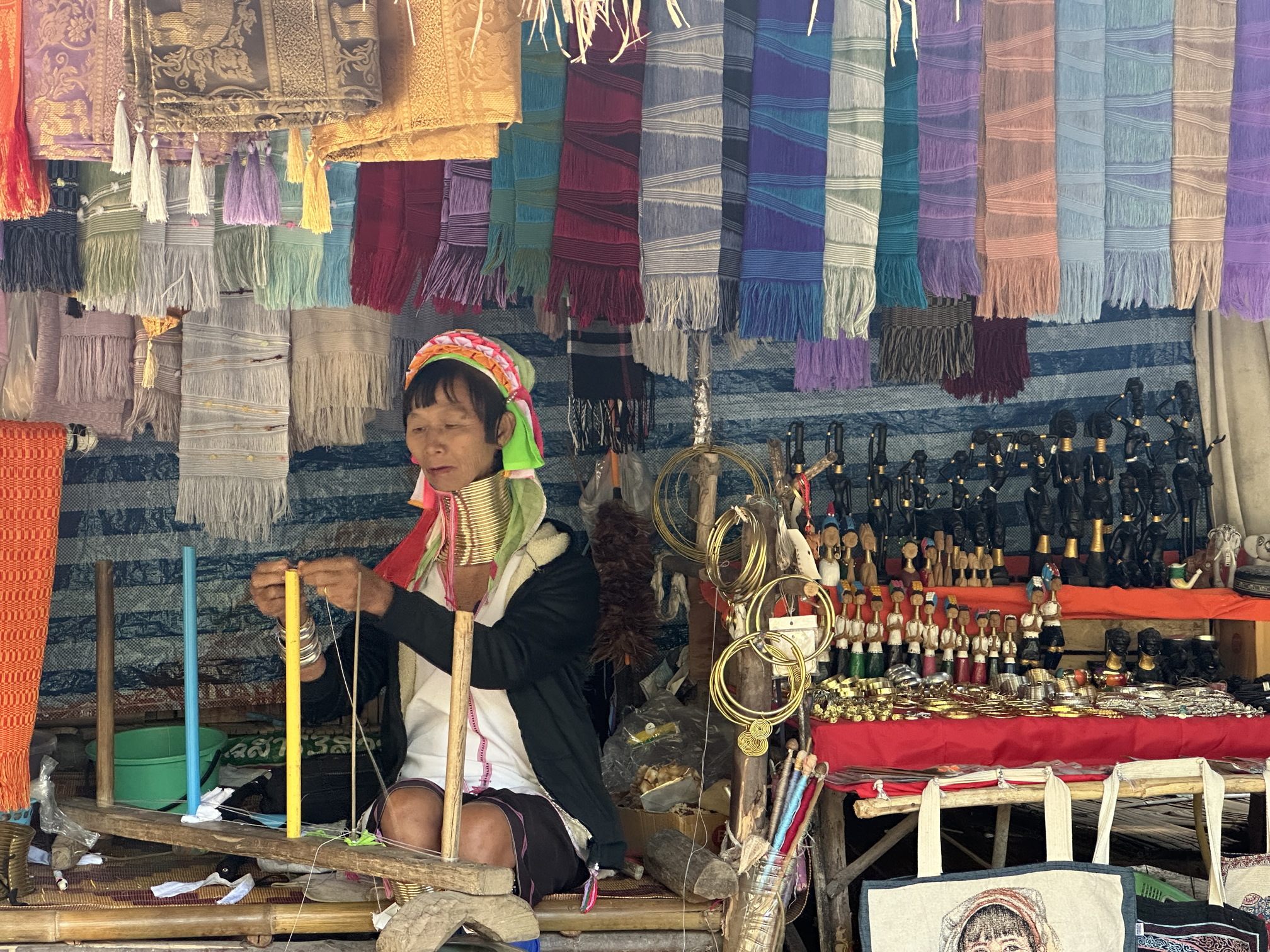
Everyone else on my day trip visited a hill village and some temples, but not me. My tour featured an ethical tourism dilemma and wrestling questions of art and authenticity into submission. And they didn’t even charge me more! I bring the drama all by myself.
One hill village, one hot spring, and three color-coded temples. Let’s make a day of it.

Our guide was an irrepressibly chirpy woman who went by the nom de touriste of MM. When MM wanted to signal that something was true, she’d say “I confirm.” “It is very hot out today, I confirm.” She would do elaborate skits where she’d act out asking herself a question so she could answer it. “But MM, why are there no photos in the temple?” “Well, my dear…” We were all My dears. 100% charming.
The group was small, only five others besides me. An American man; two 18 year-old girls, one from Mexico and one from Spain, who’d met at a Danish international school and become fast friends; a French woman; and a grown-up Mexican woman. Maybe it was the small group and maybe it was just a random collection of friendly folk, but we all chatted amiably in different groupings all day. It was the most social group I’ve had on a tour, and it was a pleasure to spend the day with them.
Mae Khachan Karen Village
Thailand’s north is home to a number of hill tribes: Hmong, Karen, Lisu, and Akha. None of them are native to Thailand, having migrated from the north, mostly originating in China, over varying timespans. The Karen migrated from Burma/Myanmar starting as far back as the 1800s, with a large influx fleeing persecution in Myanmar in the 1980s.
As a result, every Karen village in Thailand is a refugee camp. Citizenship for Karen refugees is being slowly doled out, but most of the Karen are stateless, having only the most limited of rights, if any. Many of the Karen tribes follow the traditional practice of the women wearing brass neck rings, which is why you’ll see references to Karen Long Neck tribes. Mae Khachan is a Long Neck village.
I’m sure you’ll agree that that’s all kinds of fraught, and there’s an active debate about the ethics of visiting the Long Neck villages. The Con argument is that the villages are human zoos, and what the fuck is wrong with you? You monster. The Pro argument is that they charge a fee to enter the village and sell handicrafts that they make or resell, and without the income that tourists bring they’d die out as a distinct culture.
I obviously came down on the Pro side of that argument. Mostly because I wanted to make sure I brought money and left it with them, but also because the Con argument, while morally compelling at first glance, seems wrong to me. You could make that argument about any native village, and we’ve been to lots of them. They provide insight into different, compelling cultures and allow us to take home beautiful representations of those cultures. In exchange, we leave money behind. That seems to me the very essence of tourism, the alternative apparently being staying home.
We visited the rug weaving workshops in Teotitlán del Valle, outside Oaxaca. We visited Tenganan, a thousand-year-old Balinese village, to see the weavers of rare Geringsing double ikat. I visited a village outside Bangkok specializing in Benjarong ceramics. No one has suggested about those locations that visiting them was an unethical act that treated the residents as zoo animals.
Which leads to the only possible explanation, which is the neck rings. Treating the Karen as so exotic that visiting them in their village is deemed a form of colonial-style aggression is to infantilize them and other them in ways I find problematic. They have agency here, and they have chosen to open their village to tourists and sell their handicrafts to support their way of life. It seems like they should have the last word on that subject, not some pearl-clutching philosophy major.
MM started us with an introduction to the village’s guardians, a male and female figure right by the entrance. “But MM, why is there a statue with a penis?” I wasn’t curious about that in the slightest, as lingams seem super common in Southeast Asian art. I did wonder why she was stroking it. That seemed odd. “But MM, why are you treating the lingam like your long-lost best friend?” Neither she nor I asked, so we were all just left to wonder.


She explained that starting as young girls, lingam carvings were worn as a kind of protection, and that her mother had gifted her first lingam charm when she was eight. Wha?! Since when have penises protected women? Women need protection from penises, not by them. No questions, though. I just wanted her to loosen her grip so we could move on.
When MM had gone over the itinerary in the van, I was concerned because only half an hour had been allocated to the Karen village. I was afraid we were going to one of the smaller villages, and was concerned that there would be no mercantile opportunities, which was kind of the whole point for me. If I couldn’t leave money behind, the Con argument carried more weight. MM assured me that there were handicrafts available, so I relaxed.
Half an hour turned out to be perfectly adequate for exploring the small village. Especially since no one spoke English. I’d have definitely sat down for a conversation, had one been on offer. The village boasted about twenty stalls with women selling their weaving, as well as manufactured goods they were reselling.


The weaving is done on an old-style backstrap loom, and features wide, exposed floats, where the horizontal weft threads are skipped. This creates a distinctive design, but it also requires less materials and less time spent weaving. That hardly seems a coincidence, and wouldn’t be the first time that practical constraints drove creative decisions.

This woman did beautiful work, and I bought three scarves from her. 


This diagonal pattern really shows off the floats. There’s more float than weft in this design. 
This basketweave is denser, with the float more a design element than the entire point. 
Like most of the weavers, this one also sold commercially manufactured goods that she purchases and marks up.
This picture is too good to bury in a slideshow. I didn’t pay anything to take pictures of people’s wares, but I just wanted a picture of this beautiful family. The little girl is clutching the 20฿ note I tipped her. Children should totally get paid for being adorable. To be fair, she’s probably more than 20฿ of cute.

For accuracy’s sake, by the way, the Karen women don’t really have long necks. The rings push their collarbones down, which compresses their rib cages and makes their necks look unnaturally long. Is trick!
I left the Karen village feeling pretty good about the visit. The people were lovely and the weaving was excellent. I walked away with five scarves and a lighter wallet. Order had been restored.
Mae Khachan Hot Spring
This was more a roadside stop than an actual hot spring. MM admonished us that there was no swimming, but there were places where we could dunk our feet if we wanted to. I stuck a finger in that water, and there was nothing to worry about. No one who enjoyed having skin would even think of swimming in that water. Or even putting their feet in. Yowch!


Wat Rong Khun – The White Temple
The next batch of weird presented itself at the White Temple in Chiang Rai, and the Blue Temple that followed it on our tour. Both temples seemed at first blush to have been manufactured as tourist attractions. They seemed less like authentic Buddhist temples and more like temple-adjacent fever dreams. That feeling was reinforced when I learned that the White Temple was not a working monastery, like every other temple I’ve been to in Thailand. Not a monk to be found.

This fractal confection seemed to be cosplaying as a Buddhist temple, and the word that kept coming to mind was inauthentic. But that wasn’t quite right, as it was certainly an authentic artistic expression. It took a minute, but it finally clicked into place.
Our absolute sweet spot for crafts is when artisans take traditional techniques and rework them through a modern lens. That’s not a lack of authenticity, it’s the precise method by which cultural traditions thrive and grow, rather than being preserved in the amber of custom. It’s the Mahler quote I used to describe the weavers we met in Teotitlán del Valle: “Tradition is not the worship of ashes, but the preservation of fire.”
Looked at through that lens, the White Temple wasn’t the Disneyfication of a Buddhist temple for the entertainment of tourists, but a towering artistic achievement, the reimagining of an entire Buddhist temple as a work of modern art. That flipped my perspective completely.
When I got home, the interwebs taught me more about the White Temple than MM was able to share, confirming what I’d come to on site. First, Wat Rong Khun is not as sui generis as it seems. A temple of that name existed on the site, but had fallen into disrepair. With no funds available to renovate it, a local Chiang Rai artist, Chalermchai Kositpipat, decided to take on the work himself, and has poured more than $1.2M USD into his Buddhist money pit.
The White Temple was opened to the public in 1997. Kositpipat continues to work on it, with work scheduled to be completed by 2070. Presumably after his death. Rather than being a touristy gloss on a Buddhist temple, Kositpipat seems to mean it. He intends for there to be a real working monastery and meditation center, the whole complex sincerely meant as an offering to Buddha.
These are my favorite travel experiences, when the struggle to make sense of what I see leads to a broader, deeper understanding. In this case, it allowed me to fully sink into the White Temple’s ridiculous excess, without any niggling concerns about its authenticity.

The “frosting” is a combination of whitewash and glass chips inset into all of the surfaces. 
The big temple in the center is the ordination hall, or Ubosot. But before you get there, you pass over the bridge symbolically representing samsara, the Buddhist cycle of birth, death, and rebirth. 
Crossing over this ghastly expanse (which is gray, not white) symbolically represents the passage from suffering to spiritual clarity. MM said it was hell. 
Once you pass over the bridge, you reach The Gate of Heaven, the pathway to the Ubosot. The entrance is flanked by the mythical guardians Death and Rahu. 


Crossing this threshold represents the passage from the profane to the sacred. 
While the Ubosot isn’t quite so sanctified that it bars women from entry, it is sacred enough that photos are not permitted. Which is a shame, because the interior makes the outside look sedate. Rather than the traditional Buddhist murals focused on karma and rebirth, Kositpipat has let himself go apeshit. It’s his money, after all.
Images from pop culture and recent history serve Kositpipat’s perspective about the perniciousness of overconsumption and Western cultural influences. This manifests as images that range from Michael Jackson to the World Trade Centers, from Angry Birds to mushroom clouds. But don’t be sad that I couldn’t take pictures. I’m happy to scrape the web for these photos from travelphotoreport.com. Not sure why they were permitted to take photos and I wasn’t (am I not a journalist?), but these exist and that’s a good thing.


The backside of the Ubosot is just as deliriously overwrought as the front.


The rest of the grounds may fail to live up to the insanely high standards of the primary temple, but there’s still another 44 years of work to be done. I believe in the vision. Which is not to say that there wasn’t plenty more weird on offer.


This looked like a sculpture, but on closer inspection it was a Buddhist Donation Station™. For 30฿ you get a metallic lucky bodhi leaf that you inscribe with a wish and hang on the tree.


And fish feeding. I’m a sucker for feeding fish, I confirm. If you ever want to take advantage of me, take me to a koi pond and hand me fish pellets. I’ll be incapable of executive function and will sign whatever you put in front of me.

I mean, you can see why I initially struggled with questions of authenticity. There’s way more hold my beer than I associate with Buddhist temples. 

A comically overgenerous portion of fish food for a mere 10฿. I tried to give it away, but wound up dumping it over to finish it off when there was about an inch left. That did lead to a very satisfying aquatic frenzy.
Sorry there are no 3d glasses for this.
And… There was merch.

There was the usual constellation of souvenir vendors you find at all such attractions, but these were housed in a notably more modern setting. 
I did not test this claim. Although I will say that Chiang Mai’s pizza has been much better than expected. 
I think these were Ramayana plushies. 
There were several clothing vendors selling clothes in the style of the Hill Tribes, using knocked off manufactured fabrics. 
I explain that phenomenon in the post on Thai crafts. 
This came from the official on-premises gift shop. Ganesha is my favorite of Buddha’s SuperFriends™, and I didn’t own any Ganesha merch. Problem solved.
“We few, we happy few, we band of brothers…”

Wat Rong Suea Ten – The Blue Temple
The Blue Temple is the White Temple writ small. Built by one of Kositpipat’s students, it opened to the public in 2016, and was likewise built on the site of a derelict temple. Unlike the White Temple, it’s not a Buddhist Winchester Mystery House. It’s more modest in scale, if just as outrageous in conception (OK, slightly less outrageous in conception), and is actually completed.


Thankfully, pictures were permitted inside the temple.

The entrance offers the first glimpse of the unexpectedly white Buddha. 


The view from a kneeling prayer position. 


Looking back towards the main entrance. 
Sadly, not available as a t-shirt, a grievously missed opportunity. 

Another Donation Station™. 
And the little bill holders. The Thai temples have seemed the most aggressive in SEA in monetizing visitors. 
Someday I will make merit, I confirm.
As spectacular as the entrance was, walking around the main temple offered up even more extravagant follies.


As elaborate as the design is, the site is basically the main temple and some modest, if ornately decorated, grounds.


And here we have the quintessence of the Thai temple experience: Monk’s bowls for a donation, and the source of that donation. No problem if you’re tapped out, step right up.

The reunion tour…

Wat Huay Pla Kang – The Red Temple
Our last stop in Chiang Rai was the Red Temple, another contemporary structure. It opened as a monastery in 2001 and was certified as a temple in 2009 by the National Buddhism Office. Which I did not make up. The National Buddhism Office is a real thing that exists.
The red temple of the Red Temple is actually a nine-tiered Chinese-style pagoda. But that’s OK. Buddhists are chill about that stuff, so it’s ok to let it go.


There was also a swell white stucco ordination hall.


But the payoff here isn’t the Red Temple at all. It’s the 80 meter tall statue of Guan Yin, the largest Guan Yin in all of Thailand. She sits on top of a hill and towers over the rest of the compound. And she is not a Buddha, a common misconception. She is the Goddess of Mercy in Chinese Buddhism, befitting the general Chinese flavor of the construction at this site.

It is very hard to judge scale, so let me help. You’ll notice that Guan Yin has two eye slits and a third eye in her forehead. Those are windows accessible from an observation deck. You take an elevator to get there, which lets you out on the 25th floor. That structure is over 250 feet tall.


You’ll be shocked to learn that the interior is overdecorated.


And there you have it. I had a wonderful tour. I’m using the same tour operator to visit the national park near Chiang Mai, Doi Inthanon, and I am gutted that MM won’t be the guide for that tour. I would follow her anywhere, I confirm.