Thai Crafts
With a few exceptions, I haven’t been seduced by the Thai crafts. There are several potential explanations for this. ① It’s not that impressive a craft culture. ② We just shopped our way through six months in Southeast Asia and Thai crafts aren’t distinctive enough to grab me by the wallet. ③ Dorothy is better able to birddog interesting shops than I am, and I just haven’t found the good stuff. ④ I have no actual taste of my own, and absent Dorothy’s presence I am completely unable to discern quality. ⑤ All of the above.
I think it’s mostly ③ with a side order of ②, but I must soldier on, even with my paltry resources.
One of the biggest challenges is that quality and price don’t seem to be on a spectrum here. They’re a binary, with cheap tourist crap at one end, heirloom artisanal hoohah on the other, and precious little in between. On the one hand, that meant I wouldn’t be coming back with crappy merch, and on the other it meant I’d have to make sure I didn’t overspend for a signature piece of questionable (i.e. my) taste. As Dorothy will attest, threading needles is not my specialty.
There were definitely winners in the Thai handicrafts mix, but plenty of losers, too.
Chatuchak Weekend Market
One of my first stops in Bangkok was the Chatuchak Weekend Market, which purported to be the major crafts and textile market. As you can see, it’s a beast.

Also, less than intuitive to navigate. I had read that the textiles were to be found in Stall 25. I found Stall 24 and Stall 26, but no 25. I asked a security guard to help, and he took me to 25, which I couldn’t find by myself because they were in the following order: 24/26/25… Of course. Silly me.
Also, very little fabric in Stall 25, or elsewhere. I took what I believed were two full, exhausting turns around the market and never saw any concentration of textile shops. The odd one, randomly dropped, but no sector. And most of what was there fell on the Cheap Tourist Merch end of the spectrum.


Even merch can be, comparatively, quality, and Chatuchak definitely offered quality merch.


One shop had every flavor of Ganesha imaginable. Merch, for sure, but I honestly wanted every one. I’m easily beguiled. On the other hand, these are objectively adorable.


And there was even a little bit of fabric.

Beautiful two-way silk scarves, but these are all over Thailand. Beautiful, but not special. 
Traditional silk prints, like we used to order online for the corset business. 
And one, one!, shop with real wovens. But to situate this on the merch/artisanal scale, this was $700 USD. That was never coming home with me.
Warorot Market
Chiang Mai also has a primary textile market, or so the legend goes, the Warorot. Turns out that’s trueish. Warorot is a large market with a lot of crafts and manufactured goods, as well as a produce market, and a few textile shops. The real textile shops are on the streets surrounding the market. The closest I could come to identifying them was the vague advice to “Walk around outside the market. You’ll find them.” Which I did, but not until my second visit.
These are not quality goods, however. These shops carry commercially produced bolt goods, not artisanal wovens. No Thai silk, and none of the mudmee, the Thai ikat, produced in the north, which is what I was really hunting for. I’d seen a little mudmee in Bangkok, but Chiang Mai felt like it should be the source. Yes, of course, but not at Warorot, as I’d been led to believe.


There were quite a few shops in the streets around Warorot featuring Hill Tribe-styled clothing. There are a number of ethnic hill tribes in the north of Thailand: Hmong, Karen, Lisu, and Akha.
Starting in the 1980s, the brightly colored embroidered fabrics made by the Hill Tribes caught on as fashion, and demand, as it does, began to outstrip supply. The traditional Hill Tribe embroidery is time consuming to make, and that simply won’t do when the market demands volume.
You’ll be shocked to hear that it’s very difficult to find authentic Hill Tribe textiles or clothes today. What’s on the market now are manufactured goods made in the Hill Tribe style, including, even, printed knockoffs of embroidered patterns. That’s almost exclusively what’s to be found around Warorot.
Chinatown’s Sampeng Lane
Bangkok’s Chinatown was another place that was supposed to feature fabric, but I never really found it. It’s a dense warren of narrow lanes that’s pretty confusing to navigate. I did see a few fabric shops, but they were selling cheap cottons and rayons, not quality goods. Dense and interesting, but the hunt continues.


Song Wat Road
Hard by Chinatown, right by the river, Song Wat Road is an up and coming neighborhood with some pioneer boutiques opening up. In a couple of years I’m sure it will be much less commercial, much more gentrified.
This was probably the closest I came to the missing middle part of the spectrum: affordable craft goods made by real people, not stamped out of factories.

One of the best known of the boutiques. It’s a small store, and it was very full of people. 

Another small boutique, whose name I don’t remember. 

Still plenty of commercial roots still showing. 
Right on the Chao Phraya river. 
The neighborhood is known for its murals. 

These are scattered randomly about Bangkok, a program called Elephant Parade. Individual artists decorate their own elephants.
Pak Khlong Talat Flower Market
You may certainly argue that a flower market hardly qualifies as crafts. You may also get your own blog and taxonomize the world however you like. But this is my blog, buster, and I say that Bangkok’s Pak Khlong Talat Flower Market is displaying crafts.


One of the most notable things about this market is that it smelled good to me. That may not sound like much to you, but I pretty much lost my sense of smell some years back. I went to an ENT recently, whose qualified medical response was, “Huh.” I hope he’s still paying off his student loans.
My nose isn’t completely dead, just mostly. If you dropped me off blindfolded in a wet market, and please don’t, I’d know. I might even be able to tell if I’d been left in livestock or fish. But an odor has to be pretty strong to register, so the flower market was a pleasant surprise.
Shocking no one, the area around the flower market was also given over to flowers.


Jing Jai Market
Another Bangkok market that offered craft goods in the rare middle of the price/quality spectrum. Jing Jai sprawled across a large, non-linear space, so it was hard to make sure you’d seen it all. It even had its own dedicated farmer’s market.


Srinagarindra Train Night Market
Bangkok’s most massive night market. This one boasts over 2,000 vendors and an unknown amount of acreage. It big. It also has a weird specialty: antique furniture and vintage clothes. Crafts per se, not so much. But excellent food and a very entertaining evening. Also a ton of nail salons and tattoo parlors had stalls, but not a single massage spa. If there’s a Guinness record for Fewest Massage Spas Per Square Mile in Thailand, Srinagarindra is the obvious record holder.
It was also a profoundly local experience. It took the fingers of both hands to count the other farangs I saw, but that’s all it took.

The sheer scale was mind blowing. 


This shop was called Europe’s Finest Antique. And here I thought that was their queen. 
One of the many ubiquitous shrinkydinked nail salons. 
And an airplane. Why the fuck not? 
I had dinner from here, but contented myself with an anodyne chicken wrap. No ostrich, goat, rabbit, or deer for me. I am weak.
ICONSIAM
ICONSIAM is one of Bangkok’s newest megamall experiences, having opened in 2020. Sitting directly on the Chao Phraya river (I arrived by ferry from the other side), ICONSIAM boasts >5.5M sqft of retail space, a 3000 seat auditorium, two residential towers (52 & 70 stories) with 446 units, a >110,000 sqft waterfront park. And a Hil-ton ♫in a pear tree♬.
It has a fuller complement of luxury brands than even the other Bangkok malls: Prada, Armani, Hermés, Cartier, Louis Vuitton, Dior, Tiffany, Gucci, Balenciaga… None of which are the reasons I went. It also has a couple of floors devoted to ICONCRAFT, showcasing handmade goods from local artisans. That was the draw.
At the end of the day, it was long on spectacle and short on crafts. They had a few pretty things, but the selection seemed much ado about not much.


Nothing says luxury like calling out the Singapore airport.
Chamchaa Market
How many ways is it possible to fuck up a simple shopping excursion? I am so glad you asked that question. Spoiler: all of them. You can fuck up a simple shopping excursion all of the ways.
Dorothy had found a site aggregating dozens of specialty craft makers in Chiang Mai. One of them had their shop in Chamchaa Market, about 25 minutes from my apartment by Grab, so I thought that would be a worthwhile excursion. I pulled them up on Google Maps, and then opened Grab to see how much it would cost to get there. All the deets seemed perfectly reasonable, and I added Chamchaa to my To Do list.
Next thing I hear is my phone chirping. It’s the Grab app telling me that my driver is on their way. I must have inadvertently hit the Book button when I set my phone down. And the driver wasn’t the typical 8-10 Grab minutes away. They were two minutes away.
I apologize for the image, but it’s important to note that I spend almost all of my time in the apartment in my panties. I don’t like to run the A/C, so I keep a table fan turned on me and bask in the comparative coolth. That meant that when the app chimed, I had two minutes to throw on clothes, grab my bag, and make it down by elevator from the ninth floor.
Which I did, with only a modest helping of agita. First hurdle cleared. Then my driver pulls up and tells me that Chamchaa is outside of Grab’s Chiang Mai zone, so while she can take me there, I won’t be able to get a Grab back, and she won’t be able to pick up a fare to return to town. I ask if she’d wait for me while I shopped and take me back, for which I’d pay her cash outside of Grab. We agreed on a price and took off. Second hurdle cleared.
When we arrived, it was to a suspiciously deserted market.

Further inspection revealed this:

It was a fucking weekend market. Which I’d arrived at on a Monday. Final hurdle: tripped over and faceplanted. Whaddaya gonna do? The whole escapade was so ridiculous, the only appropriate response was to laugh at the absurdity.


Chiang Mai Old City Elephants
My mother, Jackie, collected elephant figurines. She had quite an impressive collection. I asked her once what that was all about, and she told me that someone had given her an elephant once as a gift, and then someone else had come over and seen the elephant and brought her another, and it just kept snowballing and that if I ever brought her an elephant figurine as a gift she’d be delighted to kill me.
You can imagine how hard it was not to bring her elephants after learning that, but I was a good son and controlled my urges. Still, I’m grateful she died before I visited Thailand, because I’d have broken down and brought her multiple elephant figurines. They’re hard to escape here, and they made me think very fondly of the crusty old broad.


Nimman
The Nimman district, where I’m staying in Chiang Mai, is full of shops that fall squarely in the otherwise empty middle of the price/quality binary.

I’m not traveling with wooden boxes, but weight was the only thing keeping me away. These are swell. 
A t-shirt. 
How awesome is this? 
Oddly, not as awesome as this. 
Lots of interesting jewelry, although this is the only piece I bought for myself. 
Did you know you could just decide to be the sort of person who wears rings? I’m a whole new me. 
Shhh. Don’t tell Dorothy.
Now we come to the winners. Textiles, obviously, clothes, no surprise, but also some unexpected ceramics and lacquerware.
Benjarong Porcelain Village
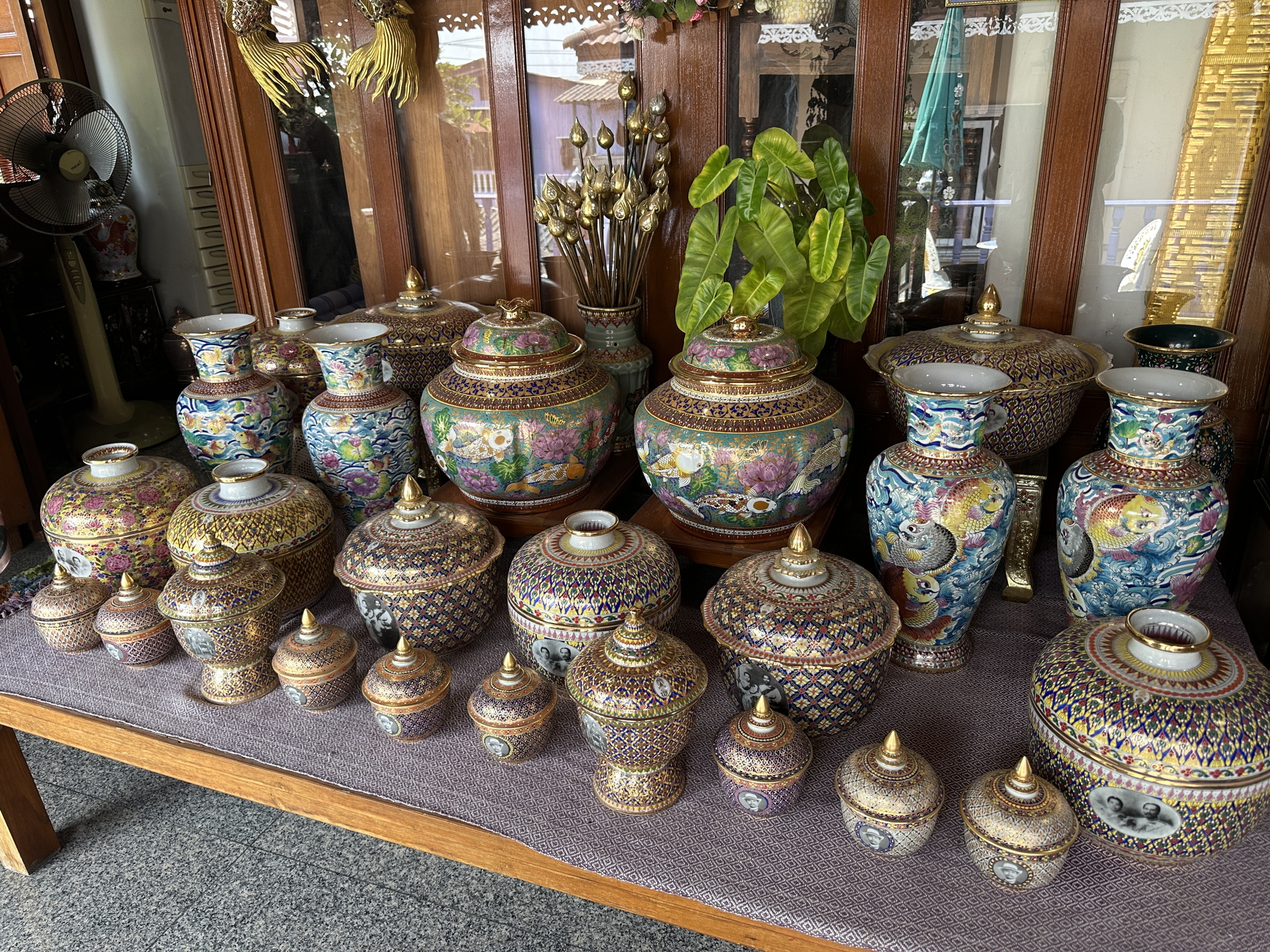
First up, Benjarong. The word is a mashup of Balinese and Sanskrit that means “five colors,” but modern Benjarong can be anywhere from three to eight colors, or more.
Benjarong dates back to Ming Dynasty China, circa 13th century, and was exclusive, in the beginning, to the royal court. It migrated to Thailand about 600 years ago when a Chinese princess married into Siamese royalty. The technique is notable because it gets kiln-fired after every color, an incredibly labor intensive approach that pops the colors and gives the surface depth. It’s a rich, sumptuous effect. And if you sense more than a whiff of chinoiserie in the designs, that’s its geographic origins leaking through.
The Benjarong Porcelain Village, Don Kai Dee, is about 1:15 west of Bangkok by car. Except that there’s no way for tourists to get there, which is baffling. It’s not on any tours, and while you can take public transit part of the way, you’re finding a tuktuk for the last bit, making it about 3 hours each way. You could rent a car, but how many tourists are doing either of those things? Way too much friction.
There are shops in Bangkok that have some Benjarong, but there’s a whole fucking village producing it well within tour range. Why isn’t it promoted and easy to get to? The place was deserted while I was there. There were three other people: a farang with a Thai wife and her mother. They’d driven there in their car. I had to suborn a Grab driver to work off app in order to get there. It’s just crazy. This is serious Thai cultural heritage, and it’s treated like a state secret.
But I am brave and intrepid, so I got to go. And you get to ride along.


Benjarong comes in three design patterns: geometric/floral, figurative, and portraiture. I’ll sorta apologize for how many pictures there are of this stuff, but the breadth of the designs was wild. Maybe it was confirmation bias because my rent-a-driver cost $65, but I thought this stuff was the bomb.


I was most attracted to the florals and geometrics. The figurative stuff, although undeniably awesome, had too strong a chinoiserie flavor for my taste.


There were even a handful of practical items. Not that bowls aren’t practical.


I saw exactly two paintings done in Benjarong, and man was I tempted. The only thing holding me back was my uncertainty about how to manage transit home without it getting broken. I would 100% have bought one if I could have imagined that solution.


What actually made it home? It was so hard to choose. I felt Dorothy’s absence keenly. I left with a footed dish, a covered bowl, and *shhh* earrings. Don’t tell her, OK?


San Kamphaeng
The quaint hamlet of San Kamphaeng sits about 25km and 40 minutes west of Chiang Mai. It is known specifically for its cluster of high-end craft shops. And I do mean high-end. These shops epitomized the expensive end of the Thai craft binary. In fact, only a few of them had anything affordable at all. Absolutely beautiful work, but most of it pitched to trust fund babies. Fine. Bring on the hunt.
San Kamphaeng was the tail on a day trip to Wat Doi Suthep, but right outside the temple, even before we left, there was a high-end jade outlet, the Orchid Jade Factory.


In San Kamphaeng itself we stopped at a gemstone jeweler, a lacquerware maker, a silk weaver, and a celadon ceramics shop. All of which were outlandishly expensive. But I was able to find a pretty piece of affordable lacquerware and a nice celadon bowl. I am brave, intrepid hunter.
This is the hall of ridiculous gemstones. I asked about a pair of earrings with the smallest possible jadeite stones I saw: $460.

Next up, the lacquerware. During the demonstration she kept taking a lighter to the finished lacquerware, to prove… that you could take a lighter to the finished lacquerware? Sadly, they wouldn’t let me take pictures in the shop.


My purchase.


Then we went to a Thai silk maker. They raised their own silkworms and fed them mulberry leaves, which is where the classic Thai golden silk comes from. I’d never actually seen the silk thread being extracted from the cocoons, so that was pretty cool.


The final stop in San Kamphaeng was Baan Celadon, another fully vertical enterprise.


Thankfully, no restrictions on photography in the shop.


Clothing
I think I’ve been comfortable buying clothing for myself because I haven’t had to triangulate with Dorothy’s exceptional taste. I kept looking at stuff saying, “Well, I think that’s swell, but what would someone with taste and discretion be attracted to?” That’s a sucker’s game, but I didn’t have to play it shopping for my own clothes. Dorothy already knows I’m immune to the eyebrow, and she’s resigned to being seen in public with me no matter what I’m wearing. Bless her soul.
The Terminal 21 mall, just a few minutes walk from my Bangkok condo, was a treasure box. Each floor was themed to a location, and for some random reason the London floor was all independent menswear shops. It was easy for me stop in after dinner and find another shop I’d somehow missed on previous visits. Then it wasn’t, which was OK, because Chiang Mai.

This is the front of an embroidered shirt and shorts. 
My first Terminal 21 visit was after my cannabis-infused massage, so I was still high. 
But I stand by these purchases. Here’s the back. 

And a lovely, lightweight knit shirt. Still London, but a different shop. 

A delightful seersucker I found on my second visit. 
This was a London shop called Kwanyo, which specialized in embroidery. 


I went home with this, because bunnies. 
Here’s a few things I picked up on the Chiang Mai portion of the itinerary.


From a random street vendor. 
The same image of Hanuman is front and back, but the front uses some crazy kind of dimensional ink. 
From my day trip to the Mae Chaem weaving village. 

I couldn’t decide whether this was awesome or cringe, so I sent the picture to Dorothy, who pronounced it both awesome and cringe. Sadly, then, not for me. 
The 200฿ pants I was forced to buy at a temple because my knees were offensive to Buddha. Which, tbh, I kind of get.
Textiles
Not a one of you will be surprised that the big win in Thai crafts is textiles. Every country we’ve visited in Southeast Asia has specialized in some kind of hyperlocal weaving technique that, on close inspection, boggles the mind, and Thailand is no exception.
I’d intended to cover textiles in this post, but I think this has gone on long enough. You can find the textiles post here. After you’ve had a chance to recover from this post.