Swimming The South China Sea
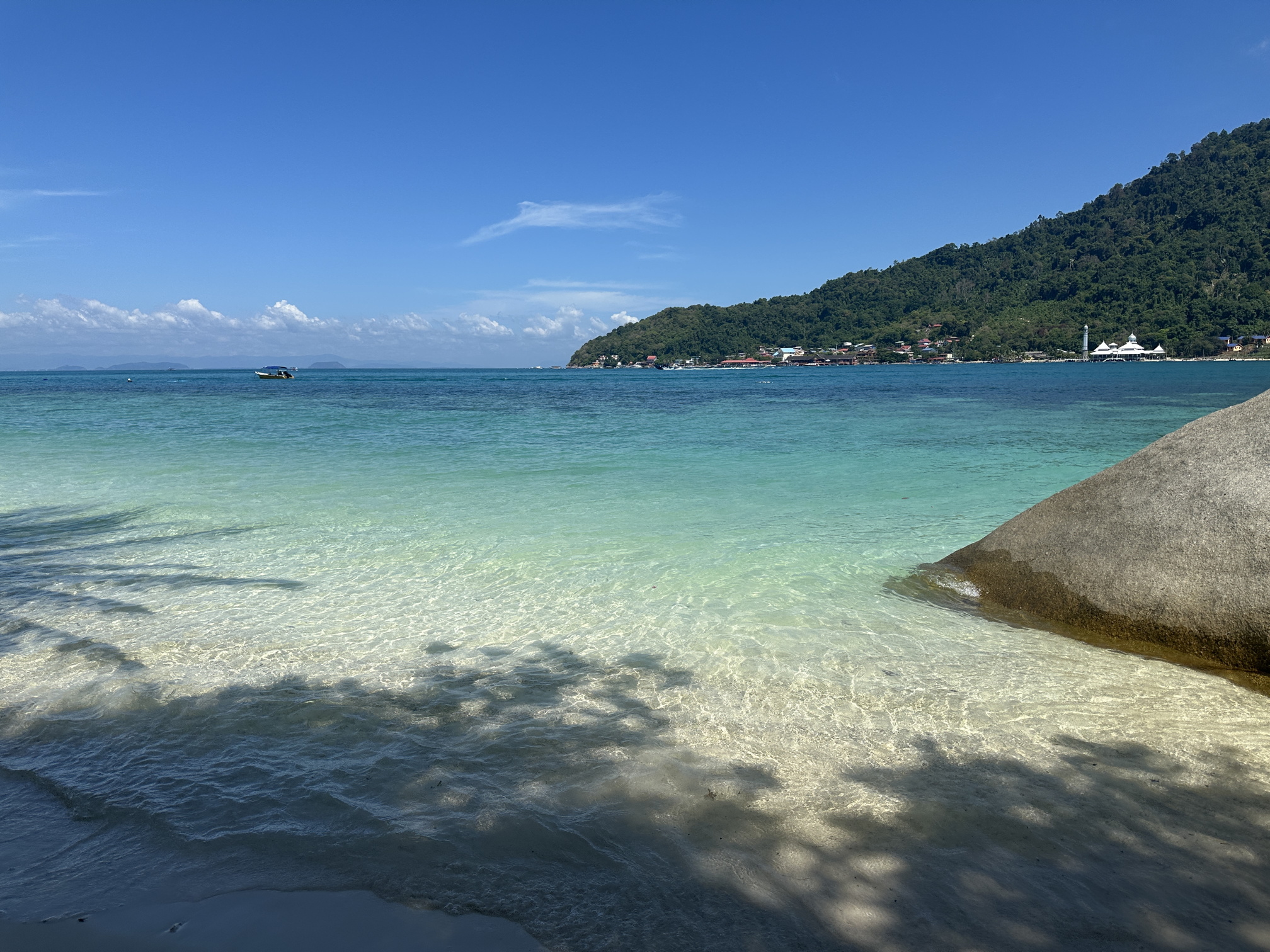
Pools don’t count. Don’t get me wrong, pools matter, but they don’t count. I’ve arranged pools at every Airbnb it was possible to do so and they have been essential, used daily, at least. Always pools, if it can be arranged.
Lakes can count, under the right circumstances. But islands are the gold standard, surrounded, as they tend to be, by oceans. We try, at least once per country visited, to spend at least a week (or a month – looking at you, Bali) body-of-water adjacent. Bobbing in a pool is lovely, but it doesn’t hold a candle to bobbing in the ocean. We are committed, unapologetic bobbers.

Which is what makes my current location, George Town, such a disappointment. George Town is on an island, Penang, which doesn’t, between sewage and fatal jellyfish, have a single swimmable beach. Unacceptable! It’s the reason I find myself on Pulau (island) Perhentian Besar (big). Big Perhentian Island, not to be confused with Pulau Perhentian Kecil, Small Perhentian Island.
But here’s the thing about the island and beach trips. They are incredibly fun to do, but not, I think, of particular interest to read about. They feature pictures of beaches, pictures of sunsets, and pictures of fish. The only practical purpose they serve is to make you feel bad that you’re not bobbing in the bathtub-warm waters of a tropical island, like me. And while your envy keeps me warm at night (that, and the tropical weather), I don’t honestly think there’s much in it for you.
So I’ll follow the classical form here, and give you pictures of beaches, sunsets, tropical islands, and fish. It’s the template, and who am I to rail against the constraints of my cage? But most of this post is about AI.
I know, right? Way more excitement than you were expecting. Why? Because as a blogger I am an honorary pundit (the hazing ritual is harsh), and haven’t yet provided my hot take on AI. The Guild contacted me, and they’re not happy. But why here, in a post about tropical bobbing? Because, in a first on our travels, AI brought me to my current location. I am in Pulau Perhentian Besar at all thanks to Google Gemini.

But first, dessert.
After my toe injury, I wasn’t certain a beach junket was actually wise. With my Jiminy Cricket in Chicago, I’d have to navigate avoiding sepsis on my own. I went back to the clinic that had originally treated the wound, but I showed up just as they closed for a long lunch break. I had a scab on my toe still, but it wasn’t swollen or tender to the touch any longer, and I’d scheduled my trip for two full weeks post-incident. It would be fine. I’d be fine. Everything would be fine. So, unburdened by either common sense or knowledge, I took off.
Getting to Pulau Perhentian Besar was a multi-step process. First, fly from George Town to Kota Bharu, on the eastern side of Malaysia. From Khota Baru, a taxi trip of over an hour to the Kuala Besut Jetty. From there a speedboat, which made multiple stops before depositing me at a jetty that led directly to my hotel, The Barat Perhentian Beach Resort.


The Barat is a classically shabby/chic resort. I’m a budget traveler, so I didn’t spring for an ocean view room, which seemed unnecessary. I am 60 seconds from my door to the beach. What I didn’t realize is that those rooms also come with en suite bathrooms. I have my own dedicated bathroom, but it’s a separate room down a hallway.


And exactly what treats does the Barat offer? Bobbing, snorkeling, and hiking. Eating, at the overpriced restaurant. There’s a little strip of resorts all next to one another, so if I tire of the Barat’s overpriced meals, I have other places to get the same overpriced rice-noodles-pizza-sandwiches. To be fair, it’s an island. Everything here arrives by boat, so it shouldn’t be cheap. But it adds up. I’m spending about $35 daily on meals, since there are no non-restaurant options. I’m only here for five days, but I still cringe whenever I settle my bill.
I forgot gaze. I’m on a tropical island, so gazing is also a major activity.


Fun With Wildlife
At one point I swam (OK, walked in shallow water) too close to the rock this pair of black-naped terns called home.

They seemed offended by my presence, and were happy to make certain I understood their feelings. I loved that they didn’t scream until they were right at my head.
In addition to the two bad terns, Barat’s beach offered one very aggressive fish. Territorial like the terns, this pushy little bastard headbutted my calves whenever I ventured onto his lawn. At first I thought it was driftwood, but I never saw any driftwood, and the impact was way more forceful and intentional than something just floating into me. It only occurred in this one spot, and it was a surprisingly creepy sensation. I screamed like a little girl every time. Although it tended to strike from behind, the coward, I did see it once launch a frontal attack to the shin. The hissing gave it away.
Light My Fire
I wasn’t expecting any sort of entertainment, but they offered an evening fire dance performance on the beach. I think it’s required by custom, if not law. It had a very DIY, this-whole-thing-could-blow-at-any-moment vibe. Like maybe I shouldn’t feel deeply attached to my eyebrows. They didn’t seem deeply attached to their pants.
I especially admired the casual smoking while fuel was decanted from one vessel to another. I mean, they were eventually going to light them, but still. I felt… exposed. The whole thing bespoke an exceptionally low TLI (Tort Lawyer Index, calculated as TLs/hectare).


I wasn’t expecting crowd work, but there’s your low TLI at work again.
Truthfully, this was way more entertaining than it had any right to be. And I’m sure their safety protocols were impeccable. What could possibly go wrong?
Snorkeling!
I signed up for a morning trip, 10:00 – 1:00, that stopped at four locations. We’ve been snorkeling a fair amount, so I don’t want to be jaded about it, but it was… OK. I mean, I was snorkeling a Malaysian island in the South China Sea, so it’s hard to complain. It’s like sex. As a general rule, bad sex is still better than no sex, and so it is with snorkeling. This wasn’t even bad snorkeling. It just wasn’t particularly distinguished snorkeling.
It starts, as all good stories do, with beautiful views from the boat.


The first stop was Rawa Island, which produced no good underwater photos, but did provide a classic white sand beach and water so turquoise it made my teeth ache.

Next stop, Tokong Burung, the Temple of Birds.

This offered up some underwater goodness.


Tokong Burung also provided one of the day’s highlights, this beautiful stingray.
Stop #3 was Serenggeh Island which provided the day’s absolute peak, another close encounter with wildlife.
I’d found a broken plastic bottle sitting on the sea floor, so I dove down and retrieved it, like a good boy. What I failed to grasp is that I’d seemed to have taken a key piece, if not the only piece, of Moon Wrasse enrichment infrastructure. As I swam with the bottle in one hand, I was approached by a horde (that’s the collective noun, look it up) of Moon Wrasse, nosing around me much closer than fish are generally prone, to see what I was up to with their toy.
I was very tempted to let go and let it sink back to the bottom, but I just had to play White Savior to those poor, benighted fish, who couldn’t possibly have known what was in their own best interest. Thank goodness I was there to save them from themselves. They will speak of this day, and their encounter with the Great White, to their grandfry.
Although the Moon Wrasse were the standouts, and are kind of my favorite fish anyway, there were other fishes of note.


Parrotfish. Allies, amiright?
The final stop was Nemo Reef. No one calls them clownfish anymore, they’re all Nemo fish. Although truthfully, they may prefer that. Clownfish seems a little disrespectful.
One of my boatmates claimed to have seen a clownfish here, but his photo fell short of dispositive. Myself, not even a hint. I’m not sure our guides even know what one looks like. I think I only swam for about 15 minutes here. Last of four stops and feeling those years. But more pretty turquoise water.

The day left me with an imponderable to ponder: Why are there so many different brands of fish? Why isn’t there just one fish, or maybe a handful at most?
I get why there’s lots of land animals. Different habitats, different diets, different ecological needs. All that creates diversity. But fish all live in the same ocean. OK, maybe a little warmer here, a little cooler there. I know that’s reductionist. Some fish thrive at different depths and different temperatures, and their morphology expresses that. Freshwater fish are often in bounded environments, leading to differentiation in the aquatic equivalent of Madagascar.
But there’s a ridiculous profusion of fish on the shores of this one island, all different shapes, sizes, and colors. All sharing the identical biome and all eating pretty much the same stuff. Why not just one fish here? What drives species differentiation in a common ecological environment?
I know it sounds like I’ve taken a blow to the head, but I’m kind of serious. I don’t normally assign homework, but please fill the comments below with cogent explanations. I could ask Google, but you’re more fun.
Tuna Bay
A theoretical short walk north from the Barat is Tuna Bay, which purports to have coral and fish accessible from its beach without needing a boat. We’d had a walk-in reef experience in Bali, so I was very excited to walk to Tuna Bay and see what was on offer.
I headed north up the beach and found this:


There was another sign that identified this as a “Jungle Trek.” That felt more accurate than the sign that promised it was 15 minutes to Tuna Bay. Because those were the last signs on the hike (path is definitely the wrong word), and the only way you could do it in 15 minutes is if you already knew the route well. Even then, once you were out of the jungle and back on the beach, Tuna Bay was another 10-15 minutes further north.


Was I on the path? Off the path? I deduced at one point that I was off the path because I was pushing my way through nettles that left me bloody, and that just didn’t scream path to me. I finally burst through the jungle to the beach, and was rewarded.

This lovely, secluded cove was still short of Tuna Bay, but I didn’t know that when the jungle finally released me, and the pull of warm ocean water made me forget all about what salt in my wounds would feel like.
I did trek the final mile to Tuna Bay, and there was some coral and some fish. Nothing like Jemeluk Bay in Bali, and well short of the previous day’s underwater extravaganza. I didn’t even bother taking pictures.
The trek back was, if anything, worse than getting there. I followed the signs at the head of the trail and wound up at a dead-end. I circled back to the closest resort and found someone to help. He explained that a tree had fallen across the trail so there was now another, unmarked, entrance to the path. He brought me to the entrance and waved his arm in a compound curve to mimic the direction the path would take.
It’s a good thing he did, because the official path took me to the same dead-end I’d been able to reach from the blocked path. If I hadn’t known to look in the direction of his arm motion I would never have seen the little sub-path forking off to the right, which put me back properly on the trail. I noticed that path mere seconds before I intended to just sit down in the jungle and cry. Good timing!
I stuck with the beach at Barat after that. Right at my feet, and very little bleeding required. The wildlife was a little pushy, but nothing I couldn’t handle.
Revolution #9
What’s the Escape Velocity brand? “Overpromise and underdeliver™.” Because I don’t truly have a hot take on AI. To the extent that I have a take at all, I think that there’s an AI investment bubble but not an AI technology bubble. That’s a warm take, at best. Lukewarm, even. Tepid.
One of the things I’ve read that the various AI bots excel at is travel planning. Which just happens to be the most onerous part of our journey. Discounting, of course, learning to butcher a different language at every stop.
The actual practical logistics aren’t that complicated. Once you know where you’re going from where you are, it’s not rocket science to determine the optimal method to get there. A quick stop at Rome2Rio usually answers that question, with a follow-up visit to Skyscanner if air travel is involved. What’s truly complicated is determining where to go in the first place, and secondarily where to stay once we’re there. That’s where I figured AI might provide a boost.
The inability to swim on Penang was the driver. I knew that Langkawi Island was a nearby resort island, and that the best snorkeling in the area was at Pulau Payar Marine Park, in between Penang and Langkawi. I couldn’t find any tours to the Marine Park leaving from Penang, so I figured I’d have to spend a few days on Langkawi in order to get my beach and snorkeling fix. How sad.

I told Google Gemini (a.k.a. Google AI Mode) that I was on Penang, that I wanted to spend a few days on Langkawi so that I could take a day trip to the Marine Park, and that when I wasn’t doing that I wanted to be able to walk from my lodgings directly into the water. How should I get there and where should I stay?
Gemini suggested two specific beach communities that met my criteria and from which I could get to the boat to Pulau Payar, and offered up links to several tour operators. I pointed out that the dock was a good 30 minute drive from the beach communities that had been suggested, and asked if there were any beaches that met my criteria closer to the dock.
That served up a detailed description of the coast around the boat dock, and a firm recommendation that the 30 minute Grab ride was a perfectly reasonable price to pay for the beach stay I craved. I checked one of the tour sites, which said that the Marine Park was closed right now. I went back to Gemini and specifically asked whether Palau Payar was open, and it confessed that it was closed for annual maintenance until the end of the month. First mistake.
It asked if I wanted recommendations on specific hotels at the beaches it had suggested, and I told it that I was still thinking about whether it was worth going to Langkawi if there was no snorkeling available. That produced a detailed list of the pros and cons of going, including a breakdown of all the other activities available besides snorkeling. It followed by asking if I wanted recommendations to other excellent snorkeling sites, like the Perhentian Islands. That was the kind of proactive suggestion I hadn’t been expecting.
I even asked it, since my dates were fungible, if there was any savings to be had by sliding the dates around. I got back a detailed analysis of the seasonal pricing policies for flights, boats, and lodging, and a net out that it didn’t make any difference at all.
It then offered me the ideal way to get to Perhentian, and detailed, to-the-minute logistics. It was a multi-stop process: Grab to airport, flight to Kota Bharu, Grab to Kuala Besut Jetty, speedboat to Pulau Perhentian Besar. It provided logistics in both directions, flight numbers, and precise timing for each of the steps. It even told me how long I’d have for lunch at the jetty before my boat left.
And it was correct to the minute. I stepped off the speedboat onto the jetty at my resort at precisely when it said I would.
I asked it, since my return boat left the dock at 4:00 and checkout at the Barat was at 10:00, how I should spend the time. It provided hour-by-hour suggestions, along with the info that after checkout I could store my luggage in the locked baggage room the Barat had behind the reception desk and use their public shower, so there was no reason I couldn’t swim as part of my post-checkout activities. That intel was incredibly specific and 100% correct.
The only mistakes it made were not flagging the Marine Park as closed until I specifically asked, and some of the pricing. Flights and rooms were slightly more than Gemini had suggested. Which is hardly a surprise, given the current volatility in energy prices. But everything else, down to the level of detail of the specific government access fees and which ones took cash vs. credit card, was completely accurate. While I came to Gemini more for directional guidance than detailed logistics, the quality of the logistics information was impressive.
Not only did it point me to a solution I might not have found on my own, or only found after many hours of keyboard pounding, it saved me countless hours of research. I got through in a couple of hours what would have taken me several days unaided, and it did so with a concierge-level of both service and knowledge.
I lightly fact-checked Gemini’s work, but mostly I just put myself in its metaphorical hands to see what would happen. I’d be on the beach no matter what, so the downside risk to the experiment seemed modest. I have to say that I’m more than pleasantly surprised. AI will be an integral part of our travel planning going forward.
Obviously, I hope, I don’t use AI in any way in the writing of the blog itself*. But the successful Gemini experiment made me curious. So I asked it to write a post about indigenous culture in Argentina in the style of Mark Nevelow’s Escape Velocity blog. Which, to my shock, it was able to do.
Not at all well, thank goodness. My day job is safe. But its attempt to recreate my voice, and the textual analysis of my writing that it performed to do so, was fascinating. I’m going to try the same prompt with the other bots and see what happens. That is a whole post of its own.