George Town Of The Jungle
I thought for a change of pace I’d move away from the equator. Since towards worked out so well. You can still wave from George Town, but it’s a solid 370 miles north, almost twice as far as Kuala Lumpur. Which makes it not a degree more temperate. It’s just swampy here.

George Town reminds me a lot of Melaka. It has a very similar history, with immigrants arriving from all over Asia and SEA. The most prominent populations were Indian Tamils and Chinese from across southern China. They settled down and married Malays, creating a unique Peranakan culture. Melaka is a much older city, with Chinese and Indian immigration starting in the 15th century. George Town was founded in 1786 by the British, with immigrants starting to arrive soon after.
George Town was the first British settlement in SEA, and was established as a free port. The absence of any duties or taxes on trade quickly built it into an influential stop on the trade routes connecting India and China. The Peranakan Chinese took full advantage of the business opportunities and accumulated substantial fortunes in their new home. Several of their opulent mansions still stand, and are museums today.
As in Melaka, the streetscape reflects the Peranakan influence, with Chinese-style shophouses the most prominent vernacular architecture. There is still a vibrant Little India in George Town, although its architecture, mixed between shophouses and British colonial buildings, doesn’t reflect any Indian influence. Temples, of course, excepted.


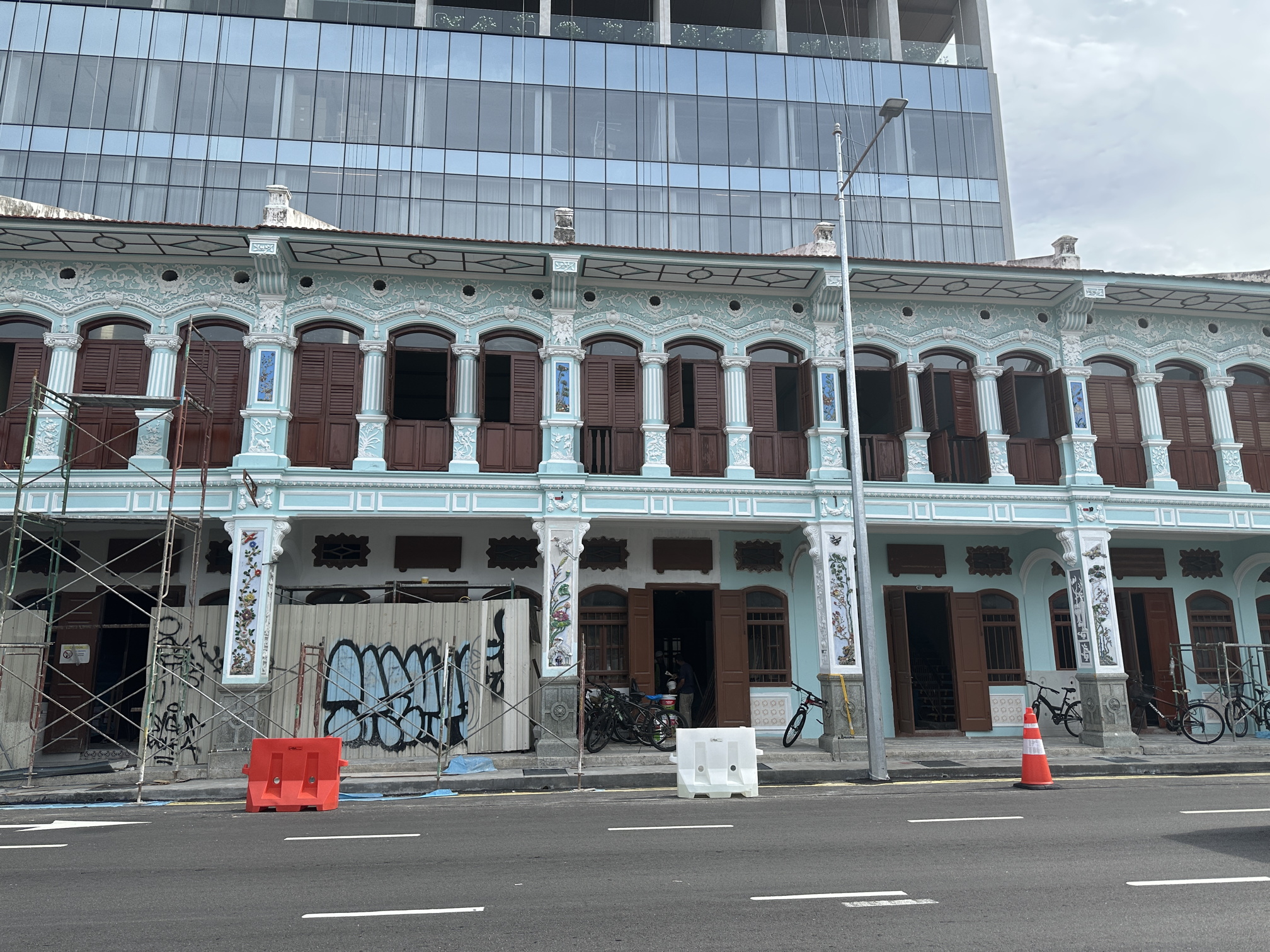
The shophouses are characterized by covered colonnades. 
They’re handy for more than protection from the equatorial sun, as rainstorms are fairly frequent. Except for the corner-to-corner dash, you can stay pretty dry. 
Poe Choo Seah was built in 1902 for Peranakan Chinese in the Straits Eclectic style, smushing together Chinese, European, and Malay architectural elements. 

Also pretty at night.
The biggest difference seems to be scale. George Town feels like Melaka’s big brother. I think it’s that the Portuguese mismanaged Melaka in a way that kept it from growing into the significant trade port it should have been, based on its location, while George Town, fueled by its status as a free port, took off and grew into a major economic engine. The Peranakan mansions are larger, the districts more extensive, the wealth more obvious.
Vietnam shares a border with China on the north, so you’d imagine that’s the place in SEA, at least that we’ve visited, with the strongest Chinese footprint. But that influence primarily manifested in shops. A lot more of the products in northern Vietnamese stores were Chinese imports than in the south.
The Chinese influence in George Town seems much more pervasive. The most visible example is bilingual Chinese/English signage, like the one below. It feels like there’s definitely more signage in Chinese than Malay (for that matter, there may also be more English signage than Malay). That’s because Chinese make up over 51% of George Town’s population, to about 31% Malay and 8% Indian. No wonder George Town feels like the most Chinese place we’ve been.

The Apartment
This is a perfect example of accommodations that are only suitable because I’m alone. It has a kitchenette and a fully equipped bathroom, but it still manages to feel distinctly like a hostel. Perhaps it’s the bunk beds. Perhaps it’s the complete absence of furniture. There are a couple of kitchen cabinets, but there’s no drawers or storage of any kind. I have had to use every clip, magnet, hook, and trick we’ve picked up along the way to unpack and move in.
More likely it’s that the apartment is a generous 6½ feet wide.


There is one feature I genuinely dislike. The front door locks with a button on the inside and a key on the outside, meaning that it’s possible to lock yourself out. Because we’re constantly in different apartments, it’s hard to create a consistent protocol for where things like keys live. We’ve tried to create habits, like hanging the key on the door wherever we are, but sometimes that’s not possible. It’s not possible here, so it requires holding the key in my hand when I leave to make sure I have it.
There’s also a locked door to the apartment’s vestibule, which has a four-digit key code. The very first time I left the apartment I held the key in my hand, like a good boy, exited through the vestibule door, and realized just as it clicked shut that I’d left my phone in the apartment. The phone that held the four-digit code (that I’d only used once and hadn’t yet memorized) that would unlock the vestibule door, allowing me to use the key in my hand to open the apartment door and retrieve my phone.
Fuck.
Nothing like a good panic to start the day. I was in luck, because the business on the first floor had the number for the residential operator and they were able to call him and get the code. Which, even though I’ve memorized it now and I hold my phone in my hand with the key when I leave, is written on a scrap of paper in my pocket. Analog backup.
The apartment is fine. But home is starting to exert some noticeable gravitational pull at this point.
The Neighborhood
The apartment doesn’t really matter all that much, because I’m staying right in the UNESCO World Heritage Zone in George Town, and it’s delightful. There’s another tourist-friendly area here north of George Town, Batu Ferringhi, which is known for its beaches. Except between the sewage churned up by storms and the various brands of jellyfish, including the Box Jellyfish, charmingly known for its fatal sting, there isn’t a swimmable beach anywhere on the island of Penang. Batu Ferringhi is great, I guess, if you both love the ocean and have no desire to actually get in it. Seems like a Venn intersection that should be pretty empty.
The neighborhood also offers the typical SEA welter of massage shops and nail salons. I love that when I sat down for a pedicure, the response was, “Well, this looks like a two-person job.” Four hands pedicures. I’m going to miss SEA.


Dining
My apartment is on Beach Street (Lebuh Pantai), renowned as the best eating street in a city famed for its cuisine. Ground Zero for dining out. In addition to the restaurants, this is a very dessert-forward culture. You’d think that would be true everywhere, but it’s not. Some places just don’t do dessert. Philistines. Beach Street, and all of the UNESCO part of George Town, is stuffed full with patisseries, boulangeries, gelaterias, and artisanal ice cream shops.

Dangerously, this is right across the street from my apartment. 
This is four doors down on my side of the street. 
When you order they custom fill the donut with cream, in this case lemon custard, and add the topping, in this case lemon zest. 
Not that anyone would want an Unhappy Waffle Stick, but where would you even find one? Not here.
But this is my absolute favorite, also on my block. This gets my vote for the most passive-aggressive business name ever.

You’ll note that they spelled all of the other French words correctly: Boulangerie, Bienvenue, Chez. Kwason is entirely intentional. “We shall take your recipes and shit on your language. Take that, Frenchies!” It’s especially chilling paired with the massive kwason effigy over the sign. Surely meant as a warning.
Beach Street also features a bevy of durian shops, multiples per block. Durian is popular all throughout SEA, but it seems like the national flower in Malaysia. I almost can’t smell it anymore.

This was the line to get into Durian Valley, which often stretched from the mid-block doors to the corner. 
It seemed odd, because the other durian shops on the block were deserted. On the other hand, I remember the roti shop in KL that always had long lines. I didn’t understand until I went to a roti stall with no line. It’s a mistake I only made once.

The one thing the dining scene doesn’t really offer here is cocktail culture. It’s not that there are no cocktail bars. There are a few. But because of the government’s confiscatory alcohol taxes, they are outrageously expensive. I’ve been clean for most of this tour, which is not a massive hardship, but I thought a drink after dinner would be nice one evening.
I stopped at a bar called Nomad. Cocktails were priced at 50 ringgit, almost $13 USD. I opted for a shot of bourbon, figuring that would be cheaper. Plus, their cocktails all seemed tropically sweet. My carefully measured one ounce pour was 42rm. And that was my one drink in Malaysia.
Jalan Kek Chuan
Still within easy walking distance is Jalan Kek Chuan, voted by some random magazine as one of the most beautiful streets in the world. So that’s worth checking out.


I mean, yeah, I guess. If I’d walked down it unbeknownst I’d have thought, “Cute.” I would not have thought, “Holy shit, that is one of the world’s most beautiful streets.” Not to be a dick about it, but it’s a one-block stretch of well preserved, nicely painted shophouses. The paint is doing all the heavy lifting.
Shopping
I’m in an excellent location for shopping, in all of its various manifestations. There are convenience stores scattered all about and a hypermarché about a fifteen minute walk. Provisioning is super easy.
Armenian Street
The primary tourist street, Armenian Street, is all of two blocks away, not that it offers much of interest. It’s exactly what you’d expect from the description, and no different than any other tourist street in SEA. Great if you’re looking for souvenirs (I’m not), useless if you’re looking for art (I am).


Pasar Chowrasta
There are two large covered markets within easy walking distance of my apartment. One, Pasar Chowrasta, dates back to 1890, and is the primary produce and wet market for locals. Even if I’m not shopping there, I love these markets to death. They’re colorful and vibrant and full of, well, it’s almost impossible to tell what they’re full of. Shit you’ve never seen before.


Penang Bazaar
The other market, Penang Bazaar, is more clothes and products. Tourists show up, but, like Pasar Chowrasta, this is primarily for locals.


Macallum Street Night Market
Night markets, at least those I’ve seen in SEA, are outstanding places to learn and sample the full range of local cuisine, but otherwise not good for shopping. The Macallum Street Night Market followed that pattern. It was two arms around a street corner vertex, with one arm food and the other arm merchandise. The merchandise was cheap and forgettable. Not a place to find hidden treasures. But the food side delivered big time.


Crafts & Clothes
The crafts action in Malaysia is clearly all in Borneo. Kuala Lumpur has the benefit of being a capital city, so at least it had shops that curated from across the country. The crafts scene in George Town is quite a bit more modest.
I think that’s a result of George Town’s history. The city was created from whole cloth as a mercantile center, so there was never a lineage of indigenous culture and crafts here to carry on. I’m not claiming the island was uninhabited, but George Town wasn’t built over an existing settlement with an extant culture. That, and its prominence as a tourist center, means that most of what passes for craft here is tourist tchotchkes.
I’d say the bulk of the energy that might be directed at traditional crafts in other places is focussed on traditional cooking here. The restaurants that specialize in Peranakan cuisine are filling the same need as crafts traditionalists, preserving an old culture while injecting it with enough modern elements to keep it from ossifying. The food scene here is as rich and diverse as the crafts scene in Borneo.
So there’s this: an owl shop and a cat shop right next door to one another. That’s just bound to end badly.


As far as clothes, they fall into two distinct camps: either showily colorful and batik-adjacent (meaning printed batik-like patterns rather than actual batik), or aggressively neutral, showcasing all the hues of the rainbow, from ecru to taupe.


But the fashionable set, locals or tourists, demands something more refined, more tasteful, something completely leached of terroir, something that could have been made anywhere and says nothing at all about either who made it or who’s wearing it. It’s as if Eileen Fisher had been forced at gunpoint to stop using so damned much color.
It’s an act of perverse will for an entire city in SEA to have settled on a shared aesthetic of meh, like everyone got together and agreed that their colorful cultural heritage was somehow shamefully tribal and should be abjured. I’m all for updating and modernizing traditional crafts, but turning your back on them completely is just wrong. It would be one thing if it was the odd designer or two, but it’s the upper end of fashion throughout George Town.
Swear to god, these are all different shops. And this is hardly all of them. There are more. Many, many more.


Batek-Lah
There was, thankfully, one shining exception to this, a batik shop a mere five minutes walk from my apartment. They carried both yard goods and clothes, with everything handmade locally, nothing manufactured. At this point we’ve seen a lot of batik, but this work stood out both for the quality of the design and the exceptional sense of color. These did not look like any other batiks we’ve seen.


I took pictures and sent them to Dorothy, who agreed they were excellent. Once I determined that there was nowhere else with quality goods, I went back early enough in my day that Dorothy was still awake and we video shopped together, which I just love. I toured her through all of the yardage, and she was able to pick out (I have no idea how, amidst all the bounty) three pieces. I got two meters each, enough for her to make a blouse or skirt.
It is possible that I had a couple of shirts made. It is very hard not to overindulge in SEA textiles. They are delicious. I have gotten fat with pastry and ice cream while my suitcase has gotten fat with shirts and textiles. One of us is more likely to recover than the other.


The Prodigal T-Shirt

This kind of counts, in the sense that it appeared in George Town. But its origin story is Cambodian.
I bought this in Siem Reap, and promptly left it at an Airbnb in Vietnam. I was sad. Very sad. I scoured the interwebs for contact info for the shop, and reached out via email and through their Facebook page. That was in August of 2025.
Eight months later, I got a reply from the owner. She still had some of these, but the Cambodian postal service wasn’t servicing the US because… Jesus, don’t make me say it.
I asked if she could ship to Malaysia, and so she did. It eventually wound up here, although there were some bumps and bruises on the way. At one point the Cambodian tracking showed that the package had been held up in Malaysia due to a force majeure event. I think what they meant to say is that it had been handed over to the Malaysian postal service and they could no longer track it. But sure. Force majeure. Nothing about that description made me nervous.
You will be pleased to know that I am no longer sad. I am now happy.
Craft Batik Factory
This is not in my neighborhood at all. In fact, it’s 24km away on the north shore of Penang, about a fifty minute drive. It’s the largest batik maker on Penang. I sort of wasn’t planning on going, but a few days before leaving to return home I contacted a Grab driver whose number I had and made arrangements. I was packing and repacking to see how well I could distribute weight and protect delicate artifacts and I was a little bored. Plus, I was pretty sure I had a few kilos wiggle room, so why not fill it with batik?

Truly grand in scale. 
But also exceptional quality. 


The largest batik production space we’ve seen so far. 
It was interesting to see the contrast between grand production scale and artisanal results, two things that don’t normally go together. 

You’ll be shocked, shocked to hear that I bought shirts. This one is hand-painted batik. 

This one is a block print, with an unusual for me Mandarin collar. Not generally a fan, but I tried it on and it looked good. I was taken by the almost formal pattern. 
This will truly shock you. I bought a blouse for Dorothy without her input. The timing didn’t work for a video call, but I found this and thought it was adorable. I’m pretty sure this is the first article of clothing I’ve ever bought for her. I hope she doesn’t hate it and feel obligated to tell me she loves it. 
Even more dangerous, I bought her fabric. I know, right. What the fuck was I even thinking? 
The fabric and blouse are surprise homecoming presents, so don’t ruin it by telling her.
Little India
Melaka’s Little India was a several blocks-long stretch, but George Town’s feels like a district, comprising about four very packed square blocks. It’s within the UNESCO zone and less than a ten-minute walk from my apartment. Like Jackson Heights in Queens, it offers anything with a taste of home: food, clothes, jewelry, textiles, Bollywood video stores… Although I don’t think India has been home for these folks for quite some time.


Clan Jetties

The Clan Jetties were built on reclaimed coastline starting in the 1880s. They were originally the entry point for new Chinese immigrants, but gradually became associated with specific clans.
Over time, the jetties were built up with stilt houses used for both residences and clan business. There were originally nine jetties, but two were destroyed for development just prior to UNESCO designating the Jetties as a World Heritage Site in 2008, protecting the area and driving tourism.
Most of the jetties feel primarily residential, to the point that it feels less like walking down a public street and more like hopping a fence into someone’s backyard. Chew Jetty, though, has fully embraced the tourism model, converting quite a few residences into tourist-oriented shops and restaurants.

Chew Jetty features a serious temple on the land side of the jetty. 
It’s interesting to see the Chinese-influenced temples, after all of the Indian-flavored Hindu and Buddhist temples in the rest of SEA. 


Main Street. 
Typical Jetty houses. 

Way more commerce than any of the other Jetties. 
Definitely leaning into tourist retail. 
Even here, a graveyard of taupe. 


Looking back towards land. 
It ends with a restaurant, not a bang.
Them other Jetties.

Lee Jetty featured a welcoming entrance. 
And a substantial temple at its head. 
A typical Jetty residence. 
The Lee Jetty jetty. 
New Jetty’s main drag. 
No New Jetty jetty. It just kind of ends. 
You can see how the buildings are constructed. The brown waters made me wonder how sewage was handled, as this seemed like an infrastructure-light zone. I believe the euphemism direct discharge says it all. 
Tan Jetty’s main street. 
Ending in an actual jetty. 
Yeoh Jetty. You see what I mean about it seeming a little like trespassing.
Street Art
George Town is known for its street art, from official installations to co-opted buildings.

Probably George Town’s most iconic image, installed onto a wall on Armenian Street. 
People line up day and night to feed the Gram. 
It’s slathered on merch everywhere. 


A trompe-l’œil piece so well executed I thought it was a cutout mounted between gates the first two times I passed it. 
It’s just paint! 

This guy’s work was all over. His wrought iron cartoons are all tied to history specific to their locations. 


Blurring the line between street art and signage. Also, just sayin’, but if I did that I’d be trafficking in racial stereotypes. I guess it’s OK if you do it to yourself?
Seen On The Street


Signage
And by their signage shall they be known. One of my very favorite things to do in a new location is find all of the goofy signs and graphic design. It’s consistently high-quality entertainment.

There is an argument to be made that Instagram is not responsible for the collapse of our civilization. It’s just a very stupid argument. 
Nothing to add. Except, I suppose, that I’m grateful it’s gentle. 
I’m not at all sure what a Pork Belly Birthday Cake is, but I’m sad it’s not my birthday. 
“Set ’em up, barkeep. Perms all around, on me!” 
Like Pokémon cards? Another inexplicable Chinese hobby. Like mahjong, or KTV. 
Fine. Then I won’t come in. Jeez. 
This was printed on a bag of kwason. I have to think you’d burn your thighs if you followed these instructions to the letter. 
Honestly? I thought that was the Dutch spelling of House, and felt very stupid after finally getting it. It only took two weeks of passing it daily.