Melaka: It’s More Than Just Gin
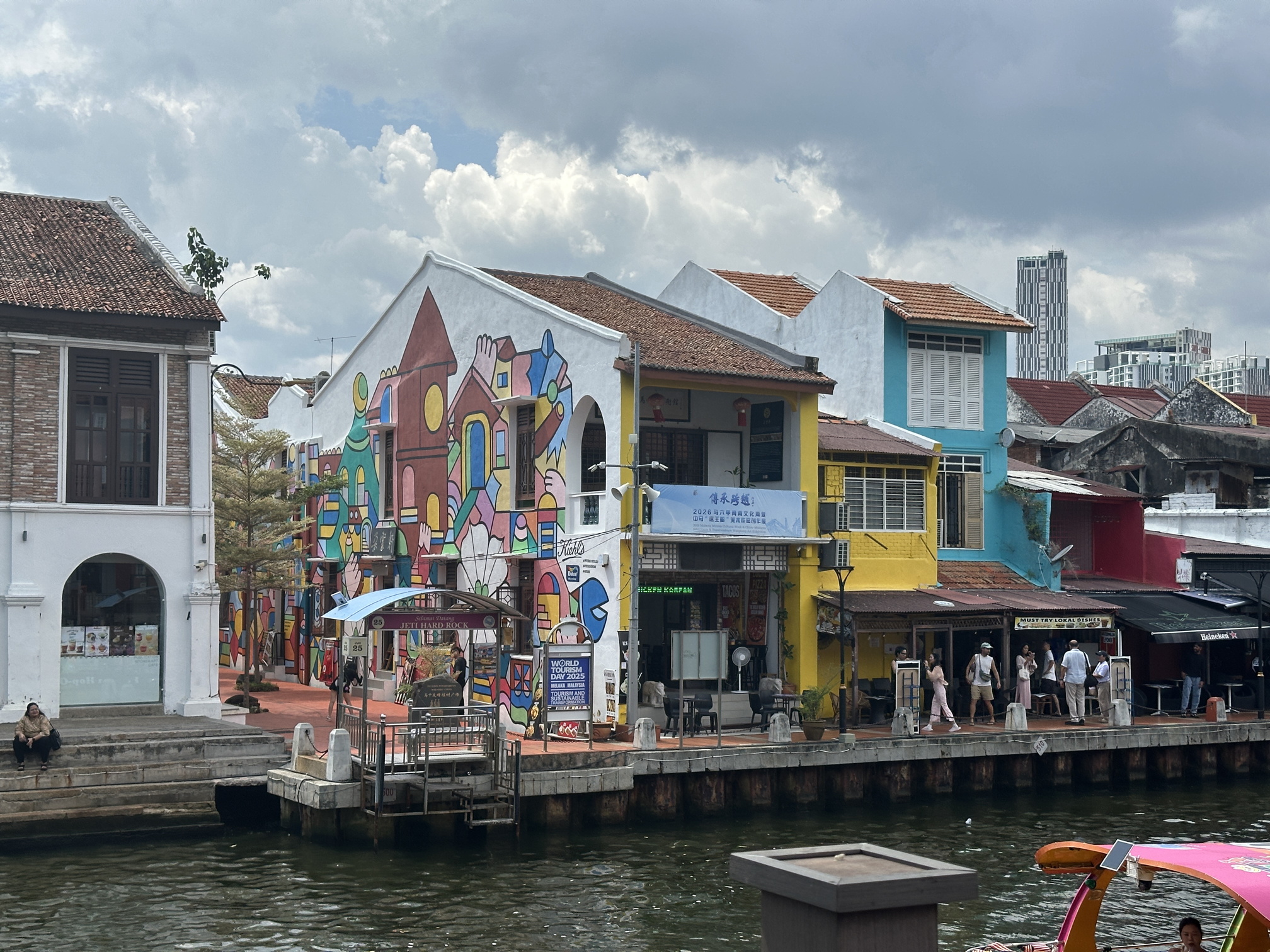
Melaka, or Malacca, as we stubbornly insist on calling it, is a mere two-hour bus ride from KL. As an historically significant site right around the corner, I’d have been foolish to miss it. Also, KL was starting to feel tapped out, so a couple of nights in Melaka wouldn’t cut into my fun.

Melaka was established in about 1400 due to its strategic location at the narrowest part of the Strait of Malacca. In its early years, Melaka was actually a protectorate of China, which shielded it from assault by the other regional powers, allowing it to flourish as a key trade stop, connecting China, India, the Middle East, Africa, and Europe.
You’ve probably already guessed that this arrangement didn’t last. Melaka had built itself up into a target, and the Portuguese, who had no word for consent, heard Yes. They took Melaka in 1511, intending to dominate Asian trading by leveraging Melaka’s critical role. Sadly, that required some competence in execution the Portuguese couldn’t quite muster. Their administrative ineptitude diminished Melaka’s role, allowing trade to be splintered amongst smaller, warring ports.
The Dutch figured they could succeed where the Portuguese failed, and launched a series of attacks on Melaka starting in 1606 and culminating with a Portuguese defeat in 1641. The Dutch held onto it until ceding it to the British in the Anglo-Dutch Treaty of 1824. That lasted until the Japanese took Melaka in 1942. Melaka was part of various Anglo-Malay confederations until 1963, when it joined the now independent and newly named Malaysia.
One of the hallmarks of crossroad cities, from Marrakech to the Silk Road, is that their exposure to traders from other lands leaves a noticeable multicultural footprint behind. Welcoming is the brand that built these cities, the echoes of which still reverberate today.
While the British brought Indians and Chinese to work the plantations during its Malaysian episode, Melaka had a foreign presence practically since its founding. Chinese immigrants in the 15th century married local Malays, creating a unique culture called Peranakan, or Baba-Nyonya, with its own cuisine and unique crafts. The Portuguese also married Malays, creating the Kristang, with its own creole language and cuisine. Tamil traders came in the 15th century and intermarried, creating the Chitty. They adopted Malay language and customs, but insisted on keeping the Hindu faith. There’s a substantial Chinese presence from multiple Chinese ethnic groups, such as the Hokkien, Cantonese, and Hainanese, that didn’t intermarry. And, of course, the colonizers left their usual architectural stylings behind, even if most didn’t stick around for the afterparty.
That’s the backstory that motivated me to visit Melaka. That kind of history tends to leave a delicious residue.
I probably shortchanged Melaka, only giving it a couple of days. With so little time I was only really able to see the historic city center. That gave me access to most of the commonly accepted Places of Interest, but I’m not sure I was able to see anything but the surface. As a result, it was a little disappointing. “Baby, it’s not you, it’s me.”
Chinatown
My hotel was incredibly central, a short walk to all of the key locations. I stayed on Heeren Street, which, with its neighbor one block over, Jonker Street, is the heart of the historic Chinese sector. The area is known for its 17th century shophouses, and Jonker Street hosts a weekend night market. Hey, I was there on a weekend! Don’t knock it. Dumb luck is better than no luck at all.

The old Chinese shophouses. 

The Melaka River. 
Melaka is known for its murals. 

Exactly what it says it is. 
Chicken Rice Balls are a local specialty, made of rice and chicken broth, like a Chinese matzoh ball. I made sure to get a plate, but I think it may be a side dish. The waitress kept suggesting other things to go with it and, truth be told, they were a little meh all on their own. 
Yep. The entire planet. 
My favorite toy I’ve seen recently. So much to love. It’s Small Particle Building Blocks, not Lego. It’s purloined IP. But mostly, it’s laser focused on Development Of Intellectual Stimulation Potential. Raise your hand if you’d like some of that. 
Wow. I’m a little surprised they didn’t call out the Development Of Intellectual Stimulation Potential. It’s practically dripping with it.
Then there was the Jonker Street Night Market. I don’t know. This is month nine for me in SEA over the last year. Maybe I’m over night markets? They’re always crowded, and while I don’t object to people en masse, the shoulder-to-shoulder thing isn’t much fun. The highlight for me is always the food. The night markets always stand out for presenting the range of local cuisine all in one place.
The goods on sale always seem to disappoint, though. They’re a mix of cheap tourist goods and cheap local goods. I don’t know that I’ve seen a single interesting thing, that wasn’t edible, in a night market.
One thing the night market had going for it, as well as Melaka overall, was the relative dearth of mat salleh. Most of the tourists seemed to be from other SEA countries, and I’ll never complain about being one of the few gringos.


The Baba & Nyonya Museum
The Baba & Nyonya Museum is the actual home of a Peranakan family from 1861. Four generations of that family lived there until it was turned into a museum in 1985, which makes this as authentic a museum as is possible. Baba and Nyonya, by the way, are male and female honorifics, and are used together as a synonym for Peranakan.
While there were poor Peranakans, the owners of this house were distinctly upper crust, both socially and financially. The house represents almost a Gilded Age for the Peranakans in Melaka, with rich furnishings, tapestries, and hand-carved wooden furniture. It also raises the thorny epistemological question: Is it chinoiserie if it’s actually Chinese?


I’m not sure which one, but one of these is called The Golden Elixir Of Life, in which a heavenly maiden exchanges the Peach of Immortality for The Golden Elixir of Life. In the essay section below, please explain why you think this is a good or bad trade, and whether you think the Peach of Immortality should have its own emoji. 
If it’s not obvious… 
These are embroidery. 
More ridiculous embroidery. 

One of my children, to be unnamed, is contemplating major lifestyle changes. I was asked, in the event of becoming a grandparent, whether I had a preferred form of address picked out. I had never considered such a thing, and the most obvious answer, Mark, which is, you know, my name, was summarily rejected.
Truthfully, every other known option felt ill fitting at best and stomach-churning at worst. Gramps? Papa? Pop Pop? Pappy? How about The Dead Guy, since any of those other names would be over my dead body? But I think I could make Baba work. That doesn’t curdle. Although if I’m Baba I feel like Dorothy is more Yaga than Nyonya.
Crafts
There’s always shopping, amiright? Thankfully, all of the interesting shops were within a 5-10 minute walking radius. The shops along Jonker Street were definitely tourist focused, to the point where it was hard to figure out if Melaka had any craft traditions of its own, distinct from the rest of Malaysia. Whose primary craft traditions seemed to center on tote bags and refrigerator magnets.
One shop I found was a generations-old cobbler. His grandfather had made foot binding shoes for the Chinese gentry, but he was the last in the line, as foot binding was outlawed in Malaysia in about 1912, following China’s lead. But his grandson still has all of the old patterns, and makes the shoes now as artifacts.


The only other crafts I saw that had any Melaka terroir, and weren’t simply tourist gimcracks, were Peranakan beaded shoes and embroidered dresses for Nyonyas.


The highlight, as it turned out, was right across the street from my hotel: Mr. Joe’s Jewelry. It was contemporary design, nothing even vaguely traditional about it, with a specialty in stones and minerals. It is possible that I bought as much as I did because it was air conditioned. Mostly it’s that, while I can’t buy clothing for Dorothy in her absence, I have a passable track record with jewelry. The work was also objectively swell.

In addition to more traditional stones and minerals, they specialized in fossilized coral. Really beautiful pieces. 
Fossilized coral rings. 
And earrings. 
Also beautiful Mother of Pearl rings. 
I thought some of the findings were a little aggressive. The materials were so beautiful, I felt like the findings should get out of the way and just show them off. 
Also, cool fossils. The long black ones are orthocone nautiloids, the precursor to modern nautiloids, before they curled in on themselves. 
Some clever cloisonné. 
I got a pair of rings for myself and two pair of earrings and a pendant for Dorothy. But listen, the jewelry is a surprise. She doesn’t read the blog, so don’t spill the beans. OK?
Dutch Square
Also called Red Square, but not in a Commie sense. In a paint sense. The Dutch built the primary structures in the Square, Christ Church and the Stadthuys (State House). In an unsurprisingly arrogant attempt to impose their will on nature, they painted them white. Stained red from muddy rainwater and peasants spitting betel nut juice on the walls (hmm…), the British finally conceded in the early 1900s and just painted them fucking red. And thus was an icon born.

Nothing says equatorial jungle like Dutch Colonial architecture. Which is, sadly, kind of true. 

Pengisytiharan Kemerdekaan, the Proclamation of Independence Memorial. 
One of the four gateways into the Portuguese fortress A Famosa. 
When I first saw this observation tower right off the square I assumed that the central shaft was an elevator. Then I saw it descend and realized that the entire observation deck was the elevator. 
It’s not a real city unless there’s a Hard Rock Cafe. Take that, Paris.
The Square’s other main attraction was these trishaws. What you can’t see in the pictures is that each of them had a boombox strapped to its back, pumping out overamped Malaysian pop. That wasn’t ideal, much, I imagine, like being a BB in a can, but I could not get enough of the trishaws themselves. If you can’t tell from the pictures, these are basically bicycles with elaborately coiffed sidecars bolted on.


The trishaws are human-powered, which just seems wrong in the equatorial heat. I saw one poor bastard off the bike, pushing it up an incline, the sidecar fully loaded with a family of five. Whatever the amount, they did not tip him enough.
Little India
I had high hopes when I learned that there was a Little India neighborhood. But rather than a hotbed of vernacular architecture and Buddhist or Hindu temples, it was just an Indian neighborhood. Not unlike Jackson Heights in Queens. Not uninteresting, but it fell short of my imagined expectations.


Kampung Morten
Kampung Morten is a traditional Malay village in the middle of Melaka, designated a Heritage Village by the Malaysian government. For reasons unclear, it was named after a British tax collector. At least when I visited, it was just a bunch of houses of similar design, with Christ Church red roofs. There were no museums, displays, people, or information. Maybe technically a village, but practically a neighborhood. At least it wasn’t a long walk.

And that’s Melaka. Was there more to take away if I’d been there longer? Sure. Maybe. I dunno. But it was certainly an enjoyable interlude, and I can check Meleka off of my International Travel Bingo card. I’ve been to Melaka and you haven’t. No complaints.