KL Krafts
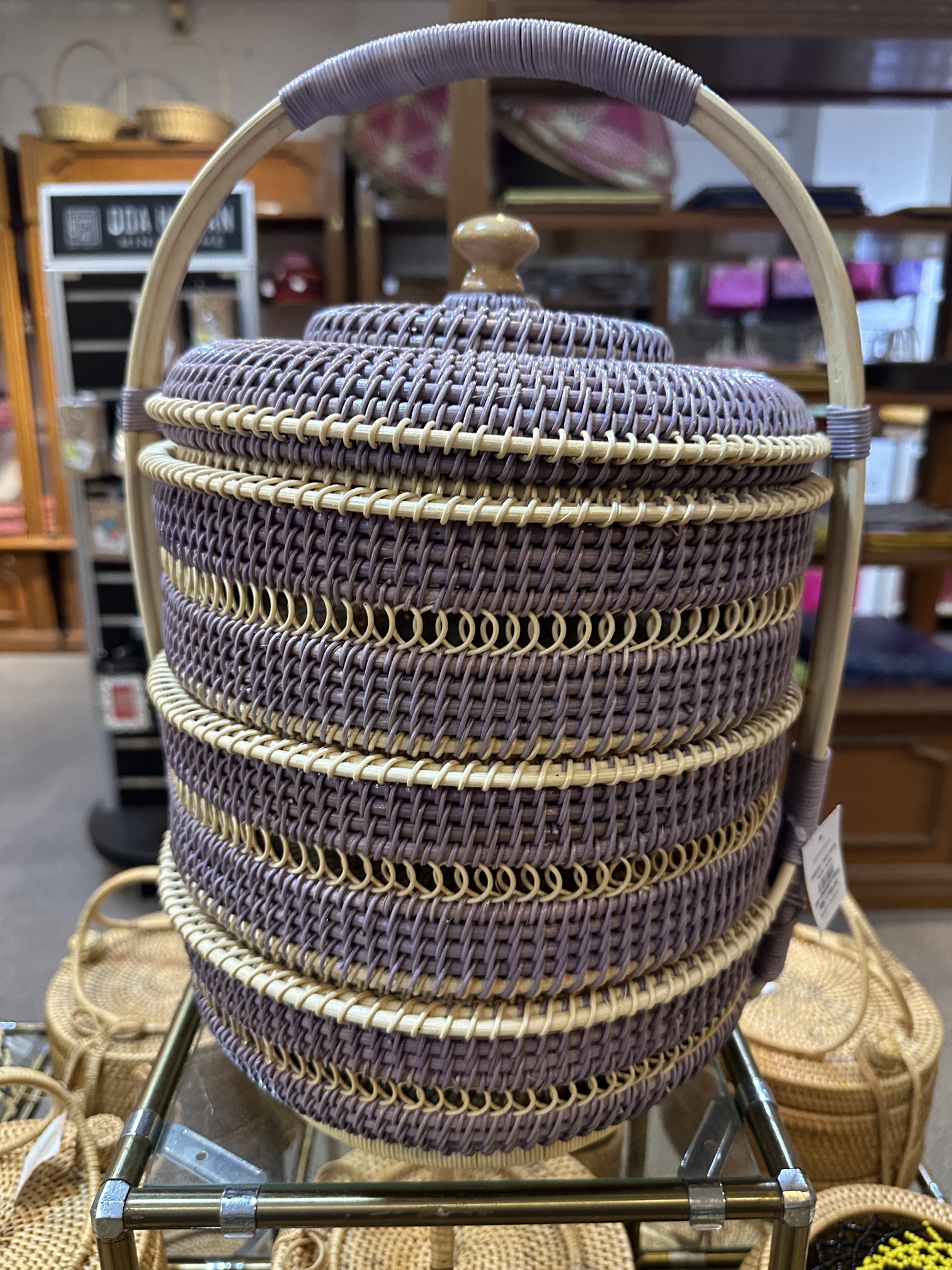
Kuala Lumpur’s craft scene functions like in most other capitol cities: it aggregates a Best Of selection from across the country into museums and specialty boutiques, but it’s not a place where craft happens. At best it can point to a tradition, or even individual artisans, that it’s possible to learn more about and, ideally, track down.
KL offered a couple of craft malls, an outstanding batik maker, and an excellent museum. But, as expected, the real action was elsewhere, where craft traditions are a lived part of daily life. In other words, Borneo.
Central Market
Central Market, despite its name’s connotations, is exclusively a crafts bazaar, with a second floor emphasis on batiks. This is considered the go-to market for crafts in KL. I love nothing more than a good crafts mall, a place that digs deeper than refrigerator magnets and keychains, and Central Market delivered.


This place, which sold Turkish imports. 
Nice pieces, to be sure, but weird. 
The lacquered coconuts are a little touristy, but not awful. We own several from Vietnam. They’re kind of cool. 
And this place, which makes pet clothes. 
Hard to get enough. 
Made me want a cat again, just so I could humiliate it. 
I don’t think it’s working. Not fat shaming, just saying.
As promised, the second floor delivered batiks, wovens, embroidered goods, and readymade clothes.


Kompleks Kraf
A larger physical complex than Central Market, but with dramatically fewer vendors. The emphasis here was on the experience, so there were multiple huts where you could make your own batik or make your own batik. The full range.
I get those, but I also kind of don’t understand why you’d want to go home with an artifact that represents all of the skills you could learn in a couple of hours rather than the work of a master who’d devoted a lifetime to his or her craft. Nothing comes out of those “experiences” but handprint ashtrays. To each their own.
But the setting was beautiful, and there were cats. A win all around.


There were also a couple of large shops with truly outstanding examples. None of which, of course, were local. Every time I saw something juicy, it was from Borneo. All signs point to the Sarawak excursion as my prime Malaysian looting opportunity.
There was an excellent fabric selection, with batiks, wovens, and embroidery, all with prices to match.


But the highlight was the Borneo reed and rattan weaving. Wow! I can’t wait, and I’m already regretting that it’s only for a week.


Jadi Batek
Jadi Batek was so good, I went back and scheduled a morning visit so Dorothy would be awake. I put her on a video call and toured the store for her, zooming in where she saw something of interest. She was able to pick out her own fabric that way, and it was a lovely way to share the experience.
When I went the first time it was clear that there were way too many quality choices for me to just pick something out for her. Taking her shopping with me was the only reasonable option. And I am nothing if not reasonable. Shut up.
They had a nice selection of shirts, but nothing I loved. However, they offered to make one for me from any of the fabrics I liked at the same price as off the rack. They promised three-day turnaround, but actually had my shirt done that afternoon. Having been involved with Bespoke, Dorothy’s custom made clothing shop, I cannot imagine how that’s done. Pretty much the same in Hội An, so there’s clearly a method. Black, black magic.


National Textile Museum
Malaysia has been crafting textiles for centuries, and the breadth of that craft is, as you’d expect, on excellent display at the National Textile Museum. In addition to the specimens there are multiple displays demonstrating, step-by-step, how each of the different textiles is made. I surprised myself with how many of those techniques I already knew.

I’ve been chasing weaving all over the world with Dorothy, and damned if some of it hasn’t rubbed off. I’m no expert, obviously, and know exponentially less than Dorothy, but I am able to look at a weaving and say, “Ah, that’s a discontinuous supplementary weft.” Or, “How did they get a backstrap loom to do that?” I never tire of the surprise that elicits. Like a puppy that has just complimented your outfit in perfect English. And then pissed on your shoes.
I visited the Museum on one of my last days in KL, so it came after my Borneo junket. I’d seen examples of many of these techniques while there.

A double-sided embroidered piece used as a head covering by men of the Binadan tribe of Borneo. 
These next two are examples of pua kumbu, a warp ikat (the vertical threads are tie-dyed, instead of the more common horizontal weft ikat) made by the Iban tribe of Borneo. 


This is pua sungkit, which uses the warp ikat technique of pua kumbu but adds songket to it. Apparently because they can and you can’t. Mind blowing. 

Both the top and bottom are made from tree bark. 


Some fine examples of kelingkan, dense embroidery with metallic thread. 
They had some spectacular examples of songket. Songket is one of those discontinuous supplementary weft techniques I’m so proud of recognizing. Additional gold weft threads are manually worked into the warp threads to create the patterns, which are discontinuous across the horizontal length of the fabric.
We’d seen songket woven in Bali, and came home with a piece, but Balinese songket, because of the complexity of the weaving, tends to be done as a border treatment. Hold my beer, say the Malaysians, who weave entire sarong lengths in songket. It’s a crazy amount of work. And the reason we don’t own any Malaysian songket. It is appropriately priced to the effort required, which puts it out of budget for us.


They also had some excellent beaded pieces. These are made from European glass beads, which started trading in SEA in the 1800s, although glass beads were being brought from India as far back as 500 AD. None of the pieces at the Museum have dates, though, so no way to know exactly what’s going on.


There was a separate gallery with an exhibition on technical experimentation. That’s 100% a sweet spot for us, the intersection of tradition and modernism, but we normally find that as the output of specific studios or artisans. Seeing that curated and aggregated was a nice surprise.

As with any intentional experimentation, some of the work is just going to be silly. But not necessarily in a bad way. 

That’s fun. 
Jellyfish batik. 
A patchwork of organza and embroidery. 

More jellyfish, this time with hand-stitched details on a digital print. 

An octopus-themed silk batik. 

A mosaic-inspired velvet pouf.
And there’s KL. A few treasures, but mostly just confirmation that Borneo is where I’ll find the hotness.