Borneo At The Right Time*
If you play word association with Dorothy (which I highly recommend, by the way, as you’re 100% never getting back what you expect) and toss her Borneo, she replies with “leeches.” And while I’m not certain leeches are truly Borneo’s spirit animal, it did free it up as a location. I suggested I might go to the Philippines after Thailand and she was all, “Nope, not without me. Why don’t you go to Borneo? You can have my leeches, too.” A pretty compelling offer.
As Caesar did not quite have the Gaul to say, Borneo est omnis divisa in partes tres. [Come for the incisive analysis, stay for the Latin jokes] The bulk of it is Indonesian, called Kalimantan, with the north of the island, Sarawak and Sabah, belonging to Malaysia. Then there’s the little pimple of Brunei, carved out of the Malaysian piece. I visited Kuching, the capital of Sarawak.

But not, I am sad to report, for long enough. I’d booked a month in Kuala Lumpur, and by the time I figured out that I’d allocated too much time to KL and not enough to Borneo, I was pretty locked in to my logistics. I took a week out of the middle of my KL stay, packed a light bag, and sucked up the Airbnb double dip. Next time, more homework before committing.
Why did I need more time in Borneo? Part of the answer is embedded in the choice to refer to it as Borneo, rather than Sarawak. Like Bali and Java in Indonesia, Borneo has a culture notably distinct from the federations to which it belongs. No one says Welcome to Sarawak. They say Welcome to Borneo. I’m not sure I saw anything that identified the location as Malaysian. Their identity is as Borneans.
Although that’s not a real word. They identify by their particular chunk of Borneo, so the Malaysian Borneans are Sabahnauts or Sarawakjobs, while Indonesian Borneans are known as Kalimantandooris. You have to know this shit or you come off as insensitive. Trust me, no one wants that.
Borneo’s culture is the primary draw here, although the tropical equatorial jungle, chock full of sweet-bleeding-Jesus-what-the-fuck-is-that comes a close second. I don’t feel any particular need to introduce Dorothy to Thailand (not a shot at Thailand, just an acknowledgement that it shares a lot with the parts of SEA we’ve already visited), but I would love to get her to Borneo for a deeper dive than my one week afforded. I left plenty of meat on that bone.
My two favorite places we’ve been so far are Tunisia and Oaxaca, and Borneo is kind of a mashup. What made Tunisia special was the extent to which traditional Berber culture was Tunisian culture. Berbers were hardly dominant ethnically, but they held all the cultural cards. Sadly, the US had an indigenous culture that rich and deep, but something bad must have happened to the Native Americans, as their traditional culture is hanging on by a thread. Maybe ChatGPT knows.
Oaxaca is a little different, in that the dominant Oaxacan culture is actually a mélange to which 16 discrete indigenous tribes have contributed: Zapotec, Mixtec, Mazateco… The depth of that culture is astonishing, specifically because of the varied contributions from each of the individual tribes.
Borneo splits that difference, with the indigenous tribes creating the dominant culture but maintaining completely distinct identities. It’s as if Tunisia had half a dozen completely different Berber tribes, each with its own very specific culture. The indigenous tribes are grouped under the umbrella Dayak, to distinguish them from the Malay, Chinese, and Indian populations. Within that there are the Iban, Bidayuh, Kayan, Kenyah, Murut, and Ngaju. But even that’s an oversimplification, as those six groups collectively comprise over 200 discrete ethnic groups. The stew here is rich, delicious, and unavoidable.
Kuching
Kuala Lumpur is about 200 miles north of the equator, as close as we’ve been, accounting for its ponderous atmosphere. The obvious comfort break was to visit Kuching, because it’s actually closer to the equator, a mere 100 miles, a paltry 1.55° north. Basically, equator. So, whatever the superlative of ponderous is. Life threatening? As we used to say about St. Louis summers, wet but somehow still on fire.
Kuching is Sarawak’s capital, but not on the scale of Kuala Lumpur. About 600,000 people live in Kuching, as opposed to KL’s 2 million. It definitely feels much smaller. The Sarawak River winds through the city, so there’s waterfront everywhere.
Most importantly, the condo I stayed in featured a massive infinity pool, although they called it an Infinite Pool. It was so large I thought it might have been Olympic length, but I think infinite is a little much. Turns out it’s a mere 90 feet, just over half an Olympic pool (I counted the 4″ tiles. Shut up.).

The real Sarawak story is the crafts. Even in KL, whenever I saw something interesting it had come from Sarawak. But before we dive into crafts, let’s take a walk. Kuching has plenty of charm of its own.

The Masjid Bahagian Kuching. Sarawak is less Muslim than the rest of Malaysia, but there are more than enough believers to support this majestic beast. 
The New Sarawak State Legislative Assembly Building. 
Not sure what this is, but I always love to see indigenous architectural details incorporated into modern construction. 
Shophouses on Jalan Khoo Hun Yeang, built around 1900. 
Kuching is Malay for cat, so Kuching is known as Cat City. People here give directions based on the cat sculpture. 
The Hong San Si Taoist temple, built in 1848, and still as lurid as the day it was built. That’s commitment to the bit. 


The promenade along the Sarawak River. 
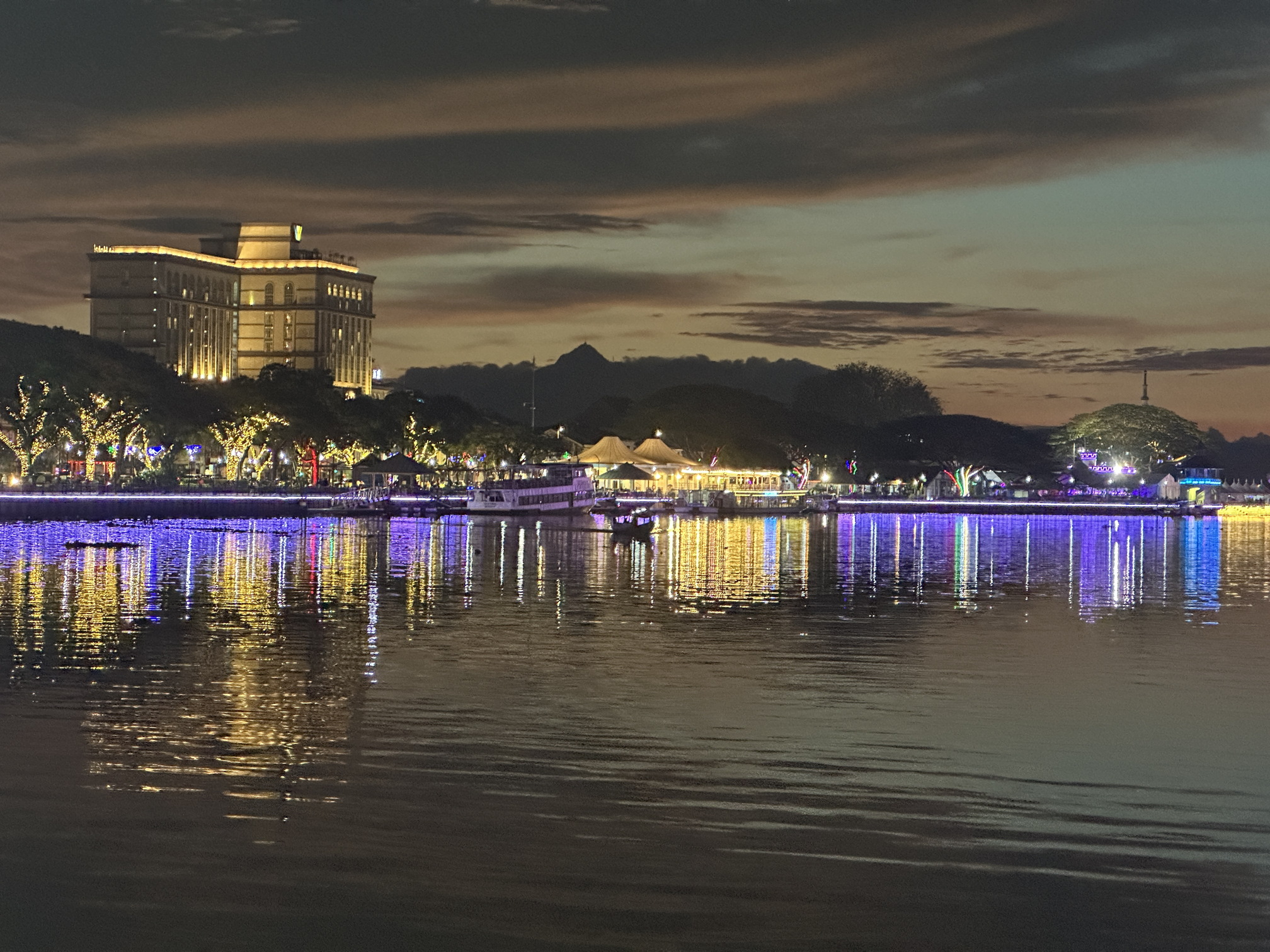
The Sarawak River at night. They run dinner cruises in the evening, but a little too touristy for my refined taste.
And of course, always happy to enjoy local signage.

I feel like if you have to say it out loud there’s a problem. Like you should never preface a joke by saying how funny it is or brag about the size of your dick. Let the work speak for itself. 
They seem justifiably proud. 
For pirate gardeners. 
Not the first idea what that’s supposed to evoke. 
An homage to James Brooke, the first White Rajah of Sarawak. An odd thing to commemorate. Like a Pinochet-themed restaurant in Santiago.
Markets
There was a hypermarché a short Grab ride from my condo, but the interesting markets were outside Kuching. I took a car and driver for a pair of full day tours while I was there and part of those tours involved stops at two markets: the daily fresh market in Serian, about 40 miles southeast of Kuching, and the Serikin Weekend Market, about 35 miles west of Kuching, right on the border with Indonesia. Those were on separate days, as they’re nowhere near one another.

Serian Daily Market
This was pretty much a photo op stop. I was going to the much larger market in Serikin the next day, and the merch here was pretty much food oriented. It’s hard to stock a kitchen for cooking for only a week (with my cooking skills, at least), so I wasn’t really in the market for a market. Mostly eating out in Kuching, as befits the seven-day tourist cadence.
But this was close enough to one of the nature reserves on my itinerary to warrant the stop for strictly ethnographic purposes.


Serikin Weekend Market

This was the big cheese, and well worth the trip. Serikin is right on the Indonesian border. How close, you ask? The far end of the market ends mere meters from the border.
It’s so close that it’s considered a free zone. Indonesians are allowed to cross the border and sell in the market without showing papers or dealing with customs, so long as they don’t go beyond the town of Serikin proper. I’m sure there are plenty of free border zones around the world, but this was my first experience. It’s an interesting setup.
My driver kept emphasizing that the goods on sale at the market weren’t from Sarawak, they were from Indonesia, muled across the border for sale. Which while technically true is kind of beside the point. That border is a line on a map, not in the real world. Like how the mountains of Chiapas butt up against the Guatemalan highlands. You can draw whatever lines you like, but it’s likely to be same same on both sides.
The market part of Serikin was over a kilometer long, set up right on the main drag. The far end was the produce market, right near the border, and while there were food stalls along the way, the bulk of the market was goods, from decorative objects to housewares. I was the only mat salleh (farang in Thai) there, which I always love. It means I’ve found the real deal, where the locals go.
In fact, other than hiring a car and driver, as I did, or renting a car and driving yourself (madness), there’s no way to get to Serikin from Kuching. There isn’t even a bus. I’ve run across this repeatedly in SEA, where there’s some locus of interesting culture that takes a Stanley-and-Livingstone level of commitment to access. Which most tourists, obviously, can’t muster.
Admittedly, the Serikin market isn’t specifically for tourists, but that didn’t keep me from leaving money there. I’ve visited a couple of places, like the Benjarong Pottery Village outside Bangkok and a weaving village outside Chiang Mai, that should be catnip for tourists interested in real craft traditions. How to get there? Rent a car and driver for the day. They should be bussing tourists in to these places, but they’re deserted.
Serikin was hardly deserted, except of tourists. It’s an exceptionally robust market, with a great array of goods. Here’s the produce end of the market.


And here’s the shank of it.

A full kilometer of this. 
Lots of clothes, from utilitarian to… 
Fancy. 
These are not the quality goods you’re going to find in Kuching’s butiks. These are strictly manufactured. 
But that doesn’t keep them from being compelling. 
And plenty of cool stuff. Beaded bags. 
Whatever these are. 
And whatever these are. 
Believe it or not, I do not now own a hornbill hat. 
Something for everyone. 
Clearly not for tourists.
I have confessed to leaving money in Serikin. What did I buy? Two shirts for me, as shirts appear to be my love language. I have, at most recent count, added twelve shirts to my wardrobe on this trip. This market was also my place to pick up gifts, which is frankly harrowing on my own. I have zero trust in my judgement in Dorothy’s absence. I have no idea whether I’m bringing back treasures or tourist crap.


Roadside Attractions
My first day trip was to a fabric weaver, a wildlife reserve, and the Serian market. Day Two was a cultural center and the Serikin Weekend Market. Between the two days, there were a handful of little sidebars, interesting things along the way.
I suppose it’s churlish to note, but I didn’t much care for my driver for the two days. He never really left the car to serve as a guide, he just narrated whatever we were passing while we were driving. Usually the same things in both directions. And there always seemed to be something worth noting, even when there wasn’t.
But the biggest issue was his English. I have absolutely no call to dunk on anyone over their English, given that the only things I know how to say in Malay are thank you, forbidden, and danger. Although, to be fair, that does cover most circumstances.
Still, he was very hard to understand, which wouldn’t have been a big deal if he’d been using fewer words. He spoke in a mix of English words in a Malay accent, Malay words, and nouns for local places and things. So everything sounded Malay, and deciphering which of those sounds represented an English word gave me a headache. I said “I understand” a lot, even when I didn’t.


These local food courts, where we stopped for lunch, are a thing here. You walk by the stalls and figure out what you want, then sit down and wait for a waiter with an iPad. Everything is numbered. You tell them you want the #7 from stall #12, and they note that you’re sitting at table #5. Then food arrives and they take payment. Efficient, and, with maybe twenty stalls, the range of choices is excellent.

Kuching Buddhist Society
One pullover was at the Kuching Buddhist Society, which, unexpectedly, featured a large statue of Buddha. Did not see that coming.
The Buddha was impressive and the grounds were lovely. A completely worthwhile stop.


Paku Rock Maze Garden
The Paku Rock Maze appears to be a naturally occurring geologic formation that has been colonized and turned into a roadside attraction. It seems to be a popular spot to rent a traditional costume and have your picture taken. There was some kind of photo shoot going on while I was there.


The rest of my day trip adventures are covered in the posts on crafts and wildlife.
* Please note: All song title jokes and references, and they are spread liberally throughout the blog, are specifically for Bruce’s entertainment. If you are not Bruce you have my permission to be amused, just so long as you understand that these jokes are not truly for you.