Land, Air, & Sea
Biomes, not theaters of war. A tour of Malaysian wildlife took me to all three zones. One of them, Land, was something of a war, if I’m being honest. But all of them featured fascinating critters.

Although this trip did start out with a shock. I got a notice on my phone that I’d received a WhatsApp message from Exotic Asia Hotline. My first thought was, “How did my WhatsApp number get compromised?” My second was, “Do they deliver?”
It turns out it was my infelicitously named tour company confirming my reservation. Maybe it’s a side business. More likely the tours are the side business. Sweet. I’m not just a tourist. I’m a coconspirator in a Malaysian money laundering scheme. Made it, Ma!
Land: Bukit Malawati
First stop, Malawati Hill, in Kuala Selangor. About 40 miles west of Kuala Lumpur, Malawati is a strategic location at the mouth of the Selangor River, draining into the Straits of Malacca. Malays built a fort there in the early 16th century, but the Dutch, in a fierce combination of boredom and rage, took it in 1784.


My favorite part of this history is that the leader of the Dutch troops was an officer named Dirk van Hogendorp. Yep, Fightin’ Dirk van Hogendorp. I am totally not making fun of his perfectly reasonable Dutch name. I’m sure there are respectable van Hogendorps all over Dutchland. But seriously. I’m sure he was positively savage in person, but the name doesn’t exactly inspire fear. Dirk van Hogendorp. Say it with me.
Curiously, the British didn’t come along and fuck the Dutch for the fort (until much later). The Malays actually captured it back the very next year, before it fell for good in the 19th century during a civil war fought with the colonialists as amused bystanders.
But there was plenty of back and forth before then. To no one’s surprise, the Dutch took the fort back and used the opportunity to build a lighthouse on the hill in 1794. Then the whole thing became British, as things did back then, and they refurbished the lighthouse in 1910, which still stands today. The ruins of the fort are also still around.
But I promised wildlife. And a land war. What gives?
OK, absolutely no one goes to Malawati Hill for the lighthouse or the ruins of the fort. They go, as I did, for the monkeys. And where there are troops of monkeys, there will be war.
Did you know that the alternate collective noun for monkeys, besides the more standard troop, is cartload? I can assure you, Malawati Hill boasted cartloads of monkeys. Specifically, there’s one cartload of Long-Tailed Macaques and another of Silvery Langurs, also called Silver-Leaf Monkeys.
I’m on record about the macaques. They are not mischievous. They are aggressive little thieves and thugs who’d mug you for a banana. To use a random example. But I was very excited to meet a cartload of the langurs, who are, by repute, gentle, pleasant creatures. From whom the macaques could learn a thing.
They’re easy to tell apart, by the way. The Silvery Langurs, as the name implies, have black fur tipped in silver, approachable faces, and bright orange babies. The macaques are brown, with frightening muzzles tapering to sharp, pointy teeth and dead eyes that would love nothing more than to watch you suffer.
We’re dropped off at the bottom of Malawati Hill and make our way up, through the trees abutting the coastal mangrove forests that are home to both macaques and langurs. The various cartloads of monkey hang out in those trees because they are adjacent to a generous source of food: us.
On the way up the hill.


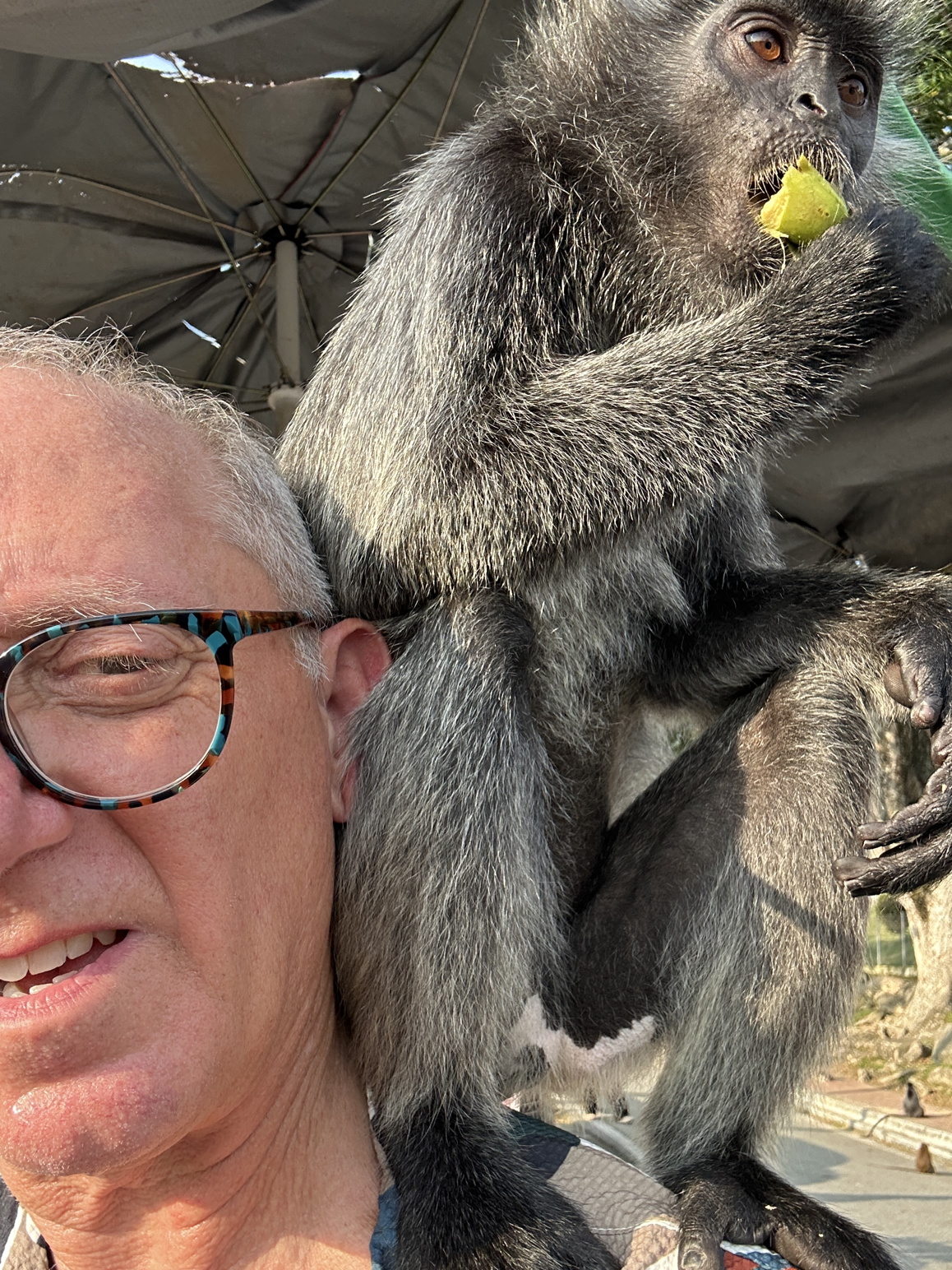
The langurs, especially, have no problem being close to humans. Very close.
There are a lot of babies, and lots of committed parenting.


Very alert and protective.
Both the langurs and the macaques carry their chiddlers clinging to their bellies.
I am forced to admit that this particular cartload of macaques seems less criminal than most. Perhaps it’s the exposure to the langurs, or perhaps they’ve simply learned that they get more food if they display some rudimentary manners. Either way, I feel noticeably less at risk in their presence.
It feels like the walk up the hill introduces you to the whole concept of monkeys, so you’re at least somewhat prepared for the scene that greets you at the crest. What is that scene like? Chaos. Madness. War.
At the top of the hill, vendors hawk little burlap sacks generously stuffed with sliced fruit, beans, shoots, and bananas. For a mere 10rm, about $2.50 USD, you can be part of the great circle of life. Feeding monkeys. So many monkeys.
That looks like fun, doesn’t it? Since the theme of this whole adventure seems to be Stupid Things Dorothy Isn’t Here To Prevent, I signed up. You’ll never guess what happened.

How did that episode end? With one of the fucking macaques tearing the bag from my hand, running off, and hissing at me with bared teeth when I tried to retrieve it. Macaques, amiright?

The langurs were pretty awesome. Even if they had trouble maintaining boundaries. But you’ll notice in these shots that none of the macaques actually clamber up people. They’ll get close enough to steal, but don’t seem to favor scaling their marks. I am, as always, grateful for the small things.
Monkey selfies!


Air: Kampung Kuantan Firefly Park
From Malawati we drove to the banks of the Selangor River, one of Malaysia’s most critical water sources. We stopped for a ridiculous dinner, and then hopped a boat to take the river upstream to the Firefly Park.


Which is exactly what it sounds like: one of the largest firefly colonies in the world. Although the official collective noun for fireflies isn’t colony. A group of fireflies is a sparkle. Aww. In related news, I just learned that the collective noun for kittens is coven.
There’s not a whole lot to see here. It’s dark, and camera flashes both ruin the view and confuse the fireflies. But floating past is an experience so magical it seems almost fake. Like if Disney wanted to do the whole firefly thing, it would look exactly like this.
This doesn’t do the experience justice, but it’s all I’ve got.
Sea: Blue Tears
After the fireflies, we turn around and head back down river, past the mouth and into the Straits of Malacca. What are we after? Dinoflagellates. No, not prehistoric kinskters, bioluminescent plankton. Pervert.


This will be my third time with glowy sea monkeys: once before as a child in Guadalajara and once in Vietnam with Dorothy. There aren’t that many places in the world where they occur. Filling in my bingo card.
But it is a subtle effect and hard to capture. Like the fireflies, camera flash washes it out completely. We were each given a PVC pole with a fish net at the end. Scooping the net through the water agitated the poor things and made them glow. Did we care? We did not. We all scooped and scooped, bathing in the mystical glow. All you get out if it is a murky video.
As promised, Malaysia’s wildlife in land, air, and sea. It may not be much for y’all to look at, monkeys aside, but it was a pretty fine show in person.