Temples of Doom!

There isn’t actually a ton of difference between inside the Old City and outside. There are old buildings and new buildings on both sides of the moat. The biggest distinction is that the Old City holds Chiang Mai’s densest concentration of temples, all within a single day’s walking tour. I took more than one day. Because hot.
But that doesn’t mean there aren’t excellent buildings in the Old City.
Wat Lok Moli
I found Wat Lok Moli just a couple of days into my stay. It’s right across the street from the moat, so it’s not technically in the Old City. It appeared to have some serious years under its belt, warranting crossing the street. That’s a commitment here.
It turns out I wasn’t wrong. No one knows its actual construction date, but it’s mentioned in official documents as early as 1367, making it one of Chiang Mai’s oldest temples. They’ve also left the historical brick intact, as opposed to the common practice here of applying a fresh coat of stucco. Which I get, but which also makes brand new construction and historical sites indistinguishable from one another.


But that’s not what truly makes Wat Lok Moli special. It’s the golden rooster you fill with holy water, haul up to the Buddha by pulley, and tip over to water the plant at Buddha’s feet with said holy water. But I’m sure that was going to be your guess.

Wat Dab Pai
This wasn’t even on the walking tour itinerary I found of the Old City. Too minor to warrant mention. Which I kind of get, but still. That’s a pretty steep curve they’re grading on.


Wat Chiang Man
The Temple Of The Fortified City is also considered minor, but is notable because of its age and history. Built shortly after Chiang Mai’s founding in 1296, it’s of roughly the same vintage as Wat Lok Moli. It’s old buildings are in shockingly good shape, a hallmark of Thailand’s temples.


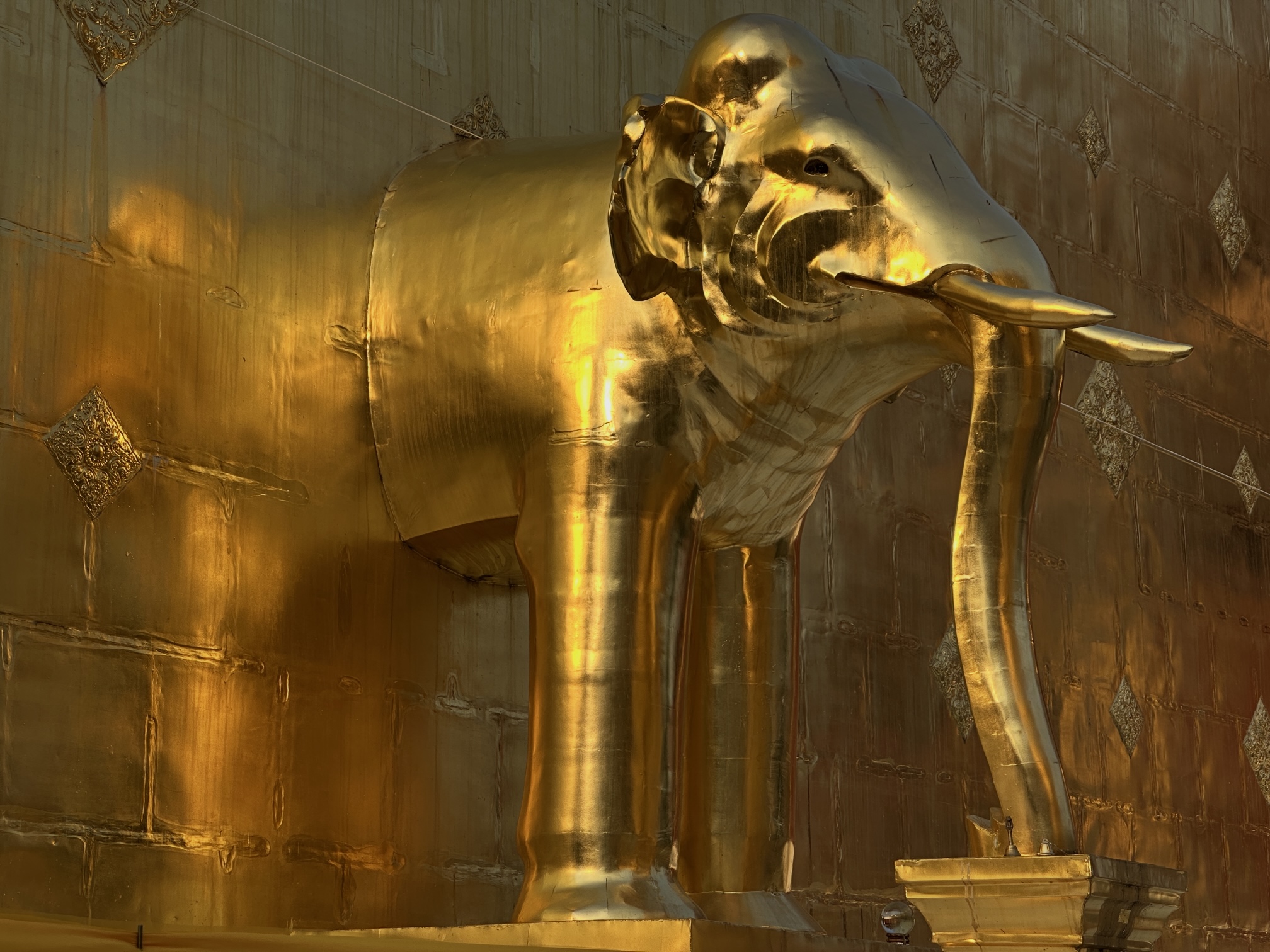
But what it really has going on is the Sacred Elephant Encircled Stupa. Which entirely lives up to its billing.


Wat Phan Tao
You’ll be shocked to learn that Wat Phan Tao features a golden Buddha.


But what it really has that makes it special, to me, is the monk’s bowls. For 10฿ you got to pick up a cup of what I can only assume are toy coins, for depositing one-by-one into the monk’s bowls as an offering. The offering is obviously the 10฿, but there’s something soothing about walking around the monk’s bowls and dropping in one coin at a time. They may have been fake coins, but it felt like real mindfulness. Monks, amIright?


Wat Chedi Luang
The Temple of the Great Stupa is more than just a great stupa. It has all of the expected trappings, golden Buddhas and ornate architecture, but some unexpected ones, as well.


The first odd thing you see on entry is a No Girls Allowed clubhouse. It’s hard to piece the story together, but buried inside the temple is Chiang Mai’s City Pillar. Whatever that is. And as a sign helpfully points out, women aren’t allowed inside because they menstruate, and apparently men are creeped out by that and don’t like to be reminded? Even though women are permitted inside other temples?
To quote the sign: “Women are prohibited to enter because they menstruate. It is believed that it humiliates and ruins the sanctity of the city pillar. Besides, men who dress inappropriately are not allowed to walk in. It is believed that any disobeying of the rules will cause social instability.”
OK, that makes sense. It’s not the men who are creeped out by menstruation. It’s the city pillar, which can apparently sense ovaries from its underground crypt and translate its humiliation into aboveground riots. Got it.
Well, you’re in luck, because I went in and took pictures that I am now happy to share with my Friends with Ovaries (you know who you are). Hopefully, that doesn’t trigger the City Pillar from afar. If you read this and then discover that Chiang Mai has fallen to the hordes, you know which organ to blame.


We were promised a Great Stupa, and one was delivered, as advertised.


But Great as it was, the Great Stupa wasn’t Wat Chedi Luang’s highlight. To me, it was the main temple, which was basically a Dave & Buster’s for Buddhists.


That thin veneer of normalcy hid an interior chockablock with Buddhist enrichment stations, promising a shortcut to the divine for the price of just a few baht. Step right up!

First stop: Gold leaf your very own statue. 
A mere 10฿ (about 30¢) gets you a sheet of gold leaf. 
I’ve often wondered where they get the labor to keep all their statues so very gold. Now I know. We pay for the privilege. 
There are ample opportunities to pick your favorite. 

It makes me want to gold leaf, well, everything. 
They even had gold leaf stations outside. 

Next up, for a mere 100฿ you can hang a banner with a wish based on your Chinese Zodiac animal, about the least Buddhist activity you could imagine. 
I am rooster. But you knew that. 
You’ll notice I didn’t ask for long life. Just health while I’m around. 
My banner floats in the breeze with all the other wishes. 
Here we’re encouraged to toss some bills in a special envelope and drop it in the box. 
And finally, eliminating the middle man. Slip a bill directly into the stick and pop it into the pole so everyone can see that you love Buddha best. 
Not like that dick who only offered a 20฿ note. He’s coming back as a dung beetle.
Truthfully? That wasn’t the real highlight. That would be the Monk Chat, which I’d read about and was actually my primary reason for visiting Wat Chedi Luang. They have monk or monks sitting at tree-shaded tables all day, from about 9:00 – 6:00. They’re just sitting there waiting for a chat.
The ostensible reason is that it gives the monks an opportunity to practice their English, but it seems primarily a cultural exchange. Especially since our monk’s English scarcely needed any additional practice. He was good.
I sat with three Norwegian elementary school teachers-in-training, who were on a multi-week tour to prepare them to teach Nordic youngsters comparative religion. And, as promised, we chatted. We asked our monk how he spent his days and where he was headed post-monk training, and he asked about where we were from and what the ladies were learning on their junket. It was fabulous, and may be my favorite half hour in Thailand so far.


Wat Muen Tum
I stumbled on Wat Muen Tum, home to Thao Wessuwan, The God Of Fortune, on my way home from Wat Chedi Luang. Another minor site scarcely worth a mention in the guides.

The site was also distinguished by the crazy sculptures lining the outer wall.


King Mengrai Temple
This was the end of my first day’s tour, and was an appropriate bookend to the first temple I visited, Wat Dab Pai. Likewise, this was considered unremarkable and wasn’t on any of the walking tours I checked.

Wat Rajamontean
My second day’s temple tour: seven temples, eight miles, five hours. You’re so lucky I’m doing this for you. Seriously, you are not up to this. You should exercise more. And you’re definitely not drinking enough water.
Wat Rajamontean is known as The Dragon Temple. For, you know, dragons. It’s billed as the Old City temple with the greatest curb appeal, and that seems right.


Wat Khuan Khama
Wat Khuan Khama, for reasons that are unclear, is known as the Golden Horse Temple. It dates from 1492, and legend (or history, so hard to say) has it that the temple had been the garden for the royal horse groom. When his horse died the groom was sad, and donated his garden to be a temple in memoriam for his loyal steed.


Wat Hua Kuang
Also known as Wat Saen Mueang Ma Luang, Wat Hua Kuang’s trick is that it’s much larger than it appears. Its street face suggests a modest footprint, but it just keeps going back.


While there I heard a low hum and found the gong that had made the sound. It didn’t sound like a gong, though. It sounded like the sound the universe made while being born. This is actually from another temple and isn’t quite as resonant, but gets the idea across.
Wat Phra Sing
This is one of Chiang Mai’s big daddies, as evidenced by the 50฿ entrance fee, which only a few temples charge. Also known as the Temple of the Lion Buddha, Wat Phra Sing has much to offer. For one thing, it houses over 600 monks. It also sports a stone stupa from 1345 that is now completely encased in gold. Also, golden elephants! And a Hall of Lifelike Monks!!


Here’s an ancient stupa, lovingly berobed in gold like a Buddhist Jill Masterson.


Then there was the Hall of Lifelike Wax Monks.


There was also chanting in one of the temples. It was interesting because there were song books everywhere and civilians joining in on the chanting, which I’d thought was a monk-specific practice. I was also expecting something more Om-like than the actual chanting of words. Or lyrics, I suppose. But that’s the great thing about being ignorant. There’s so much to learn.
Wat Tung Yu
A smaller temple, but still with some choice bits.


Wat Phantao
Also known as the Monastery of a Thousand Kilns, Wat Phantao is another oldie, dating back to the 1300s. It gets its nickname from the fact that it was used as something of a factory, producing Buddha statues for other monasteries. I was hoping for something a shade more Dickensian workhouse, but there’s no trace of those kilns any longer.


Wat Sri Suphan
My final stop was farthest afield, and outside the Old City, about a ten-minute walk south of the moat. Wat Sri Suphan is situated in a neighborhood historically, and still, known for its silversmiths. As a result, the complex, including the Silver Pavilion, is all done up in silver metallic, made from aluminum, nickel, and a pinch of silver.
So much silver.

You’ll never guess what distinguishes the Ordination Hall. 
And no City Pillar to blame it on. I guess that’s owning that you just find women nasty. 

Even in the Silver Pavilion, the Buddha is golden. There are rules. 
The backside of the Ordination Hall. 
More silver, please. 


The Wishing Whisper. I’m guessing you toss your donation into the vat and whisper your wish behind it. 
This is the kind of stuff that was available in the local silversmiths. Heavy to travel with and a little lurid. None for us. 
I sort of expected the cat to be silver. That’s two Jill Masterson references in one blog! 
There were small silversmith shops, but there were a surprising number of large venues offering experiences. For 50฿ you got a piece of silver and a template where you could punch your own pattern to make a keychain. I’d always rather see an art form represented by a master than make a shitty souvenir myself.
There was even a temple that wasn’t silver!

I know this looks like an eruv, but it’s just an elaborate rig to hold donations. 
Which are clearly for the high rollers. 
And… Buddha. Nary a hint of silver in sight. 

Not at all sure what this is, but it’s sure purty.

There was a Monk Chat here, as well, although I didn’t want to tarnish the memory of my earlier Monk Chat. The reason for all the monks is that just about every one of the temples I visited is a working monkery. I don’t know for a fact that they were all sleepaway; maybe some of them were monk day camps. But all of them provided monk training in exchange for monk labor.
Whew! That was, I think we can all agree, a lot of temples. Take your shoes off, put your feet up, and if you’re in Thailand, indulge yourself with a foot massage. You’ve earned it, soldier.
Although I still don’t think you’re hydrating properly.