Thai Textiles
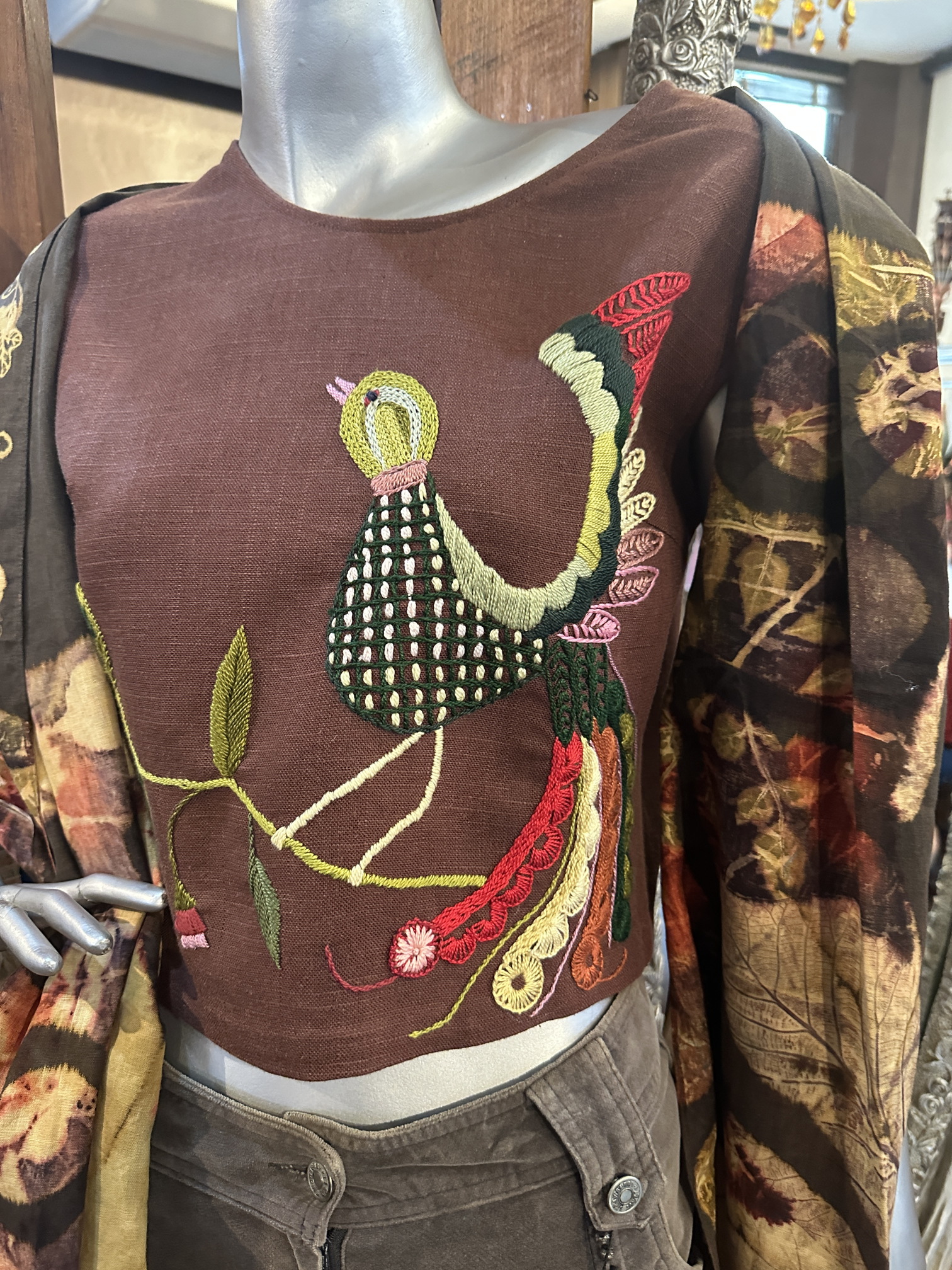
I’m sure it’s the decades spent with Dorothy, but of all the craft traditions, textiles seem like the deepest expression of a society’s culture. There may be a shared vocabulary of design motifs across the various crafts, uniting textiles, ceramics, woodworking, and painting into a common grammar of ornament, but textiles and clothing are fundamental to how you represent yourself to the world.
You can walk outside without your decorative belongings in hand, but you leave cloaked in the signifiers of your culture. Every time you dress you tell the world who you are. Pottery doesn’t do that.
Although this is true of all of the crafts, the constraints of primitive, manual methods leads not to a narrowing of the design space but to a Cambrian explosion of creativity within it. As we’ve chased weaving around the world, it feels like we should have seen every recombinant possibility that a backstrap or treadle loom can be strong-armed into producing. And then we see something, some amalgam of materials and techniques previously unimagined, that blows our minds all over again.
Even without Dorothy to provide a more nuanced understanding of the intersection of design and technique, I am consistently thrilled and delighted to explore textiles as a sharply focused lens into a new culture.
Silk
At least when I play word association, the appropriate response to Thai is… Silk. That’s a great jumping off point, but there’s plenty going on here besides the silk. There’s Teen Jok, mudmee, and plenty of beautiful cotton. In almost three months in Thailand, I’ve been able to see much of the range here.
I mentioned in the post on Thai crafts that there’s cheap and expensive for crafts here, but not much in the middle. That’s 100% true for the silk. There’s the kind of manufactured goods we used for corsets at one end, and then silk made from worms fed mulberry leaves to make their cocoons a golden color, massaged in the morning and evening, and read bedtime stories before being tucked in with a glass of warm milk. That shit’s expensive.
I found one shop in Bangkok close to where I was staying, Queen Thai Silk.


It turns out, the biggest marketplace for quality silk in Bangkok is… in a mall. Specifically, Old Siam Plaza.


Malls are a central component of Bangkok’s retail profile, and they all have their own flavor. ICONSIAM features more European fashion houses than any other Bangkok mall. Terminal 21 plays host to a cornucopia of small makers offering unique products. And Old Siam is the locus of Bangkok’s silk trade.
An entire floor is given over to silk shops, almost all of which, large or small, feature someone operating a sewing machine. I saw measurements being taken and fittings occurring in dozens of shops the afternoon I was there. You can pick your fabric and have it turned into the schmatte of your dreams all in one go.
The selection was phenomenal, as were the prices. I don’t have notes, so I can’t say exactly, but I know there wasn’t a single piece that we considered affordable.
Which is a shame, because the range and quality were incredibly impressive.


Mudmee
Mudmee is just the Thai word for ikat. There’s no special flavor, it’s the same way ikat is made all over the world, by dying the weft fibers. I didn’t find a mudmee weaving village, but I found two shops in Chiang Mai that carried high quality mudmee. One shop, Shinawatra, was literally five minutes from my condo.


They also carried a high quality selection of silks and wovens, although the mudmee was the standout.


The other shop, Studio Naenna, was an hour’s walk from my condo. So, should have been a Grab. That midday hour was intense. But so was the shop, and well worth the visit. Even if I needed a minute to recover once I got there. They don’t weave onsite, but they were the exclusive reps for some truly gifted artisans. All of the pieces were created with exclusively natural dyes.
Of course, the biggest challenge was shopping for Dorothy without a Dorothy there to render judgement. My plan was to take photos, send them to her so she could shop, and come back to pick up her selection. It’s so cute when I make plans.


What actually happened was I found this, a seven color mudmee created by their master weaver. Yes, Dorothy, it has seven colors, but it’s also a subtle and beautiful weave. And you own it now, so no carping.


By the way, it took three months each for dying the thread and weaving, so six months total effort to create that piece.
Teen Jok
Given our relative indifference to the silk, due to its cost, it looked like the mountain village of Mae Chaem was going to be the payoff. Mae Chaem specializes in an ornate, embroidery-like weaving called Teen Jok. Maggie, my guide for the trip to Wat Doi Suthep, had suggested that a friend of hers, whose nom de touriste was Cartoon, could drive me there for the day. Because absent a car and driver, there was no way to get to Mae Chaem.
Mae Chaem is like the Benjarong Pottery Village outside Bangkok: a completely inaccessible locus of Thai cultural heritage. It’s baffling to me that no one goes there. It’s not far from the famous and well-traveled Doi Inthanon national park, but not one of the dozens of tour operators goes there. When I visited the Erawan National Park outside Bangkok they tacked on a visit to a WWII-era POW concentration camp. That made sense to someone. But adding a cultural treasure like Mae Chaem to a national park tour, that would be madness. Grr.
Because it’s not on anyone’s route, there’s a shocking dearth of detailed information about Mae Chaem, even from those who blog about it. When Cartoon picked me up her first question was “Where are we going?” As in, the name and address of one of the weaving studios, but I had nothing. We were going to drive about three hours to Mae Chaem on the assumption that we’d find the studios once we were there. No wonder no one goes.
We arrive and we’re driving down what seems like the main drag, until we finally see a shop with a sign that says Textile Café. Odd, but promising, except that the shop’s doors are closed and drapes are drawn. But we pull over, and sure enough, it’s an actual studio that’s actually open and has actual Teen Jok.
So what exactly is Teen Jok? The technical definition is that it’s a discontinuous supplementary weft technique. What that means is that the weaver hand ties additional weft threads around specific vertical warp threads (that’s the discontinuous part, as the supplementary weft threads don’t go selvedge to selvedge) to create an embroidery-like pattern directly on the loom.
In the clip below, the weaver is using a porcupine quill to pull apart the warp threads.
That technique is ridiculously labor intensive, with a skilled weaver able to produce about two inches of Teen Jok in a day. That’s why you see it woven as a six inch border finish on sarong lengths instead of as entire fabric.
We saw a similar technique in Bali, called songket. The primary difference is that Balinese songket is woven on a backstrap loom and the supplementary weft threads tend to run towards the metallics. Thai Teen Jok pulls from a library of sixteen traditional patterns that all the weavers use, although any meaning those patterns might have is lost to history. There’s no jig or template for those patterns, by the way. Teen Jok is created entirely by eye and hand. Colors are dealer’s choice, and weaving is done on a traditional frame loom.
The Textile Cafe had the real deal. As beautiful as it was, I needed to see more. I don’t like running the meter with artisans, making them spread out their wares so I can take pictures and go on my way, but I needed to see more of the range before picking a piece to bring back to Dorothy. And if this place was the bomb, I’d be happy to come back.
When I told Dorothy I was going to Mae Chaem, I got a reminder: “If you buy a piece, it’s ok not to have allllllll the colors in it.” Right. I’m a clown. Noted. But the color palette on the Textile Cafe pieces seemed on the bright side, trending lurid, and I needed to know if that was just what Teen Jok looked like or if it was this particular weaver’s eye.


Now that Cartoon and I knew what to look for, finding more Teen Jok weavers was easy. Our second stop was just a little further up the road, and answered the color palette question. The weaver in this shop also had brightly colored pieces, but quite a few with a richer, more restrained palette. I suspect that the first weaver exclusively used commercial rather than natural dyes. The second shop also had a pretty wide range of clothes with Teen Jok details.


But two pieces really stood out, and I was pretty sure, although I was going to keep looking, that I’d come back for at least one of them. The first was a traditional Teen Jok sarong, but in truly beautiful colors.

The second was a solid piece of Teen Jok. I suspected I wouldn’t see another piece like it, and I didn’t. It was a startling 12,000฿, about $360 USD, but it was the very definition of the kind of signature pieces we’ve been seeking out on our travels. Less than a rug and just as significant.

The third studio we visited was probably the largest, with not only the Teen Jok sarongs, but a really nice selection of clothes with Teen Jok decorative elements. The sarongs were beautifully crafted, but I didn’t see anything I preferred to the two pieces from the previous studio.


I did love the clothes, though.


I felt like I’d seen the range, and I didn’t know how much more there was to see in terms of variation. I told Cartoon we’d do one more store and then go back to the second shop where I was prepared to comically overspend for a piece of magic.
This weaver had the expected range of Teen Jok, but nothing that was more impressive than what I’d seen at the second studio.


But then I saw something I hadn’t seen elsewhere: Teen Jok runners, over six feet long. She had four pieces of nothing but the Teen Jok.


Thinking back to the Balinese songket, Dorothy had picked a runner as the easiest format to find a home for in our crowded home. You’d never cut up the all-over Teen Jok. It would have to be a wall hanging, and empty walls don’t exist in our home. Arguably I should have gone back to the second studio to get the beautiful sarong piece, as Dorothy would have turned that into a lovely skirt. But I settled for the runner, which was hardly settling.
I asked, by the way, and that 6 ½ foot long runner took six weeks to complete.
I feel obligated to share that Cartoon was a great companion. She didn’t know anything about textiles when we set out, and it was a delight seeing comprehension blossom as she realized just how unlikely and magical the weaving is.
She also taught me two new Thai words: beautiful and delicious. Beautiful (suay) was for the weaving and delicious (aroy) was for lunch. Aroy was easy, but I still haven’t mastered suay. First, that’s a very slippery diphthong in the middle which I still don’t quite have. Second, it’s said with a rising tone at the end. That would be ok, but if you muff that and use a falling tone it means ugly.
That’s not OK. If the rising tone means beautiful, the falling tone should mean bathtub. No way should it be an antonym. Also, when I flub the diphthong, it feels like I’m being intentionally misunderstood, like how the French pretend not to understand when you say kroi-sant instead of kwa-sahnt. They know what you mean, they’re just being French.
I feel like suay, even with a slurry diphthong, should be intelligible from context. I clearly don’t mean bathtub. But I suppose if someone foreign, say French, for example, told us that something was betty-fail, it might take a minute to catch up.
A quick lunch stop and three hours driving to get home. On our way back the way we’d come into town we passed another half dozen studios we’d missed on the way in, when we didn’t know what we were looking for.
Wovens & Embroidery
The wovens were one of the few places in the panoply of Thai textiles that landed in between cheap crap and debt financing. Lokna Naono hit that middle nicely.


On the other hand, Srisanpanmai, in the upscale Nimman neighborhood, was at the trust fund end of the spectrum. They carried two things, primarily. Some excellent Teen Jok, for everyone who couldn’t make it to Mae Chaem (which was everyone but me), and antique (is 50 years old antique, or just used?) wovens from Burma/Myanmar. The Teen Joks started at about 15,000฿ ($460 USD). For comparison’s sake, the Teen Jok in Mae Chaem was 2,500฿ to 5,000฿. The Burmese wovens were priced from 15,000฿ to 30,000฿. Spectacular goods, but not even at my craziest…
While Mae Chaem’s Teen Jok weaving was almost exclusively the six inch border, the specimens at Srisanpanmai mostly featured more generous expanses of the weaving. Not enough to cover the cost differential, but enough to narrow the gap.


The Burmese wovens were all cut and sewn into wrap skirts. You could pick the stitches out and return them to fabric, but that just made the pricing even harder to swallow.


And some beautiful embroidery, too spendy for us.


Ban Don Luang Weaving Village or Bust…
As it happened, bust.
After our success finding the Teen Jok in Mae Chaem, Cartoon and I got the band back together and headed out to track down the weavers of fine cottons clustered in Ban Don Luang.
But first, please join me at the sidebar. Bloggers. Hey! Over here. I beg of you, date your blog posts. Is that asking too much? Whatever platform you’re using keeps track of publication dates. It’s a data element you can choose to display or not, and for some reason so many of you choose not to display it. All of my blog posts have publication dates, because their absence doesn’t make your posts timeless. It makes them garbage.
OK, thanks.
My point being that whatever I read about Ban Don Luang Weaving Village must have been pretty old, because it simply wasn’t true any longer. The town still had the profusion of inexpensive clothing shops I’d read about, but the actual weavers were almost completely gone.


Through much discussion with locals we managed to find two studios still engaged in weaving, but they were both doing contract work for Chinese jobbers. Neither of them had so much as a showroom featuring their creations.
The proximate cause of the decline in weaving, as we were told, was the younger generation’s disinterest in long apprenticeships whose payoff was a lifetime of manual labor (the same reason the Burmese wovens from Srisanpanmai were all fifty years old). To be fair, neither of the workrooms we visited was producing the kind of artisanal products that deliver the pride in craft and culture that offsets the grueling work, so it’s tough to argue with the young’uns.
Still, weaving by hand is always a delight to witness first hand.


This was an interesting technique, using the stick to create the dimensional weft pattern.
For some reason, this charming creature asked my age. With Cartoon translating, I told her that I was 69 and she replied that she was 67. “So, if I was looking for a younger wife…” There was much merriment, while the other women assured me that they were all much younger. One of those unlikely contexts in which I look like a catch.

Sadly, I had to leave the trail of broken hearts behind me. Ban Don Luang was a bust, for both textiles and romance, and it was time for Cartoon and I to return to Chiang Mai, bloodied but unbowed. But Thailand’s textiles were anything but a bust, as my mudmee and Teen Jok purchases attested. Although Dorothy’s presence would have elevated and enriched the entire experience, I feel like I can leave Thailand with my head held high. I did pretty good, for a boy.