Wild Wild Life
One of the disappointments of my brief, seven day stay in Borneo is that I only scratched the surface of the natural splendors on offer. On one of my day trips I visited an orangutan reserve, and I took a full day trip to the Bako National Park. Both afforded splendid equatorial jungles and wildlife living la vida loca.
Semenggoh Wildlife Centre
The first of my two day trips took in a songket weaver, a local market, and monkeys. Not just any monkeys, though. We’re talking orangutans, which can only be found in Borneo and neighboring Sumatra. That Primate Bingo card is starting to fill up.
Semenggoh hosts about 28 orangutans (from the Malay orang hutan, person of the forest), ranging in age from 55 to in utero. Four of them have been rescued, the rest born on premises. Which is not the same as “in captivity.” The reserve comprises a robust 1600 acres of free range territory, more than enough for the solitary creatures to feel at home (mothers and children are the only orangutans that travel together). They could leave if they wanted, but the supplemental food that the rangers provide anchors them to the area. It’s especially important in between fruit seasons, when food can be sparse.

I happened to visit during fruit season, meaning that the orangutans were less likely to venture to the feeding stations, which are set up for safe observation. There was a possibility that none of them would venture out at feeding time, as the jungle naturally produced a bounty of jackfruit, durian, rambutan, and mangosteen. As you’ve all come to learn, though, I’m sprinkled with fairy dust, so of course I saw orangutans.
Before our first showed up, the result of rangers tramping the forest and ululating in the traditional orangutan Dinner’s Served call, our ranger gave us the lowdown on Dos & Don’ts to keep from provoking one of the orangutans into a deadly rage. Happy to listen. Along with hide your water bottles and put your selfie stick away, it included this pertinent gem: “If I say move, move. If I say move fast, move fast. If I say run for your life, get out of my way.” He assured us that he was JK and would stand as the last line of defense in the event of monkey fuckery. Good to know, but a little concerned that a last line of defense had been mapped out in advance.
I asked our ranger what else lived in the jungle, and he rattled off quite the list: gibbons, western tarsiers, macaques, slow loris, flying squirrels, wild boars, bearcats, pythons, cobras, and pit vipers. On the one hand, glad they closed the jungle trails. On the other hand, Wikipedia says that bearcats smell like buttered popcorn. In possibly the first instance of this sentence ever being written, I’m sorry I didn’t get to smell a bearcat.
Also, when he got to macaques, I said “Oh my god, macaques are the worst.” Even nature ranger agreed that they are the rats of the primate tree. It’s most certainly not just me. Everyone hates macaques.
Also, this was the sonic background.
Everyone hates cicadas, too. That’s what travel teaches you: all over the world, we are more alike than different. Kumbaya.
Our first visitor was Ruby, 13 years old and pregnant. Perhaps that’s why she was interested in bonus snacks. Sadly, photos and videos of the orangutans are sparse, but there’s a little. Here’s Ruby managing bananas in both hand and foot. The agility and dexterity is remarkable.

Here she is in action. I love her passing the bananas between mouth and hands/feet as necessary. It makes me imagine an evolutionary path where we have four hands and no feet. You could Hold my beer yourself.
There was a second sighting away from the feeding area. One of the alpha males, the 20 year old Anaku, was in the trees just off the path a few dozens of meters from the feeding area, so we all took off in that direction. Anaku was, we were told, only the fourth largest alpha in the group, which, once I laid eyes on him, was utterly terrifying. Nothing should be that large and nothing that large should have thumbs. And a hippocampus. And have three other even larger beasts nearby. That thing was fucking enormous.
And also closer than Ruby. Much, much closer. He was maybe ten feet away in open territory. Had he taken a notion to go all carnivore on us no one could have stopped him. He’d have been on us before we could even be shooed away. Thankfully, he was eating bananas and we were silent. Enough.
However close he was, he was also behind the first line of trees on the path, so the sight line wasn’t ideal. There were a number of us clustered trying to get good photos, but Anaku himself was the best reason not to try to angle for a better shot. I really felt like holding still was the best idea. The photos suffer. I only got one vaguely acceptable shot.

But I got better video. I love him catching the bananas while hanging from the tree.
Also, a note on their names. There was a population list up with all of the orangutan’s names, ages, and provenances. In addition to Ruby and Anaku there was an Analisa, a Baka, a Selina, a Sigat, even a Roxanne. Down at the bottom of the list was a 7 year old male named Ooooha. That is so weak. That is so, “Billy, what shall we call the monkey?” Honestly, that felt disrespectful.
Bako National Park
Bako is a must-see from Kuching. It’s Sarawak’s oldest national park, and despite being one of the smallest, crams a ridiculous amount of diversity into its modest 10 square miles. it features multiple biomes, from rainforest to riparian, trails of varying length and complexity, and more wildlife than you can shake a stick at. Or that can shake a stick at you. One of the highlights is the proboscis monkey, which, like the orangutans, is native to Borneo. You see them in zoos everywhere, and you’re like, “Oh, that’s a thing.” But it’s not. It’s a Borneo-only treat. With luck, I’ll complete a row on that Primate Bingo card.

Bako is a full day tour, all by itself, and it was quite the adventure. The park isn’t that far from Kuching, maybe half an hour drive to the car park. But even getting there was an accomplishment.
We usually use a service called GetYourGuide for booking tours when there’s something we can’t muster on our own. The whole somebody’s-cousin thing seems fraught. It’s like using a ridehailing app instead of a taxi. The communication is in English, prices are set in advance, the itinerary is specified… It’s just easier.
But GetYourGuide didn’t seem to work in Sarawak. First, the prices were heinous, like $150 for a day tour. But then when I tried to book, the price doubled to $300. I finally figured out that they were all private tours, and you had to cover the full cost if there was just the one of you. Unlike other places, where the tour is scheduled, they’re selling up to ten seats, and they take off with whoever shows up. I’ve had tours like that effectively be private tours when I was the only one who booked.
At one point I passed a hotel with a tour sign outside, so I went in to see if there were more reasonable arrangements. I still had to book a private tour, but at much less than $300. So that was the first hurdle cleared. I booked it for my last full day in Kuching.

The second hurdle was that it started to rain on the drive to the park. Transit from the car park to the park entrance was by boat, and there was no guarantee that a boat would take us, and no guarantee, if we got to the park entrance, that they’d actually let us out on the trails.
We arrived at the dock and my guide, Salihin, was able to procure a boat. But it was still raining, so I had to decide whether to take the chance or not. If I bailed before the boat much of my fee would be refundable. But if we take the boat I’m committed, whether we’re actually permitted to hike the trails or not. Not a difficult decision, having worked so hard just to get as far as the dock. All aboard.
To say that the boat ride was wet is an understatement. The skiff had a canopy, but it was also slicing horizontally through a rainstorm, rendering the canopy useless. I arrived to the park pretty thoroughly soaked.


A short walk brought us to the ranger’s lodge, where we’d learn whether we’d be permitted on the trails or not. Certainly not while it was raining, as the footing, as I learned, is questionable under the driest of circumstances. We’d just have to hang out there until given the all clear. Or give up at some point and boat back.
Just on that short walk we came across this on the path: a Bornean Keeled Pit Viper. Just one of Bako’s many species of deadly snakes. Not deadly to humans, however, as it only produces enough venom to take down little critters, not something our size. We get what’s referred to as a “dry bite.” Which is better, I guess? But which still seems undesirable.

Salihin shares all of this intel after I come in close for a photo. Makes me wonder if, as a small human, I’m critter-sized.
We wound up waiting about an hour before being permitted to head out. I got an order of lovely fresh pancakes with local honey from their café, so I was able to fill the time just fine. Here’s a better example of what we were up against.
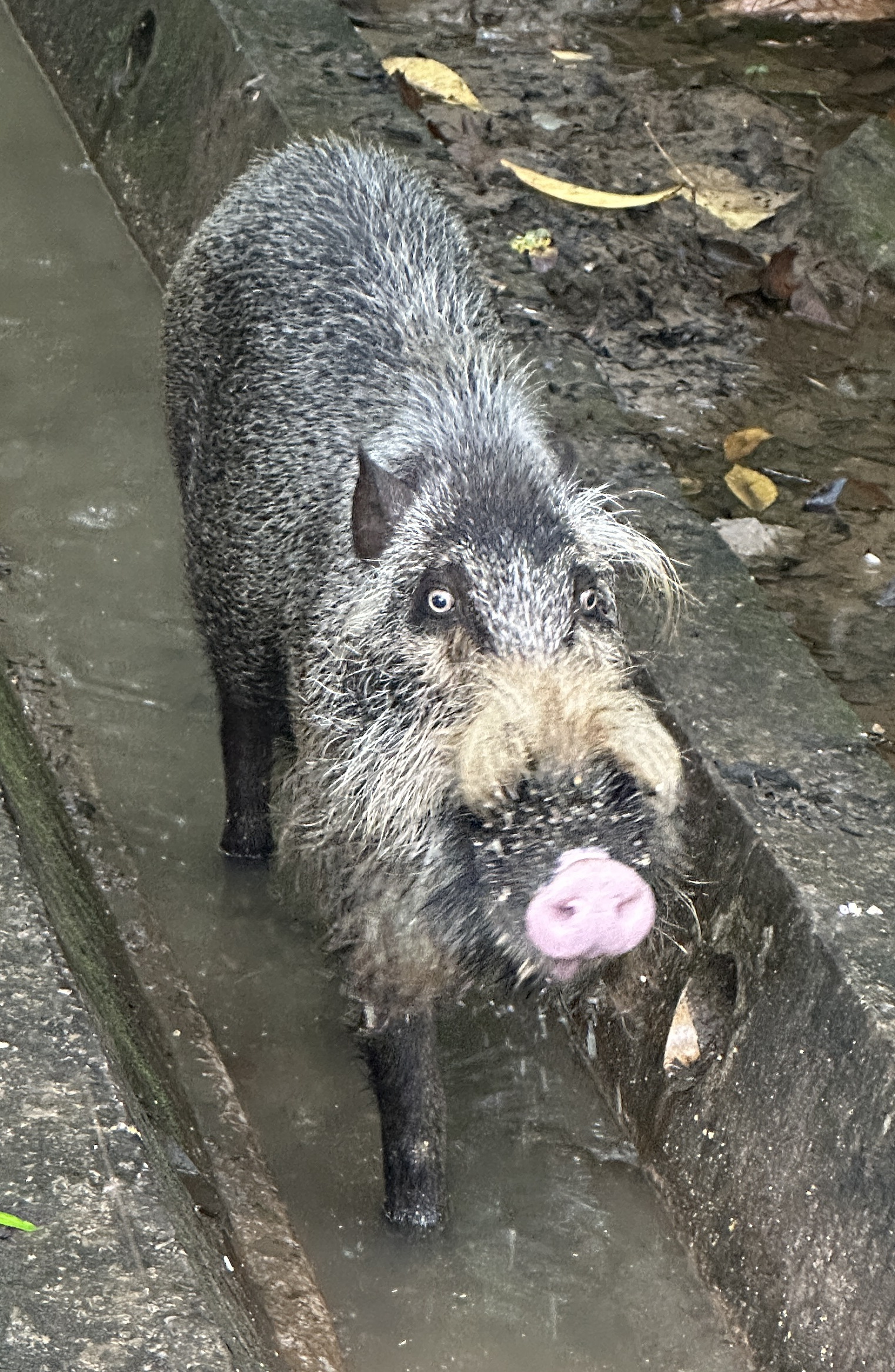
Thankfully, there was entertainment available while we waited. Besides the pancakes. A family of bearded pigs was wandering the grounds, snuffling for treats.


But you came for the action shots, and I would never disappoint you. Here’s the family.
And here’s one of the adults, up close. Jesus their noses are weird. Swear to god, when I first saw one I thought he was carrying some pink plastic thing in his mouth. Life’s rich fucking pageant.
Free to roam the wilds, Salihin and I set out on one of the trails. There are some very long trails and some very challenging trails. Wisely, Salihin chooses Bako’s bunny slope for me. Which turned out to be more than enough, thank you.
It’s very hard to overstate the jungle’s lush beauty.


Salihin claimed these Ground Pandan have the longest leaves in the world, but that’s not quite true. The plants with the biggest leaves are all palms, with the Raphia regalis clocking in at a staggering 80 feet. 
These look innocent enough… 
Until you look closely. These are all over, a kind of palm, and a real hazard on the trails. 
This is not bamboo, but a kind of vine-like palm that’s the source for rattan. 
Unsurprisingly, the path was rich with water features. 

Part of the Dorothy Sees Patterns series. 
Even when she’s not there to see them.
The spiky palms were scarcely the only hazard. There was the path itself. The paths are all what I now know are called desire paths. Meaning that they were created through use rather than planning. As people have clambered over these paths, the dirt has worn down exposing the tree roots. So the paths themselves are now an obstacle course of gnarled tree roots and irregular stone.


Completely understandable why hiking isn’t permitted in the rain. Not sure just how much safer the paths are right after rain has stopped. Those were still very wet trails. Like a geriatric mountain goat, I was somehow able to keep my feet throughout the 2.5km hike.
There were places along the trail that were considered problematic enough that railings, bridges, and stairs had been built. Having traversed the parts they considered passable without assistance, it truly made me wonder what was under those structures. It had to be pretty heinous.
Besides, the assists themselves were problematic. Stairs had been built with 2″ deep, unevenly spaced steps, structures were coming loose and dangling… The design prompt appears to have been “make it just like the rest of the paths,” as opposed to “make it better than the paths.” Fair.


While I was there for the monkeys, there was plenty of smaller wildlife to enjoy.


As we neared the end of the trail, Salihin gave me a choice: we could walk back, retracing our steps, or we could continue on to the beach, where he could arrange for our boat to pick us up and look for proboscis monkeys in the mangroves lining the shore. It would, however, cost an additional charge of 50 ringgit, about $12, as we’d only engaged our boatman to take us to and from the main dock. That wasn’t a difficult decision. Monkeys!


While we waited, I was able to take in the beach. I may have been soaked through, but I hadn’t actually dressed for swimming. That was ok. Between this and the jellyfish, I wasn’t really tempted. Not, I believe, that it was permitted. Salihin certainly wouldn’t have let me.
I asked Salihin whether the crocodiles were freshwater or saltwater, trying to calibrate the risk of running across one, and he cheerfully offered that Bako had both.
The beach had a kind of desolate splendor, beautiful but bleak. There were rock formations to clamber over and water to avoid while we waited for our ride.


As we slid down the coast, I was just able to get my camera up in time to catch a white crocodile entering the water from the beach.
What I had thought was another crocodile in a stand of mangroves was, I was assured, just a big ass monitor lizard. On close inspection, that’s definitely a lizard tail, not a croc tail, but it was so big it was an easy mistake to make.
But we’re all here for the same thing: proboscis monkeys. I have to preface the video by noting that this is more like a safari than a zoo. We’re visiting animals in their native habitats, so any sighting is a special thing. What I’m getting at is, no cute closeups.
Here’s a pair at ground level with one of them climbing up a tree. Their distinctive white tails make them easy to spot, even in the wild.
Here’s that same monkey hanging out.
And here he is dropping from the trees to the ground. An entire Day In The Life.
And that did it. Bako National Park wrapped up in a nice bow. Although there were a few more sights on the way back to the dock. There were these interesting structures. They’re rigs that hold fishing nets, which are dropped off in the morning and picked up in the afternoon with the day’s catch. They’re made from nibong, a palm used for building materials rather than food. They’re hardy enough to survive in the water for over a decade.

And just what do you think these massive rubbery mats are? I couldn’t tell, either. Salihin had to explain that it was a fisherman’s daily jellyfish catch being offloaded for processing. I noticed that the fisherman wasn’t wearing gloves, and asked if the jellyfish were the non-stinging kind. Salihin assured me that those were stinging jellyfish, but the fishermen spend so much time handling them that they just get used to it. We can add Borneo Jellyfish Hunter to the list of Jobs Mark Doesn’t Want. It’s a very long, very comprehensive list, but that’s a new entry.
To be fair, its sister document, Jobs Mark Wants, is empty.
Given how dire the day started, soaked and uncertain whether I’d even get to the park, this ended damned skippy. Getting to see both orangutans and proboscis monkeys during my stay in Borneo was 100% a highlight.
So cool. The sounds are incredible. So much nature….
I think that’s it exactly. So very much nature.
How are the jellyfish used? Food for humans? Is that person a full time, year round jellyfish hunter?
So many jellyfish questions. Clearly, your spirit animal.
Jellyfish are a year-round crop at Bako, although there may be denser concentrations in warmer weather. They are a food, considered a delicacy in Malaysia and much of SEA.
I am happy to respond to any other jellyfish-related queries you might have. Anything for you, my dear.