Magical History Tour
Temples, museums, and forts, oh my! There’s a lot going on in George Town, and the heavy Chinese influence keeps it from being same same as all of the other places we’ve been in SEA. Not that there aren’t Indian-influenced Hindu and Buddhist temples. Just that there’s something to offset them here.
Temples
Let’s stay in our comfort zone and start with the Hindu temples.


Despite ethnic Malays being the minority in George Town, there are still more than enough to support substantial mosques. This is Kapitan Keling Mosque, the oldest mosque in Penang, dating to the early 1800s.


The Chinese temples are everywhere, almost unexceptional in their ubiquity, wallpaper to George Town’s streetscape.


Hean Boo Thean Kuan Yin Temple
I kept seeing this from the Clan Jetties. I thought it was a particularly lurid restaurant at the end of the last clan jetty, but it’s actually a Chinese temple dedicated to Kuan Yin, the goddess of mercy. It’s built out on stilts like the Clan Jetty houses, which is why it’s called The Floating Temple.


Kek Lok Si Temple

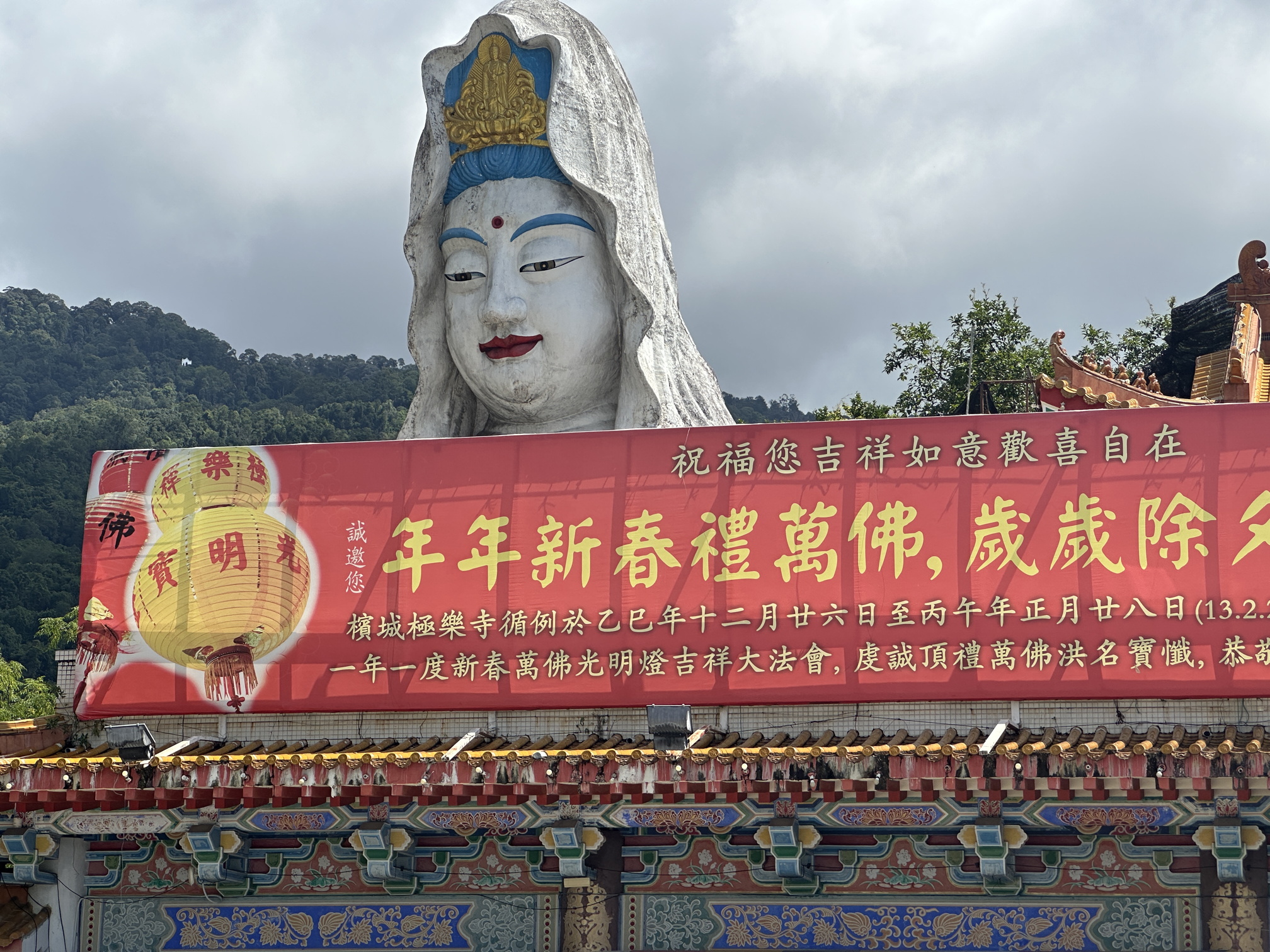
Kek Lok Si is about half an hour by Grab west of George Town, not quite five miles, and well worth the visit. It’s a Chinese Buddhist temple built between 1890 and 1930, and, like Hean Boo Thean, is dedicated to Kuan Yin. How dedicated? 120 feet of bronze dedicated.


But Kuan Yin was at the very top of the hill, and it was quite the journey to get there. Honestly, it was pretty confusing. There was a pair of short funiculars with a shuttle bus and a massive gift shop between them.

Then there were shuttles that would take you to the same places as the funiculars? Different places? I don’t really know. I’m pretty sure, though, that I missed the actual Kek Lok Si Temple. I was back down at the bottom by then and didn’t have it in me to make another ascent.
The pagoda on the left is the the topper to the Kuan Yin statue. The white wedding cake on the right is the temple I missed, or one of them, the Ten Thousand Buddhas Pagoda. I’ll wait while you guess what’s in it…

Or maybe I did see the Ten Thousand Buddhas Pagoda. This room had a lot of Buddhas.


But no. It was just a room with a lot of Buddhas. But not 10,000 of them. And merch. A lot of the temples were merchcentric, but this one was clearly the mothership.

Three tons of Burmese jade Buddha, worth ~ 1.5M USD. 
More than a little Chinese. 

And whatever these are. 
I mean, WTF? What a… diverse set of influences. Although if you’re specifically hunting a mishmash of Chinese, Greek, and faux European, you’re home. But also, what’s wrong with you? 
And this could have been a ceramics shop anywhere.
The view of George Town from the top was pretty impressive.

The grounds were littered with frankly inexplicable stone carvings. Like the long arm of IP infringement suits would never make it all the way up their holy hill. Which is probably true. Even the statues that weren’t recognizable IP felt like ripped off IP I just wasn’t familiar with. Entirely begging the question, what the fuck were they even doing on temple grounds?


On the way back down I was pointed towards the funicular… which was empty. I guessed that I was meant to operate it like an elevator, so I punched a button that did, in fact, start the funicular down the hill. They should probably have checked my license.

Back down at the bottom, I followed the signs to the official Kek Lok Si Temple Tortoise Pond. Which was awesome, but also so full of tortoises it was kind of creepy. Like if that many of any other species was in the same place at the same time, infestation would be the appropriate terminology.


If this was anything but tortoises you’d run screaming. Spiders. Kangaroos. Snakes on a motherfucking plane.
There was a guy selling bundles of leaves for two ringgit. One scarcely thinks of tortoises and frenzy together, but I didn’t merely witness a tortoise feeding frenzy, I caused it.
Thaneermalai Shree Balathandayuthapani Devasthanam
This mouthful of temple was near the Botanic Garden at the foot of Penang Hill.


Peranakan Museums
A number of old Peranakan houses/mansions/compounds have been preserved and operate as museums. They offer a fascinating glimpse into a gilded age of excess, the equal, at least, of any Western money pits. Maybe not quite on the same scale as Hearst Castle, but with similar aesthetic ideals. Enough gold leaf to choke a Trump.
Leong San Tong Khoo Kongsi

Not strictly speaking a mansion, Leong San Tong Khoo Kongsi is the clanhouse of the Khoo clan, a hopped up version of the Clan Jetties that dot George Town’s eastern shore. The compound was essentially a miniature clan village, with its own self-government and all of the functions necessary to manage clan affairs, from education to finance to welfare to religion.
This was my favorite of the Peranakan museums, in no small part because it’s completely hidden away down an alley. I walked past it multiple times and never noticed it until I went looking for it. Also, because it’s completely over the top.

It’s a whole little city. 

Outstanding cake toppers. 

The Liberace of… oh, never mind. 

Don’t know what this is all about. 
Except being very, very gold. 
The Eight Immortals, depicted here relaxing at Khoo Kongsi. The couplets flanking the mural translate as loyal officials and dutiful sons are first-class human beings and farming and studying are the two things that matter most. Yup. 
Honestly, it hadn’t even occurred to me. Until someone planted the thought in my head. Bastards. 

One of the onsite temples. 
Cheong Fatt Tze
Cheong Fatt Tze was a Chinese emigré to SEA who leveraged himself up from poverty to become obscenely rich. I’m sure that The Rockefeller of China was meant as a compliment. The wealth derived from his mercantile interests (banking, shipping, agricultural products…) also provided political power. He served as the Chinese Consul, working with the British Raj to promote Chinese interests.
His George Town mansion has been preserved, ostensibly as a museum. Also known as the Blue Mansion (guess why – I’ll wait…), it’s kind of a bait and switch. It’s not much of a museum, because it’s actually a hotel, most of whose grounds are off-limits unless you’re a guest. You can wander the public areas for 25 ringgit, but that’s pretty much the lobby and the restaurant, with a few display cases holding old stuff. There’s a guided tour that provides a little more access, but that’s at scheduled times and requires a reservation. That don’t work for this ramblin’ man.
So I saw the public bits, and it’s a pretty building. That’s all I got.


Pinang Peranakan Mansion
If Cheong Fatt Tze was a hotel masquerading as a museum, the Pinang Peranakan Mansion was a gift shop masquerading as a museum. So much architectural cosplay. I swear, every third gallery was merch. I love museum gift shops, almost as much as cake, but it was a little much.
The collection was fascinating, but seemed kind of haphazardly curated. “Here’s a room with Peranakan beaded shoes! All the shoes we could find, right here. Every pair. Yep.” There seemed to be only a fitful effort to use the collected artifacts to tell a story, which is what museums do at their best. Absent that, it’s just an agglomeration of cool objects with the occasional explanatory plaque.
If you think about it, the Hagia Sophia is just a museum of itself. There’s nothing wrong with a museum being about the structure instead of the collection. In this case, the Pinang Peranakan Mansion was primarily about the structure, but they’d filled it with interesting stuff to look at while we’re there, so thank you. It’s why all the gift shops fit in. Just more stuff to look at.
Dating back to the 1890s, the Pinang Peranakan Mansion was built by a wealthy Peranakan tycoon as his home and office. It’s designed in the Straits Eclectic style, an amalgamation of Chinese, Malay, and British architectural elements. That seems fitting for the Peranakans, who were themselves woven from multiple cultural and ethnic threads.
The house itself is epic in scale. Massive rooms flow into more massive rooms, sitting areas look like they could hold a government delegation, and even the opium room has multiple beds. Livin’ la vida loca.

The dining room, with mirrors strategically placed on the side walls so everyone could be observed from the head of the table. 
One of the opium beds, conveniently located off the dining room. The porcelain pillows were meant to keep visitors from getting too comfortable and overstaying their welcome. 
One of several open areas, for air flow. 

More than one onboard temple. 
This one features a life-sized statue of the original builder, Chung Keng Quee. A small man, even his effigy was propped up on a plinth. 

An open air balcony on the second floor. 
A second floor seating area. 
The other end of that same massive seating area. 
A pair of second floor bedrooms. 
As modestly curated as the collections were, they were still the highlight. They were diverse to comic extremes, from embroidery to glass to beading to jewels to goofy hats, all the way to a vitrine full of Hummels. Can’t make this shit up.
It’s important to note, though, that the collection on display doesn’t have anything to do with the house itself. In Melaka, for example, the Peranakan houses that had been turned into museums were family museums, where the objects on display had been curated from the original owner’s own belongings.
The Pinang Peranakan Mansion is a different story. The building had fallen into disrepair and was acquired by a developer in the 1990s who turned it into a museum and used it to display his own collection of Peranakan antiques. That’s probably why the collection seems poorly curated. It’s neither the documented belongings of a specific family nor an intentionally curated exhibit. While he may not be a distinguished curator, our developer is an eminent collector. The exhibits run the full gamut from Wow to WTF.

The Hall Of Florid Glass. 

Curtain pullbacks, from the Hall Of Gilt Housewares. 
From the Hall Of Overwrought Furniture. 

You’ll notice the Good Luck Bat on this carved chair back. 
From the Hall Of Silly Hats. 


A 53 carat diadem from the Hall Of Damn That’s Heavy. 
I suppose there isn’t that much of this, but it’s a shame to have a Hall Of European Twaddle, no matter the scale. 
The shoes and beading room was spectacular. The beaded Nyonya slippers are still a thing, available in multiple shops here and in Melaka.


Penang History Gallery
I was dubious heading into this. It had been on my list to visit, but it was specifically recommended by the couple I walked with on the Penang Hill nature walk. The woman said that she really liked it and that she wasn’t “a museum person.” A museum that describes itself as “interactive” and appeals to people who don’t like museums? I almost skipped it.
But I’m glad I didn’t. I’m not even sure “interactive” is the best description, as it suggests a level of touchscreen tech that was completely absent. Rather, the displays were all life-sized recreations of environments, such as shop streets, dens of iniquity, and bombed out WWII buildings, with faux newspaper clippings offering the context. I think “immersive” would have been a better description than “interactive.” My services are available for a reasonable fee.
The most interesting part of the history, to me, was the WWII bits. George Town was a British entrepôt which somehow came under Great Powers scrutiny during the war. When you’re a hammer, everything looks strategic. The Japanese had been bombing George Town to soften it up for what appeared to be an invasion. In response, the British… left.
On December 16th, 1941, in the dark of night, the British gathered up all of the Europeans, put them on a ferry, and evacuated them to Singapore by train. When the remaining Asian inhabitants woke up, many of them members of the civil services, they found they had been abandoned by their more “civilized” masters. The ensuing Japanese rule was as gentle as was common at other Japanese-occupied territories at the time.
The shock and horror of all of this was not that the British were feckless cowards with no regard for the savages under their aegis. It was learning that when the Americans fled Vietnam they were just following an oft-copied playbook. Nothing original to add, even in abject, tail-tucked-between-legs defeat. Typical.

An historic George Town shopping street. Which, honestly, looks exactly like George Town today. Except for the bowlers. 


An oddly specific sign from a restaurant recreation. 
A replica of Sun Yat-sen’s lodgings. 
An entire tour of bombed out George Town. 


Not exactly interactive, but animated. She didn’t do it often, but if you watched long enough the dour Queen Victoria would grace you with a smile and a wave. It made me feel special. 
Rental Peranakan dress up for the Gram.
This was probably the most alarming thing on display. I don’t think I have ever read a more anodyne description of the bombing of Japan, even in government-sanctioned America First high school textbooks. I guess when atomic clouds blot out the sun they also leach out the nuance. “A proud victory.” Chilling. There’s a special place in hell for whoever wrote that.

Fort Cornwallis
The most noticeable British colonial leftover in George Town is Fort Cornwallis. The original wooden stockade was built in 1786 by George Town’s founder, Captain Francis Light. It was replaced in 1810 by the brick and stone structure still standing today as a response to the threat of the Napoleonic Wars. Which never actually materialized in Penang, so it’s been used for administrative purposes for most of its life.
Which is almost all I can tell you about the Fort, since it’s closed for renovations. Which I discovered when I got there and it was closed.


As has been documented, Temple Fatigue is real. George Town wraps up ten months in SEA out of the last fifteen. That’s a lot of Hindu and Buddhist temples, so I’m grateful for the Chinese influence here. It’s wrapped a lovely bow on our SEA adventures.