Day Tripper
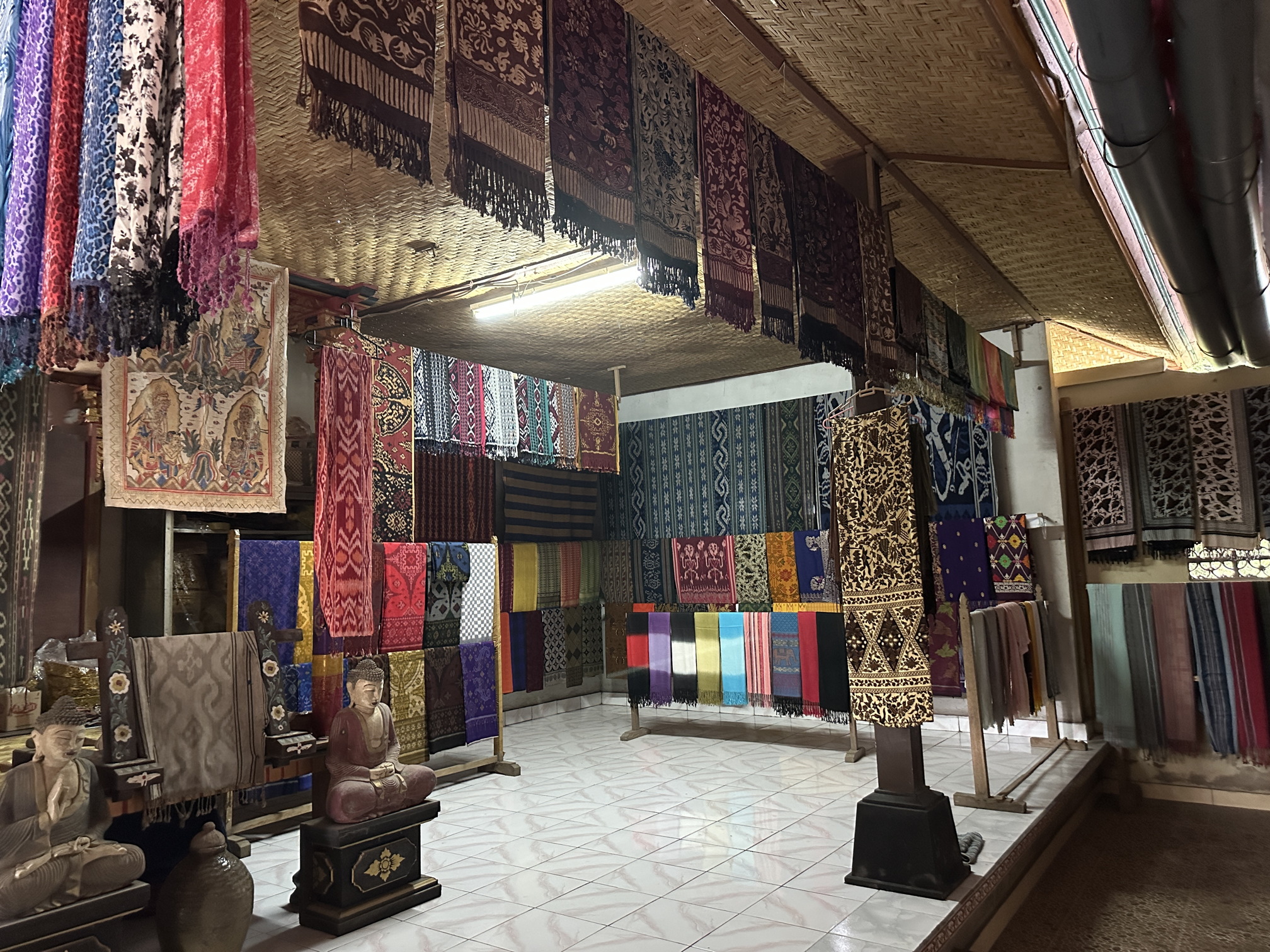
As lovely as it is to bob in the water, you just knew we couldn’t go a full month with nothing but ocean for entertainment. To what I’m sure will be absolutely no one’s surprise, we decided to visit an ancient village that specializes in an ancient form of ikat weaving. Tenganan is a little more than an hour from Amed, so we looked for other things to do that made sense in the direction we were heading. We arranged a car and driver through our homestay and put together a full day’s itinerary.

We had driven through the mountainous inland on our way to Amed from landing in Denpasar, but we’ve been on the beach since. Now that we had our bearings, the drive into the backcountry was a delight.


But what’s a roadside without monkeys? Didn’t know we were going to get all existential, did you?
There was an entire roadside monkey village. These guys may have been meant to stand guard, but they were notably derelict. They just let us past.


I did get out of the car to capture pictures, but I never approached them and never made eye contact. I’m not that stupid. Although Dorothy stayed in the car, so maybe I am.
Our first official stop on this tour was, of course…
Tenganan
Tenganan, like many of the traditional villages we’ve visited in Southeast Asia, has an entrance fee. Or in this case, a donation of your choice. Whatever you donate gets you in and assigns you a local guide. Which is good, as there’s a lot going on and no obvious way to parse it without an expert.
Tenganan is over 1,000 years old, Bali’s oldest village, and is one of the homes of the Bali Aga, the original indigenous Balinese. It holds about 250 families, around 750 people total. There are no homestays or Airbnbs. If you weren’t born there you can’t so much as spend the night, let alone move in.
About half of their economy is agrarian, primarily rice, with the other half handicrafts, mostly textiles and basket weaving. They are almost completely self sufficient. They do their own construction, carve their own wooden ornaments and stone statues, grow their own food, and raise their own livestock. The entrance donations go directly to the village, to help them sustain their atavistic culture. They aren’t untouched by modernity so much as uninterested.
But they will happily take a credit card.
The setting is, unsurprisingly at this point, idyllic. Bali, am I right?


The village is full of wonderful statues and carvings, all of them made by villagers at one time or another. I asked how old the doorway guardians were, and our guide laughed. No one knows.


The carved friezes in the public square depict various scenes and rituals associated with village life. This is where we learned that cockfighting was an important cultural and religious component of Balinese life.


Which explains this. Kind of.

That is a hand-dyed rooster, caged for our protection as it’s been trained as a fighter. While cockfighting is a Bali thing, dying the roosters ridiculous colors is a Tenangan thing. I couldn’t figure out a reason. I think it just amuses them. I stole this from Flickr, because I wasn’t able to enjoy the caged rooster in all its natural glory. No reason for you to be denied.

The wood carving is also present in elaborate doors and fanciful tools.


But I’ve buried the lede. We came for the traditional crafts and so did you. I’ve kept you waiting too long. Thank you for indulging me.
Geringsing Double Ikat
After touring the village, the guide took us to a weaving shop. Which, surprise, turned out to be his home. Hey, we’re there to support the economy however we best can. But the lovely side effect is that, after looking at the outside of the village, we got to go inside someone’s home.


Part of the home was set up as the workroom and shop, where both husband and wife worked and displayed their creations.


So what’s all the fuss about? Why is geringsing double ikat such a thing? First you have to understand how ikat creates woven patterns.
There are a variety of ways to create patterns in textiles. You can take a solid fabric and embroider over it. You can print patterns on it, either through modern printing techniques or through older methods like batik. Brocades are made by layering solid colors of thread in various patterns in both the warp (the threads running top to bottom) and weft (the threads running side to side).
Then there’s ikat. In ikat, the warp or weft threads are resist dyed in a pattern, so each thread is multicolored in stripes. The distance between the colors and the pattern of the thread’s color repeat defines what the finished weaving will look like. You design the finished weaving when you dye the thread.
Single ikats use the resist-dyed thread in either the warp or weft direction. Double ikats use different resist-dyed threads in both warp and weft directions. This is considered the single most complicated weaving technique of all, so difficult that only a handful of locations all over the world are capable of producing it (without going mad). Three villages in India, one in Japan, and Tenganan.
Tenganan has been making its double ikat, geringsing, for at least 700+ years. The earliest known citation is from 1293, but some theories tie it to the Indian Gujarati double ikat going back 2,000 years.
But wait. Geringsing isn’t just a double ikat. It’s a powerful, magical double ikat, capable of providing its wearers protection. It’s right there in the name. Gering means sickness and sing means no. There are rituals and practices associated with the weaving process that imbue the Geringsing with its powerful properties.
Warriors have worn geringsing into battle, but its more common use is to protect villagers during rites of passage and important transitions. Death is one of those transitions, and a geringsing may no longer be used after it’s helped a villager over the final boundary. That’s how antique geringsings get sold.
Our guide’s wife only made single ikat, although he had vintage pieces his grandmother had made fifty years ago. He still had the components of her backstrap loom, although his wife doesn’t use it.


Our guide told us that no one made geringsing anymore, that it was too hard. That was, how do I say, untrue. His wife didn’t make geringsing and he had us in his shop and didn’t want to lose a sale. Rather than take us to another workroom that made modern geringsing, he pimped his grandmother’s vintage pieces.
Which was fine. The antiques are more expensive than the new pieces, but they’re also antiques. We could have insisted on being taken elsewhere, and chose not to. That’s on us, not him.
We started by looking through his wife’s single ikats. Maybe she wasn’t up to the rigors of geringsing, and who can blame her, but her single ikats were beautiful.


She even had a couple of brocades to show us.


Then we asked for geringsing, and that’s when the private stock came out. They had a few more pieces, but they were similar enough that they just showed us these two.


Palm Leaf Books
Our guide’s wife was the weaver, but our guide made palm leaf books. There were two styles, one a calendar and one a retelling of the Ramayana. We picked the epic, of course.
The method was fascinating. Palm leaves are trimmed to serve as the book’s pages, and the design is etched into the palm pages with a stylus. Burnt macadamia nuts are then rubbed into the pages as an ink, sinking into the etched lines. The excess is cleaned off, bringing the drawings to life.


Stick Ikat
Having selected an antique geringsing, a modern single ikat, and a palm leaf book, our guide walked us and our haul to the lady who had the credit card terminal. And her own workroom/shop. While ringing us up she encouraged us to look at her work, but we demurred. Having just spent Berber carpet money, we were tapped out.
Then we looked at her work. Fuck.
Ikat is hard enough to wrap your head around, and double ikat requires a willing suspension of disbelief. The artisan referred to this as stick ikat, and while this is a single ikat, it’s almost as mind-blowing as the geringsing. How? Just… how?
I could find out almost nothing about this technique online. But seriously. How?


Ata Reed Basket Weaving
Just when we thought our last shekel had been surgically extracted, we came to a basket weaving shop on our way out of the village. I’m sure our route was entirely coincidental.
All the work had been produced by the man sitting in front and his family. The baskets are woven from Ata reeds, which grow in abundance in Tenganan. The work is tight, precise, and elegant. How could we leave empty handed? We’re not monsters.


We wound up enjoying the rest of the tour, but Tenangan had been the motive force for the trip, and it was 100% the highlight. We were expecting spectacular weaving, and were still blown away, but we weren’t expecting the delightful peek into ancient village life. Thanks, Bali.
Lebah Agrotourism
Lebah Agrotourism, a coffee plantation and honey farm, sits just outside Tenganan. It wasn’t on our itinerary, but our driver said it was worth our while. Who are we to argue?
Well, we did try to argue. The sign on the front said their specialty was Kopi Luwak, which is civet coffee. Civets, which are just weasels with airs, eat coffee cherries and poop them out, fermenting them in the process. The cherries are harvested and then made into coffee the usual way. As if nothing untoward had occurred.
Dorothy is a hardcore omnivore who will eat just about anything, but she has, entertainingly, drawn the line at Kopi Luwak. Not a chance, which made the stop seem superfluous. But our driver insisted that fun was to be had, so we relented.
Like, I suppose, the entire island of Bali, Lebah was a lush jungle paradise. We started with a walk through the coffee plantation. It’s not a plantation in the rows-of-trees sense, more just a place with lots of coffee trees.
A lot of the large-scale Kopi Luwak providers keep caged civets and feed them coffee cherries, like a caffeinated goose, but Lebah does it the old-fashioned way: they scour the jungle for civet scat and scoop it up for the partially digested coffee cherries. Free range, y’all. Also, world’s worst job?


The honey operation is likewise not an industrial operation, just a jungle with a lot of beehives. They keep two kinds of bees and make two kinds of honey. There’s the standard bee (Apis Cerana), which they call the Asian Bee, and then there’s these tiny little bees, almost gnat-sized, which they call friendly bees (Apis Trigona, or the Kelo Honey Bee, locally), because they bite instead of stinging.
The friendly bees live in forests, which means that harvesting the honey is a foraging operation. Lebah has been able to breed them, which is much harder to do than breeding standard bees, so they have their own population and can harvest honey onsite.

These little boxes hold the friendly bees. 
Friendly bees will also live in pots. 
Each of the colonies houses about 1,000 of the tiny bees. Do you see them? Look in the slot. 
The friendly bees make a weird honeycomb. Which is apparently high quality and valued for batik. 
The standard Asian bee is in the hanging logs. 
They make a normal looking honeycomb.
As their size suggests would be the case, the friendly bees produce much less honey than a standard bee. Each friendly bee colony produces only 1-2 kg/year, whereas a standard bee colony produces up to 10 kg/year.
But the differences really show up on the tongue. The tour ended with a tasting, meant, I believe, to part us from our cash. The standard bee honey was very good honey. If I’d tasted it on a farm in Wisconsin I’d have said, “That’s very good honey,” but I wouldn’t have gone all Tex Avery on it.
But the friendly bee honey was… something else entirely. It was way more complex than regular bee honey, with more going on than just sweet. It has an almost sour undertone, and is much less viscous than standard honey. It’s also eyepoppingly expensive. They don’t make enough to export, so it’s pretty much only available at Lebah. 60 ml was $20 USD.
It’s in a sealed bottle, so we’re confident we can get it past customs.

But the highlight of the tasting was shaming Dorothy into trying the Kopi Luwak. I don’t drink coffee, and I’m remarkably more squeamish than she is about what I put in my mouth, but I told her that I’d have some if she did. I was as good as my word. Joint verdict: Good coffee. Less alkaline than coffee that hasn’t passed through a digestive system. Not worth the weasel poop.

Taman Ujung Water Palace
Water palaces are a thing here, and they are, sadly, not grandiose, palatial water parks, which is certainly what I was hoping. Rather, they are palaces in which water is a critical part of the site design. Taman Ujung was constructed from 1909 to 1921 by the last king of Karangasem. He leveraged a site the previous king had built for exorcisms. So, no bad vibes. Nope. None. Everything fine here. Fine. Everything is fine.
The grounds and structures are, well, fit for a king. They are gracious and serene and beautiful, and less ornate than you might think. Luxurious, yes, and grand, but more stripped down than expected. It’s hard to think of a site like this as tasteful and restrained, but we’re grading on a curve here.


Belying that whole restrained thing, the compound is stuffed to the gills with fabulous carvings and sculptures.


We didn’t spend a ton of time here, but it was a lovely, relaxing interlude in an objectively stunning setting.
Maha Gangga Valley Rice Terrace
This was a funny place. On the one hand, it’s a working farm, growing rice, vegetables, and flowers, as well as managing livestock. On the other hand, it’s a roadside attraction, offering a curated experience and leveraging its natural beauty for tourism.
We were kind of expecting to be underwhelmed by the visit, due to the theme park undertone, but we were charmed by the setting and our guide.
The guide is part of the experience, and is included with the entrance fee. There’s no just wandering loose. When you arrive at the gate, you’re presented with a menu of options. You can go for a simple trek, you can swim in the pool under the waterfall, you can have lunch at their restaurant or visit their spa. You can stay in one of their huts. We chose a guided trek, which was least expensive and took a couple of very enjoyable hours.
While they’ve tarted up the fields with follies for the tourists, Maha Gangga is first and foremost a rice producer. There’s something about the green of rice paddies that seems to be its own particular color.


Beyond that, the site was truly stuffed. The valley it sat in was gorgeous.

They had ponds with both catfish and koi. We enjoyed the feeding frenzy for both of them.


There was a little stone temple just sitting in a field.


Hut-el rooms.


There was a lovely valley with a waterfall and a pond. And, for no identifiable reason, this:


There were lots of amazing flowers and plantings, some decorative and some planted and harvested for sale.


This is bola adil, a traditional Balinese gambling game. It looks like Twister, but it involves rolling a ball on a custom-made board until it falls into one of the shallow indents (it can take awhile), with betting on where it will land. We played a few rounds, with victory ever out of reach, but it was fun.

And finally, there was this. For scale, I’d say it was about 20′ tall. Other than that, your guess is as good as mine.

Where We Didn’t Go
As usual, where we chose not to go says as much as where we did visit.
When we proposed a trip to Tenganan, our driver immediately suggested two other stops in that direction: Tirta Gangga and the Penataran Agung Lempuyang Temple. He proposed both locations because they’re top bucket list stops for tourists. We declined, for the same reason.
Tirta Gangga is a water temple, like Taman Ujung. Taman Ujung is older, larger, and classier, but it’s much less traveled because it lacks Tirta Gangga’s Instagram pedigree. Which is why we didn’t go. I don’t even feel guilty about scraping this photo.

I love almost everything about our lifestyle, but one thing I definitively hate, besides the French, is what Instagram has done to travel. How long did that shot take to stage? How many people couldn’t enjoy themselves while it was happening? How can someone be so aware of the frame’s composition and unaware of their surroundings? On the other hand, it was pretty cool to learn that koi can be fed with self-regard. It’s the unexpected lessons that really hit home.
We passed on Lempuyang Temple for pretty similar reasons. It’s heavily touristed, and even more Instagram-degraded than Tirta Gangga. In fact, when you pay your entrance fee you’re assigned both a photographer and a number for the iconic photo spot, the Gates of Heaven. You queue up and wait for your number to be called, hand the photographer your camera, and pose for your Instagram photo. You get a couple of minutes to get your shot, at most, before the next number is called.

Instagram has made a photo factory out of a holy site. It’s stomach-churning.
Somehow even worse, there’s no reflecting pool. The local photographers hold a mirror under the camera to get that effect. To be fair, though, the choice to be good tourists was pretty easy. It requires over 1,700 steps to visit all of Lempuyang’s temples.
We were having a conversation on the topic of physical limitations the other day, lamenting that Bali seemed to offer a number of adventures we’d aged out of. Ziplining through the jungle. Hiking to the caldera of an active volcano. Whitewater rafting…
Then we realized that we wouldn’t have done those things when we were younger. It felt good to know that our age and fitness weren’t keeping us from adventure, just our natural aversion to things that might be fatal. It was very affirming.
What an amazing trip! You’re giving me the wanderlust!
You’re welcome. And never forget, you can always join up with us. We usually know at least a few months in advance where we’re going to be. On this trip, for example, my sister is joining us in Yogyakarta, in Java, after we leave Bali. We love to have guests.
Oh Markus Carkus! the beans are ROASTED after being “civetly” processed…
Hey btw honey is BEE SPIT after all!
I know the beans are roasted. But what other foodstuff do you harvest from poop and then process like it hadn’t been harvested from poop? None, I submit to you. None other foodstuffs.
AND you eat that honey raw… so…
Sure, but it’s not like you’re waiting for a bear to steal honey and then harvesting delicious honey nuggets from its poop. Bee spit is an entirely different matter than civet poop.
BTW, I don’t think this blog gets enough credit for its highbrow content.