Temples & Textiles
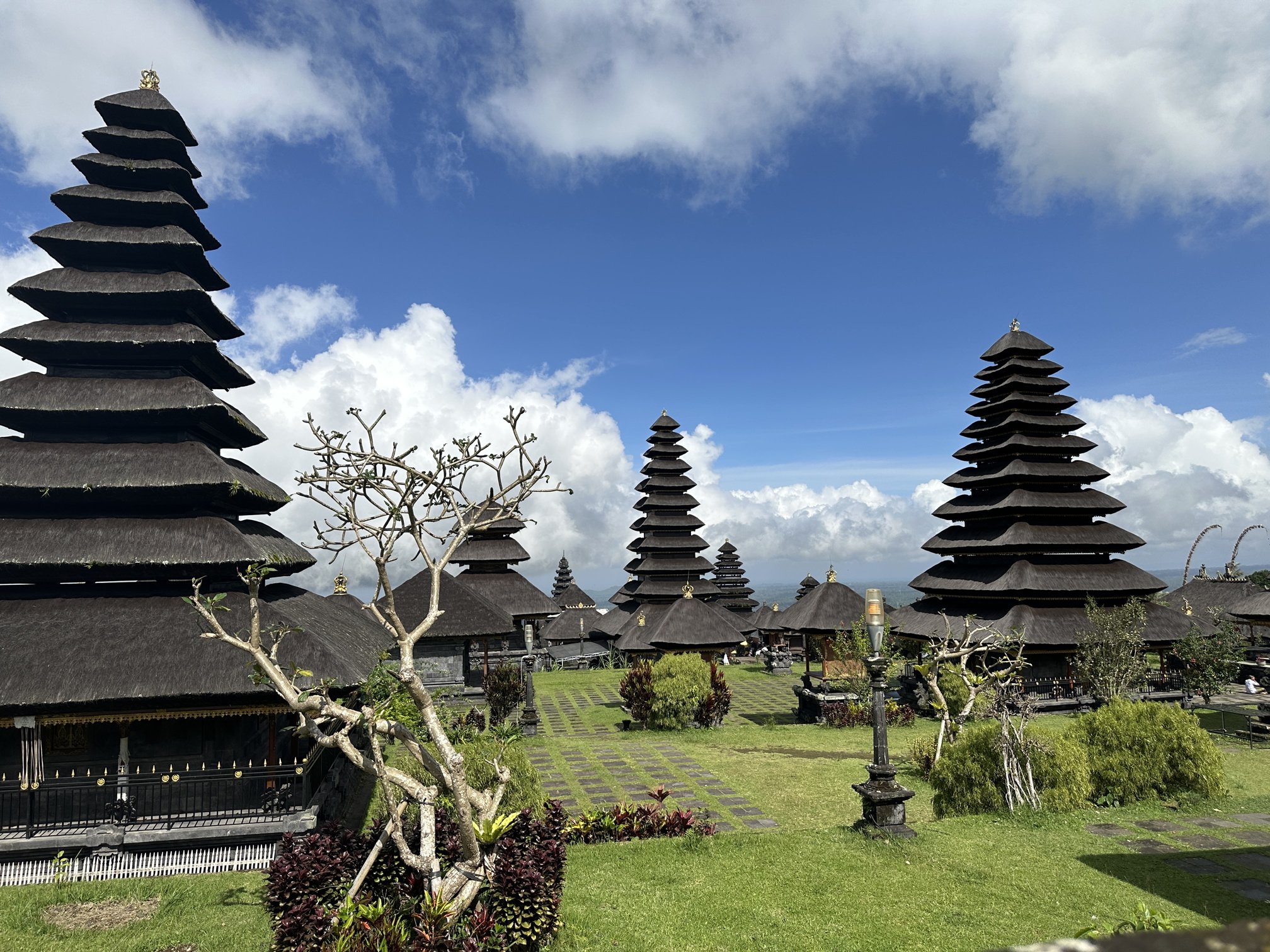
Once again, fabric beckoned. After our visit to Tenganan to see their double ikat geringsing, we planned a visit to Sidemen to see songket brocades being made. The Besakih Temple was close enough to Sidemen to add to the trip, and we chose to start there, so we wouldn’t be trooping around a large temple complex in the midday heat.

As always, though, in Bali the journey is as important as the destination. Unless you’re asleep in the back of the car, it’s impossible to drive around Bali without being devastated by its raw, unfair beauty.


Besakih Temple
I have confessed, to my shame, to a notable case of Temple Fatigue towards the end of our ten weeks in Vietnam. There are just a fuck ton of temples and pagodas slathered thickly throughout the land, and they do get a little samey after repeated viewings.
And I’m going to get myself in trouble here, but I’m expressing a personal esthetic, not assaulting a sovereign nation’s cultural patrimony. I find the Vietnamese temples a little twee. Not at first. But on repeated exposure their delicacy starts to feel a little forced. Like how Brits seem so polite until you remember they were all caned at school for speaking up. Not Piers Morgan, obviously. Some folk clearly weren’t caned enough.
My point being, if I can crawl out of the hole I just dug, that we are having no such problem in Bali. Maybe after ten weeks we would, but I doubt it. For one, we’re not temple chasing here. We’re taking a more measured approach after our Vietnam experience, so that should reduce our risk. But I also just love the ferocity and joy in the Balinese temples. Their guardian gods are locked and loaded, ready to defend to the bitter end, if necessary, with nothing but love for their followers.
If we’re going to be choosy about our temple excursions in Bali, then we can’t miss Besakih, the largest and holiest temple in Bali Hinduism. Built on the slopes of Mount Agung, Bali’s largest active volcano, it’s not even one temple. It’s a complex comprising 23 separate temples. It’s also very, very old. It dates to at least the 8th century, but the stone bases of several temples, including the main temple, Pura Penataran Agung, resemble megalithic stepped pyramids. That would place the oldest structures at about 2,000 years old.
As you enter the temple grounds, the first thing you notice is Mount Agung looming over the meru towers and the tropical foliage.

The courtyard before the first temple has a massive fountain, featuring dragon heads and clawed feet.


Just past the fountain is the reveal, Pura Penataran Agung.


The temple’s plaza is used for prayer and is off limits to tourists. There are ceremonies going on all the time, so some parts of the complex will always be in use and inaccessible. Our guide, as a native, was permitted in, and took this 360° video for us.
We were able to get a look at the main plaza on our way up the side of the temple. The umbrellas are meaningful, as they collectively represent the Trimurti: Red represents Brahma, Vishnu is black, and Shiva is yellow and white.
Once you get to the top you can see the Gates of Heaven up close. We learned in Vietnam that the Gates of Heaven shape represents hands raised in prayer. 🙏


As we ascended further up what felt more like a small city than a temple complex, we reached the area where visitors are allowed to pray. We had purchased small pre-fab offerings on our way in, which is why we were able to enter the area. Our guide lit the incense for us, and we placed the offering where directed and knelt on the stone floor. A priest chanted and sprinkled us with holy water. Money was stuffed in a donation box. It’s almost like we knew what was expected.

Our donation kit. 
We were rightly deemed unsafe to use matches. 
We’re up next. 
We each got Trimurti bracelets: Brahma red, Vishnu black, and Shiva iwhite. 
At the very end we adhered grains of rice to our foreheads using some spare holy water. It looked so nice when the locals did it. 
We looked like we’d passed out at dinner and faceplanted into the rice bowl. And I’m still trying to figure out when Apple changed the front facing camera to a fisheye.
Getting to the top also gave us access to spectacular views…

And a closeup look at the Besakih’s defining visual feature, the pelinggih meru towers. These are the primary shrines in Balinese temples, built with a masonry base, a wooden chamber, and thatched roofs.


The thatching is replaced every ten years, and the towers require ongoing maintenance. We were unsurprised to find construction going on while we visited.


The entire site was chockablock with interesting things to see wherever your eye happened to stop for a moment.


And of course, no visit to a Balinese temple would be complete without visiting the gods, who always seem delighted to protect and serve. Just like the LAPD.


There’s something about the culture of polytheistic Hindu animists that really speaks to us. The monotheists seem closed down and locked up by comparison. I suppose when your theology acknowledges multiple right answers it’s easier to relax into a lifestyle with a more expansive definition of normal behavior.
Sidemen: Textiles & Silver
This was the whole reason for the day trip. Songket is a ridiculously rich, complicated brocade only made on backstrap looms. There is no way to manufacture songket; it has to be made by hand. Thankfully, Sidemen, one of the few places that makes songket, was close at hand.
Pertenunan Pelangi Traditional Weaving
We’d researched shops and studios in advance, so we knew we wanted our first stop to be Pertenunan Pelangi. They explained that almost all songket weaving is done in women’s homes, because of the backstrap looms. Pelangi sells their finished pieces, but their onsite weaving studio produces ikats.
Which is fine, because watching ikats being woven is plenty fascinating. A large room was filled with over a dozen looms, a handful of which were in use while we were there.
What’s ikat? I’ll quote myself, from the post on Tenganan’s double ikat.
In ikat, the warp or weft threads are resist dyed in a pattern, so each thread is multicolored in stripes. The distance between the colors and the pattern of the thread’s color repeat defines what the finished weaving will look like. You design the finished weaving when you dye the thread.
Pelangi specializes in endek, which is a weft ikat. That means that the warp (vertical) threads are a solid color while the weft (horizontal) threads are dyed to make the final pattern. That information is important in understanding what we saw on the second floor. There, a young man wove colored plastic strips into frames to create patterns. It took a few minutes to understand what we were seeing.
He was creating templates for dying the thread used to weave a particular pattern. They can weave from their library or create custom patterns on demand. This method, which we had never seen before, allows for mind-bending precision, permitting traditional ikat weaving to mimic complex brocades.


Later, when we went to Ubud, we visited Threads of Life, a high-end textile boutique, where they had examples of the hand-tied thread, ready to dye.


Minds completely blown, we staggered into the shop. There’s one section for the songket brocades they carry for local weavers.


And another section for their own ikats. Which were just fucking spectacular.


Kupu-Kupu Traditional Weaving
Our second stop was, as it happened, right across the street from Pelangi. Where we found a woman, a backstrap loom, and songket in progress. We got to see songket being made after all!
What’s the big deal with songket? Well, it’s an ancient weaving technique, dating back to the 7th century. It originated when Chinese traders brought silk thread to Indonesia and Middle Eastern traders brought gold thread. It is rich and luxurious, almost decadent, and another weaving technique it’s difficult to wrap your head around.
I am thrilled we got to see it being made, as there’s no way to appreciate it otherwise. I watched the weaver work for several minutes before I figured out she was weaving. I thought she was setting up the loom, because I’m used to seeing weaving where the shuttle moves back and forth on each weft row. Instead, she was taking individual warp threads and wrapping gold and colored supplementary weft threads around them to create the brocade pattern.
Every time I think I’ve seen the full range of complexity in weaving, shit like this happens.
Would anyone like to place a side bet on whether Dorothy bought a piece of songket? I thought not.


Agung Silver
Sidemen is actually best known for its custom silversmiths. You have to be a textile nerd to know it for its weaving. Since we were there, we let our driver take us to a place he knew, Agung Silver. The shops all have tourist classes. They give you seven grams of silver and a couple of hours to make a ring for about $30. Which is fine if you want the silver equivalent of a handprint ashtray. I have never understood the desire to make something badly yourself instead of spending that money on an artisan’s labors.
It was unprepossessing, but full of lovely things. Dorothy got earrings and I got a ring. I have decided, in my dotage, to becoming a ring wearer. Do not judge, lest ye be judged yourself.


Just Add Water
Technically this was a different day trip. Perasi Beach, known as Virgin Beach, had been suggested as part of this day’s itinerary, but we passed on it for the Sidemen trip because we’re old and weak. Dorothy’s craving for a white sand and turquoise water experience, however, was not to be denied. Our black sand beach in Amed was amazing, but tropes are tropes, and they are disrespected at your peril.


For those of you keeping score, this is what happy looks like.
Cremation Creations
On our way back, our guide pulled over so we could get a look at these astounding funerary sculptures being constructed. They are custom built to order for cremation ceremonies, and are lit up along with the loved one, to ease them on their journey. It’s a shame to see this much craft and devotion go up in flames, but they are purpose built, so they know their fate going in.


We were most taken with this piece. The fish part swam you to your destination, and the fierce beast head protected you on the way.


A new note for Sam and Ruby. In addition to daily altar offerings, we may require a Balinese style sendoff when we’re finally done. I’d had something more Viking in mind, but how can this not shift your perspective?
I got most of the way through the textile section and was asking myself when you were going to post pictures of what Dorothy picked out. As always she has magnificent taste.
Also technically Buddhism is not monotheistic–Brahma and other Hindu deities (along with rafts and rafts of other deities) are posited to exist within the Pali canon, they just don’t matter–they are deluded beings stuck in samsara the same way humans are, just with better zip codes (for the moment). “Yeah we got lots of deities but none of them matter” is an entertainingly postmodern take for a 2500 year old religion.
She does, doesn’t she? One of the things I’m most concerned about as a solo traveler is being paralyzed in her absence, unable to discern quality without her guidance. My natural tendency to a clown car esthetic definitely needs to be mitigated. Maybe I have an untapped reservoir of taste I’ve never needed to trigger as long as she’s with me, and I shall blossom in her absence. Or maybe I’m just a clown in a car. Stay tuned…
I am deeply, deeply embarrassed about the Buddhism mistake, and have edited the post. Thank you for pointing it out. I take doing my homework seriously, and I’m not sure how that slipped past. ChatGPT and I shall have words.