Ubud: The Heart Of Darkness
Ubud is full of galleries, boutiques, and performing troupes, and is billed as Bali’s cultural center, aside from the capital, Denpasar. It’s also one of Bali’s most heavily touristed areas, which is why, net, we had chosen to skip it. But we had four days in Denpasar, and we thought, on our last day in Bali, that we’d take a car the hour north to Ubud and spend the day. Surely, it would be worth a day.
And it was, if it was important to have our noses rubbed in the destructive impact of overtouristing.

By hype, Bali is thick with tourists coming for yoga centers and wellness retreats. We intentionally chose to stay in Amed, an off-the-radar beach town, to avoid that, and it worked. Even Denpasar seemed more like a bustling capital than Man Bun Mecca. We were beginning to think that Bali’s reputation was unwarranted.
Har.
It’s not just that we were greeted by a sign on our way into town offering a men’s retreat where you could “Learn To Love Like A King.” Ok, fine. That is such low hanging fruit for mockery that it’s doing its own heavy lifting. But there’s nothing funny about the devastation wrought on Ubud by tourism.
I am not immune to the irony, or whatever the superlative of irony is (self-loathing?), that the only way to learn about the impact of overtourism on Ubud was to arrive as tourists. That’s the throbbing cognitive dissonance that has been a top note to our entire travel extravaganza. Sometimes I feel like a john who justifies his behavior because he treats the girls so well.
We maintain a light footprint. We live as close to the local lifestyle as possible. We support artisans over merchants. And we’re still helping to drive up the cost of living and housing wherever we go. We’re still part of the problem.
Which makes whinging about Ubud problematic. But nothing I can’t overcome by ignoring it!
Ubud reminds me of nothing so much as San Miguel de Allende in Mexico. Like San Miguel, Ubud is a charming town whose charms have been nearly obliterated by tourists. In both cases you can squint and see the town that was the original draw, the elements that attracted tourists in the first place. San Miguel still has much of its original allure, as its clientele is the 1%, and their EPCOT Center village will be properly maintained. Don’t make them contact the manager.
What’s disturbing about San Miguel takes a minute to notice. It’s not that it’s a squalid hive of tourists, it’s that there are close to zero locals loose. No visitors, just shopkeepers. Mexicans have been priced out of San Miguel, which boasts Mexico’s worst income inequality.
Ubud is pretty much the same story, although its native charms are less manicured than San Miguel’s. But the setting, the old temples, the winding streets… The attraction is still evident, despite being buried under the avalanche of boutiques and souvenir shops that cater exclusively to tourists.


It’s not the wellness centers and the retreats. It’s that there’s nothing left of Ubud for people who actually live, or lived, there. It has given itself over completely to the predations of tourists, the most invasive species of all.
Because San Miguel truly is a way station for the 1%, it’s clean, curated, and modestly peopled (the only modest thing about it). There’s only so many folks who can afford San Miguel, which is how they like it. Ubud, on the other hand, was reminiscent of the souk in Marrakech, a veritable ant farm of gringos. It was, if I may permit myself, disgusting.
“But I’m not like those other guys, baby. I’ll love you like a king.” Which I think means that when I’m done with you I’ll fuck your daughter and your livestock. It’s what kings do.
*sigh* Welcome to Ubud.
Despite the above, we managed to squeeze out several positive experiences in our day there: a pair of nice temples and one spectacular, wholly unexpected museum.
The Royal Palace: Puri Saren Agung
Very little of the Royal Palace is open to the public, though what is available is choice. The palace was built in the early 1800s and restored after the 1917 earthquake, so it’s fairly modern. It’s used these days primarily as a performance space for traditional dance and gamelan music.


No Balinese palace is complete without a panoply of delightful carvings and adorably fierce guardian statues.


Puri Kantor Legacy Palace
Puri Kantor, like the Royal Palace, isn’t terrifically old, having been built in 1930. It’s a hotel now, with its grounds only available to guests. We got to view the courtyard, which was plenty interesting, especially since there was renovation underway.


There are still plenty of highly skilled stonemasons in Bali, working on both restorations and new construction. It was fascinating to see one of them at work.
Setia Darma House of Mask and Puppets
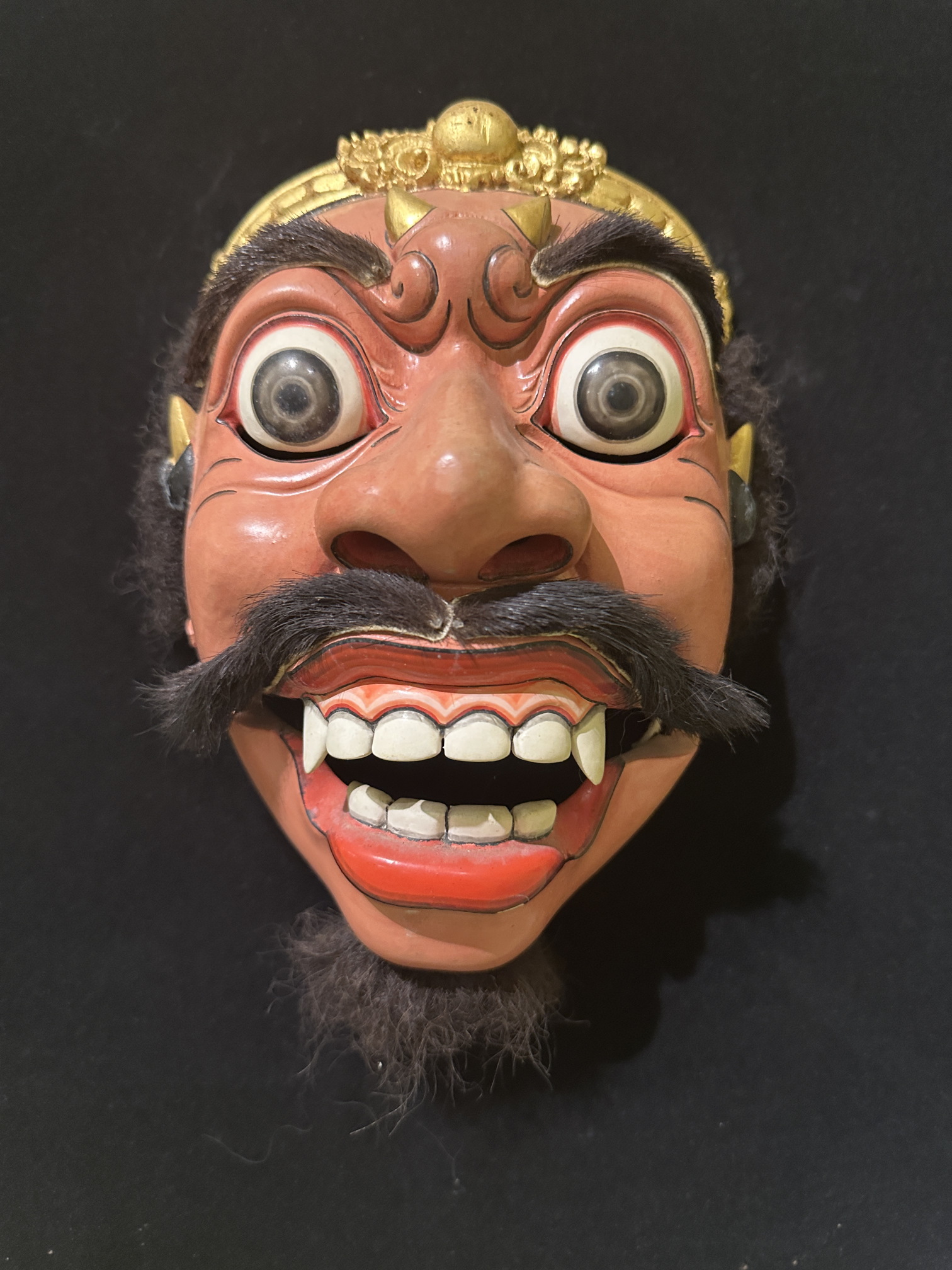
On paper, this looked like an interesting place. In real life, it was breathtaking, combining a ridiculously beautiful natural setting with a world-class museum collection of masks and puppets from all over the world.
Despite being hard by Ubud, 6 km and about 30 minutes by taxi, the place was deserted. There was one other couple there during our entire visit. It’s actual culture, so I suspect it doesn’t resonate with the kinds of tourists who find Ubud worthwhile. Fine. We were more than happy to have it to ourselves.


The museum is set up as a massive traditional Balinese compound, with each gallery taking up a discrete Javanese wooden house, a joglo. While the focus is on Indonesian masks and puppets, the collection features artifacts from all over the world. The compound also serves as a cultural hub, hosting performance and workshops.
Like many specialty museums we’ve seen, Setia Darma is the brainchild of a lone obsessive. Hadi Sunyoto is a wealthy collector who turned his private collection into a public museum in 2006. On the plus side there’s no entrance fee, so thanks, Income Inequality!
While there is, I’m sure, scholarly discourse available on the fine distinctions between regional storytelling traditions, we’ll have none of that here. That would require knowledge and expertise, and I’ve sworn off. What we have instead is a breathtaking collection of artifacts that can be appreciated for nothing more than their raw beauty. That’s enough for me, and it will have to do for you, too.
Wayang Kulit
Originating in Java, but performed in Bali, as well, Wayang Kulit is the traditional Indonesian shadow puppet show, a storytelling form over 1,000 years old. Unsurprisingly, the collection of Wayang Kulit puppets is excellent.


Balinese Ramayana Masks
Like many Southeast Asian storytelling traditions, the Ramayana figures prominently in Bali, and is responsible for some of the most beautiful masks.


Masks From All Over
Although it favors Indonesia, this truly is a worldwide collection.


Marionettes
We did a poor job of documenting countries of origin for the marionettes, but it’s pretty clear they represent a lot of different cultures and traditions.


There was also a display of hyperrealistic marionettes with no real explanation. These don’t look like archetypes, they look like very specific people. Other than the first one, which is obviously Obama and which was tagged to identify the other marionette as Hadi Sunyoto, the museum’s founder, there’s no information on who these people might be. But they’re definitely real people.


Random Acts Of Puppetry
There was a small display of New Guiinea Hand Puppets. A seriously missed gift shop opportunity.


There were a few full-size, multi-person Barong puppets.

And even a collection of puppet-themed paintings. As if the entire place didn’t already scream, “I have more money than I know what to do with!”


This one warrants its own discussion. The demon creatures are a Javanese-specific addition to the Hindu Ramayana narrative. The creature seated on the right is Samar, a Javanese demigod. The character on the left is Petruk and the bowing one in the middle is Bagong, both of them Samar’s sons. Along with their brother, Gareng, they make up the Punokawan, or clown servants. They are a consistent presence in both Balinese and Javanese wayang puppet shows.
OK. Great. But what the fuck is actually going on in this picture? Whatever it is, the women are clearly horrified. I’m horrified, and I have no idea what’s supposed to be happening. I can’t decide if I desperately want to know the story behind this or desperately don’t, so I can make up my own. Please offer potential narratives in the comments, like a New Yorker cartoon contest. There will be voting.

So did the Setia Darma House of Mask and Puppets make the visit to Ubud worthwhile? A resounding yes. As repulsive and disturbing as we found Ubud, the mask museum was at the other end of the spectrum, a peak experience and a must-visit if you ever find yourself in Bali.
Which you should.
Finally got this post read. Completely agree on the over tourism comments. Hope to catch up with you in Chicago! Safe travels!
Dorothy is staying with her parents for a month after we get back, so it will be a minute before we’re both in Chicago. It will be great to see you both.
I love the masks and puppets so much! Thank you for going so in depth!
Thanks for the encouragement. I worry sometimes that the blog posts are too much. Blog best practice is to keep them punchy – focused text and not a lot of photos, to keep load time down. I fail on both counts, primarily because I just don’t give a shit. Still, it’s nice to know that, for you at least, it works.