We Are Art Sluts
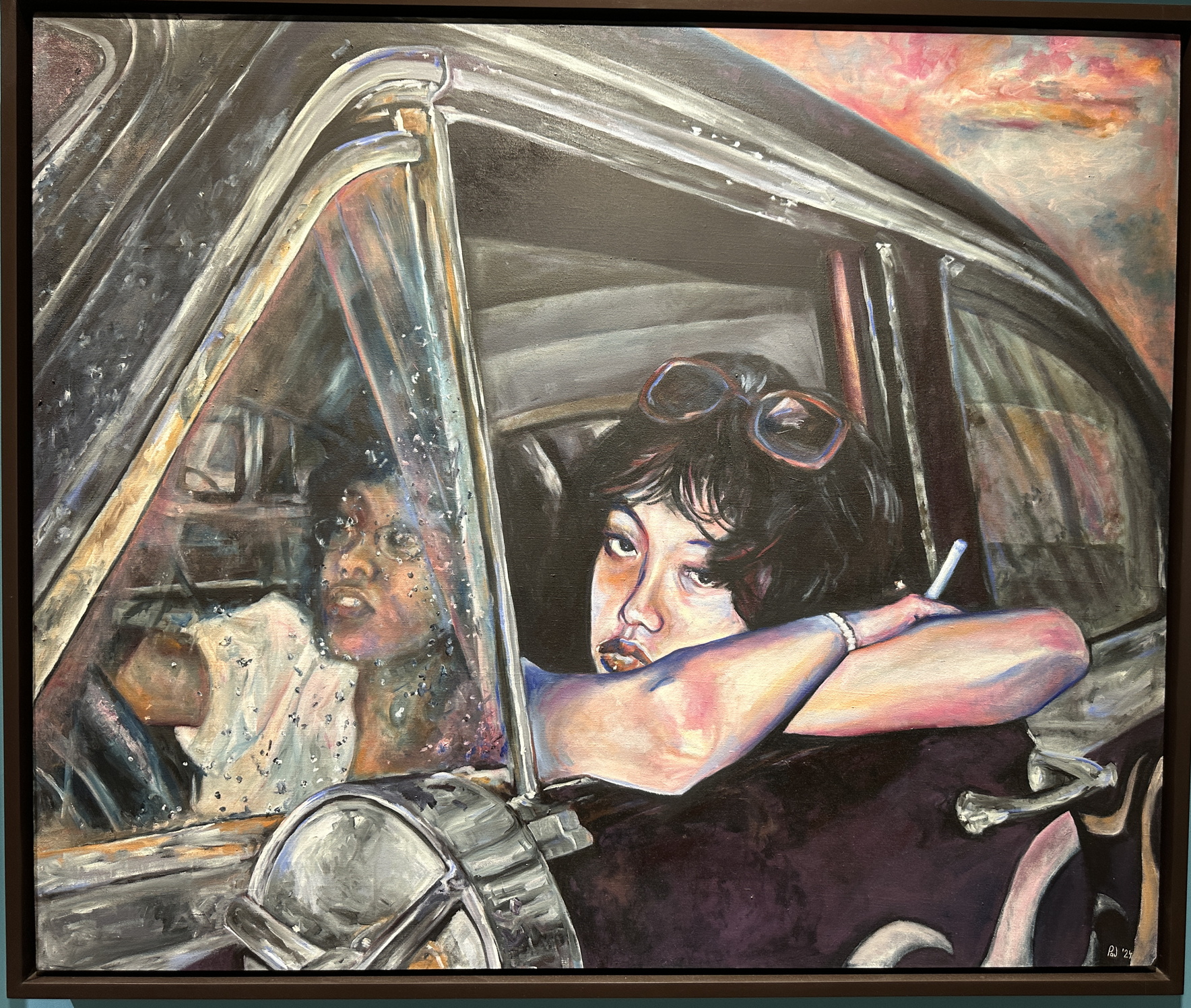
I’m not ashamed. Of anything, really, but certainly not of being an art slut. So much of our motivation to travel is to see what clever people in different places can do with their thumbs. We love us some beautiful nature, and I’ll never turn down a waterfall if offered (hit me up if you have one available), but other than food, art is what gets us up in the morning and keeps us on the road.
I’m using a pretty broad definition of art in this context, covering everything from fine art to handicrafts to ancient structures. All of that stuff UNESCO crams under the rubric of Tangible Cultural Heritage. And even the performing arts UNESCO considers Intangible Cultural Heritage. Close to our entire purpose in visiting other places is to see how those cultures express ideas about beauty, truth, and history.
I’ve already written about crafts and performance in Java, so for the purposes of this post I’m narrowing my definition of art to museums and galleries. But as you’ll see, that leaves a pretty wide range of expression on the table.
ArtJog
Sometimes it’s better to be lucky than smart. Our stay in Bali coincided with their annual arts festival, Pesta Kesenian Bali. That same luck of the calendar delivered us to Yogyakarta during their annual arts festival, ArtJog. Staged at the Jogja National Museum and lasting five weeks, each year’s festival is curated around a theme. This year’s theme is Motif: Amalan, and is incomprehensible even by the standards of ArtSpeak™.
To be fair, this morsel was translated from Indonesian (by ArtJog, by the way – I didn’t just run the original through Google Translate), but I really don’t think that’s the problem.
When an artwork is in the autonomous arena, then the selfless attitude, for example, becomes a ‘symbolic profit’, and the aesthetic moment transforms into an object of commodification.
Thankfully, comprehending this year’s motif wasn’t necessary to appreciating the work that their rubric prompted. I’m pretty sure there was work on display that pre-existed, but the vast majority of the work was created for the show. This is a prestigious exhibition, and artists step up to be included.
The entrance to the museum drops you right into it, with a massive piece called Secret of Eden. Tree roots grow out of the ceiling and spotlights cast eerie shadows on the walls. You walk through the door and enter another, alien world. It’s a brilliant way to bring you into the exhibition.


This gives you a real feeling for the overall space.
Once past Secret of Eden, the rest of ArtJog is more traditional arts festival fare: paintings, sculpture, ceramics, kinetic art, multimedia pieces… But the range of expression and the quality of the work was impressive. We actually came back for a second visit, rather than racing through. There was a lot to see.
One of our favorite pieces was called Rupa tan Matra, which roughly translates to Unmeasurable Work, referring to the labor women put into the home. To us, it was the Cotton Kitchen, every item made completely of cotton. We were allowed to enter the room and get up close. The vision and the craftsmanship were perfectly aligned.


Here are some highlights from the rest of the show. We’ll warm you up with some traditional media.


This one needs its own explanation. There were about 8-10 of these in a white room. They all just looked like blurs, but after staring, and some strategic squinting, the underlying images came into soft focus. But they didn’t have any definition until I saw them through the camera lens, which picked up contrasts the human eye couldn’t make out. I always think of cameras as capturing what we see, but it’s clear cameras see differently than we do. This photo is what the camera saw, not what I saw.

And we’ll close out with the installations and oddities.

Ceramic ceiling donuts? 


This was great. A docent encouraged riding, but peddling furiously barely moved the wheel. Watching people realize that their efforts were effectively for nought was highly entertaining. 
There was a docent with an explanation, but it’s a table with animal legs. What else do you need to know? 
A multimedia installation you could walk through. 
An entire room given over to a road made with a traditional paving technique. 
These things. 

And let’s close with Snail Lady. 

Sonobudoyo Cultural Museum
We’re always interested in what the kids are up to, but it’s hard to understand the modern context without going back to the source. The new work riffs on traditions, so it’s important to see both sides. The Sonobudoyo’s focus on Indonesia’s rich cultural heritage is the perfect counterpoint to ArtJog’s commitment to the moment.
While we’d seen many of the more modern exhibits, like the masks and puppets, in other contexts, seeing the ancient work, going all the way back to the Neolithic era, was wonderful.
The closest the curators could get to dating the Neolithic pieces was “1st Millennium,” which is pretty loose. You’d hope they could narrow it down a little tighter than a thousand-year window, but this stuff is pretty fucking old, no matter where it falls on that spectrum.


There was also a nice collection of the expected puppets and masks.

Wayang Kulit shadow puppets used for telling tales from the Ramayana. 
Same style, different subject matter. I’ll confess to being surprised to see the Virgin Birth in this format. 
A Rakshasa demon from the Ramayana. 
This fine piece is from Cirebon. The plaque tagged it as a mask of Anara, about whom I could find nothing. It’s a beaut, though.
The room with the puppets and masks also had an animated version of some small part of the Ramayana. I apologize for the poor video, but the original wasn’t super hi-def.
At one point, this character is beheaded, and his head pops out of the screen and is projected rolling onto the floor. Kids eat this shit up. The whole thing lasted about five minutes, and I could have sat there for hours watching it loop.
We’ll close out our visit to the Sonobudoyo with a random collection of Other Shit.

Sadly, no time frame for this incredible Acintya statue. Acintya is the depiction of God Almighty in Balinese Hinduism, and means “unthinkable.” A missed opportunity in the gift shop. These would fly off the shelves. 
A bronze hanging lamp from the 8th-10th centuries in the shape of a kinnari, a bird/human hybrid. 
A Garuda figurehead for a boat. Garuda has fast become my favorite Superfriend. 
A bronze bell with the best topper ever. The closest they could get is somewhere between the 8th and 15th centuries. I suppose that’s a tighter window than they have for the Neolithic pieces, so… good for them? 
Believe it or not, these next two pieces are calligraphic art. How come we don’t make cool stuff? Chevy Silverados don’t count. 

Not even a guess. But go ahead. 
My notes are unclear. I know it’s a fish, and that it’s transforming into… a demon? 
There was an entire gallery with ceremonial kris knives.. 

Gorgeous Javanese wood carving, undated. 
Wahanarata Royal Carriage Museum
This was a very strange place, and Dorothy and Nef had very different responses to it than I did. They thought it was a museum devoted to a particular slice of vehicular history, and I thought it was a monument to oppression, and couldn’t figure out why Indonesians tolerated its presence. Not that far apart, really.
Admittedly, there were some sharp wheels on display, all from roughly 1900, plus or minus. They were all royal carriages, and they were almost all Dutch, which is the part I struggled with. The Dutch permitted Indonesian royalty to exist only to the extent that they were agreeable puppets. It was easier for the Dutch to stand behind the throne than in front of it, with the Indonesian royal families serving as a wafer-thin fig leaf both concealing and legitimizing Holland’s brutal rule.
As part of this arrangement, the Dutch provided the royal families with carriages, toys intended to make them feel important. Modern. European. In the same way that Western dress infiltrated Indonesian society under Dutch rule. The condescension of the Dutch comes through loud and clear, although I’m less inclined to indict the Indonesians for complicity. Life during wartime…
All of which would have been fine if the carriages had been displayed with any shred of this history attached. They’re not simply artifacts of transportation history, they have meaning and intention. The signage was neutrally informative when it could have provided depth and context to the displays. It seemed like a curiously deliberate omission.
Contrast that with Bali’s Bajra Sandhi Monument in Denpasar, which featured historical vignettes, by way of charming dioramas, of key events in Bali’s history, with plenty of space given over to Dutch fuckery. If you walked into the Wahanarata with no knowledge of Indonesia’s history the displays would leave you with the distinct impression that the Dutch were kindly, generous carriage makers. If I were Indonesian I would want to burn the whole thing down. Or at least guest curate.
But Dorothy and Nef weren’t wrong (even though they deemed me a humorless git who couldn’t just appreciate a nice collection of antiques). There were some outstanding examples of the carriage arts on display. Why not simply enjoy them for what they are, rather than what they mean?


The Sultan’s Palace
A funny thing about the Sultan’s Palace museum is that it’s actually the Sultan’s palace. The current Sultan. It’s hard to wrap your head around, but Yogyakarta is a monarchy, whose Governor is the Sultan. Or whose Sultan is the Governor. The current Sultan, Hamengkubuwono X, wields official state power as payback for the then sultan’s support for independence during the post WWII revolution.
Chunks of the Sultan’s ancestral home have been turned into exhibits and opened to the public. But he still lives there. I said it was a funny thing, but it’s also an interesting thing, with exhibits focused around court life.

Sultan Hamengkubuwono VIII, who ruled from 1921 – 1939. 
Not exactly the coat he’s wearing in that photo, but the same vintage and silver bullion construction. 
A palanquin that should have been at the Wahanarata Royal Carriage Museum. 
There were many of these painted troop images, intended to show the uniform specifics that defined role and status. 
A purely Dutch confection. 

An actual Javanese structure. 
An early Indonesian typewriter.
Like the illustration of troops, there were also hats and parasols on display that codified fine-grained definitions of role and status in the court. A lot of attention was given to these distinctions, in large part, I think, because it was all the Dutch let them do. They were cosplaying as rulers, making the cosplay itself the only thing they could control.
Every single design element of each of these hats communicated detailed information about the wearer’s position at court and relationship to the Sultan.


The same with the parasols. Color and pattern were an elaborate code, decipherable by every one at court.


Wet Ground
There’s a nimbus of ArtJog-adjacent galleries that pop up with shows coincidental with the main event, and ArtJog publishes a helpful listing of who’s doing what. We went to a popup craft market and found a maker of shagreen leather accessories, we found a gallery with breathtaking modern takes on traditional batik, and we visited Wet Ground, a little gallery with a small but choice smattering of wall art. You know. Art.


Monggo Chocolate Kingdom
If you think this stretches the definition of art to the breaking point, fine. You can just stop reading. I put it at the end on purpose. I think that the crafting of chocolate directly speaks to beauty, truth, and history. Rather than agreeing to disagree, perhaps we can just agree that you’re very narrow-minded.
But lest you think I’m shoehorning a factory and tasting tour into this post, Monggo did start out with a museum. Of chocolate art. Packaging, marketing posters, anything and everything chocolate-related.


The art was swell and the company history was interesting, but the truth is we just love factory tours. There’s something hypnotic about seeing things manufactured, the elegance of the orchestration required to make sure all the moving parts are moving in sequence. I’m hard pressed to imagine what I’d be disinterested in seeing manufactured. Turkey franks? Sure. Hula hoops, toilets, cardboard boxes, tires… Yes, yes, yes, and yes. It’s a human/machine ballet whose choreography never fails to entrance.
But they had a museum of chocolate posters, so it counts for this exercise. Don’t like it? Think I’m willfully blurring taxonomic boundaries? Get your own blog.
Chocolate in Indonesia is a Dutch hangover. Along with the twitching. Cacao itself was brought over by the Spanish in the 1500s, but the Dutch amped that up into large-scale production for export when they took the reins. Meaning that there’s really no historical legacy of chocolate consumption in Indonesia. That said, a handful of entrepreneurs have set their sights on creating modern artisanal chocolate, leveraging Indonesia’s still potent cacao production.
Monggo which means yes, please in Indonesian, is one of those ventures, founded by a Belgian expat in 2005 because he missed the chocolate from home. It’s grown from a one-man business, peddled from the back of a pink Vespa, into a thriving venture. At its pre-pandemic peak, Monggo employed over 160 people and produced 300kg of finished chocolate per day. When they outgrew their modest space in Yogyakarta, they moved to the spacious ‘burbs and christened the compound an entire Chocolate Kingdom.

The Kingdom includes the production facility, all behind glass so you can follow the process, the museum of chocolate art, and a shop/tasting lounge. As part of our modest entrance fee we were assigned a docent who stayed with us the whole way through, helpfully explaining the process and answering questions.
Truthfully, I could watch this all day. I think there’s something wrong with me.
This was followed by mixing and molding and packaging, but there’s nothing quite like seeing raw ingredients transformed, as if by alchemy, into something entirely new.


How did it end? In a potlatch of chocolate, of course. After touring the production facility, we decamped to the shop and tasting lounge where we picked up enough truly excellent chocolate to last the rest of our trip. Our favorites were the mango, unsurprisingly, and the rendang, which caught us by surprise. Rendang is a spice mix used for cooking beef in Indonesia, and we didn’t expect to find it in chocolate. But we’re glad we did.
We enjoyed bowls of their house-made gelato while we waited for our car. You’ll be shocked to hear that the chocolate gelato was very, very, good.
I loves me a good factory tour.
100%. Doesn’t matter in the slightest what’s being made. They’re just mesmerizing.