Borneo Crafts & Culture
Borneo is the mother lode for crafts in Malaysia. Like the Berbers in North Africa, the various tribes (over 200 discrete ethnic groups) in Borneo seem responsible for the bulk of Malaysia’s cultural footprint, well disproportionate to their population (about 10% of the total).
My blink-and-it’s-over visit was a mere week, in the capital of Sarawak, Kuching. There’s a reason we don’t make a habit of the tourist cadence. It’s a drag. That week felt rushed, like I had to make every moment count. That frenetic pace is not generally how we roll, and it absolutely makes me want to come back, with Dorothy, and do it properly. Slowly. Thoughtfully.
But my commitment to squeeze out what I could made for a full week with much to report. I’ve already covered an overview of Sarawak and trips to view wildlife. Now comes the payoff: crafts. So many, many crafts.
Jalan Main Bazaar
Most people’s first exposure to Sarawak’s crafts will probably be the shops that line Jalan Main Bazaar. For about half a kilometer, souvenir shops stand cheek by jowl along this stretch, which sits right across from and parallels the Kuching River. Most of them are in the tote bag and refrigerator magnet class, although many carry manufactured versions of the traditional Sarawak basketry and printed versions of local batik patterns. There are also a handful of antique shops that seem to carry genuine goods, although at very high prices.


Jalan Main Bazaar had one other treat: actual treats. Specifically shops that specialized in Kek Lapis Sarawak, which translates just as you’d think, as Layer Cake. These are elaborately structured cakes made of layers of alternating flavor and color. Delicious and eye-bleeding. I enjoyed a chocolate/mint confection.


Steamship Building
The historic Steamship Building is on the Sarawak River side of Jalan Main Bazaar, opposite the souvenir shops. It’s a small building that holds maybe ten vendors, but they have been carefully selected for quality, and it shows. Everything on offer is hand crafted and exquisite. Most of it is priced accordingly.

Songket. We’d have loved a piece. This one was $300. Our Balinese songket will have to suffice. 
Pua Kumbu, a warp ikat made by the Iban tribe. Also a cool $300. 
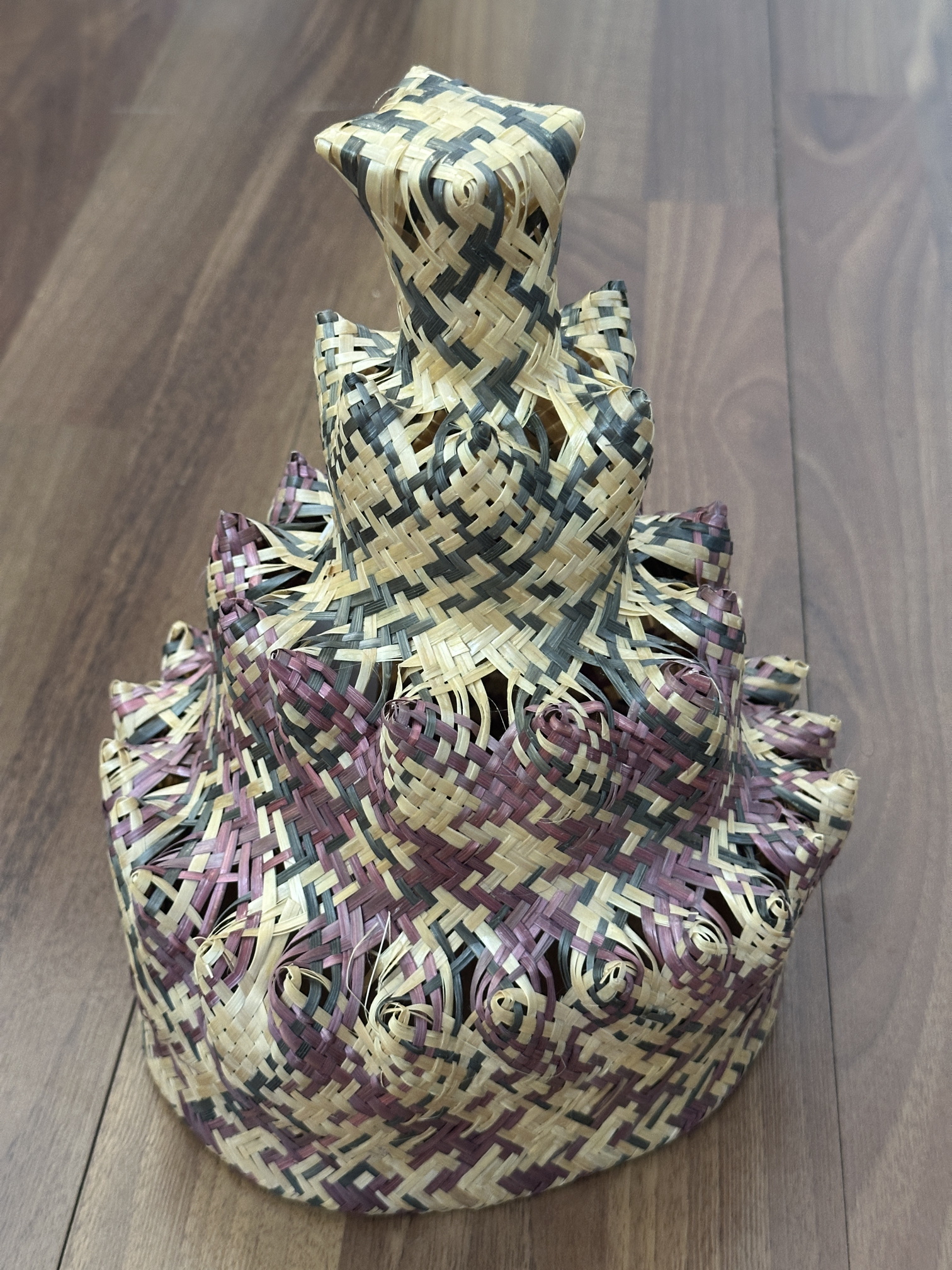
Iban warrior hats, topi tunjang, woven from rattan. 

Keringkam, the dense metallic embroidery. We wil never own a piece. This shawl is over $800.
Ranee Artisans
Now I’m digging into the butik and specialty shops where the real thing is to be found. Ranee Artisans has its own shop, but it also supplies many of the products in the Borneo Cultures Museum gift shop.


Songket & Keringkam Gallery
We had read about the keringkam, the dense metallic embroidery, and specifically about an embroiderer named Danny Zulkifli. I was able to track him down and reached out to ask what gallery represented his work. He was very gracious, and invited me to a workshop he was giving at the Songket & Keringkam Gallery. He offered me a tour of his studio after the workshop.
Once I figured out that the workshop was an all-day affair, I begged off, explaining that it would be wasted on me, as I could barely tie my shoes (I’m spending a lot of time in slides these days). Also, now that I’d done a little more work and understood how expensive the keringkam was, I didn’t want to waste his time in the studio, as I was pretty sure that unless he was selling scraps I wouldn’t be able to afford anything.
He maintained the offer and said he would love to meet me, but our schedules never matched, a victim of my short, overstuffed visit to Sarawak. But I did make it to the gallery, which was small but had excellent representation of both the keringkam and songket.
Some of their ridiculously baroque songket.

I hate to keep harping on price, but it’s hard not to be as staggered by the numbers as the work itself. This piece was $850. 

And this one was a couple bucks shy of $1,000. I’d have loved to have any of them. I would also like the trust fund that would make that possible. It’s hard to believe my parents are still letting me down. 
The keringkam selection was, no surprise, the best I saw. The work is so expensive, no one really carries a lot of it. Some of these closeups really communicate the scale of the work, both the overall effort and how very fine the work is. This is backbreakingly delicate work done at industrial scale. It’s very, very hard to wrap your head around.


Tanoti House
I’ve saved Tanoti House, the best of the craft shops, for last. They were out of the main shopping district, but only about a 25 minute walk from my condo. Which doesn’t sound like much except for the equatorial heat. Let’s just say that I was less than fresh when I arrived, and took a Grab back home.
The arrival part itself was pretty funny. As I was walking up the path to the building, a woman drove her car past me and parked. As I came up behind her she turned and asked if she could help me. “Is this Tanoti House?” “Yes.” We were standing in front of a large outbuilding full of looms. “Do you have a shop.” “Yes.” “Great. I’d love to see your work.” “Oh. OK, sure.” Like a customer walking up was so weird she couldn’t quite grasp why I was there.
But she warmed up quickly and led me around the corner to her shop. Which was staffed with a full-time sales associate (the delightful Jenny), so her confusion about a customer walking up seemed odd. Maybe they were one of those places that tours stopped at and walk-up customers weren’t a thing. They were a little off the beaten track. Dunno. However odd it started, it was a delightful experience once underway.
Not only did they have the excellent work produced in their own workshop, they also represented tribal groups from across Sarawak. I had struck a rich vein at Tanoti House. Everything was super high quality. However, this was another experience that required Dorothy’s direct involvement. I took some pictures and sent them to her, and we scheduled a return visit, when they were expecting me, so that I could bring her in on a video call and we could shop together. Important decisions needed to be made, so the Executive Committee was convened.
They had the best basketry I’d seen and beautiful songket.


But the standout pieces were the Pua Kumbu weavings.


One piece stood out from its brethren.

This is an Iban piece, and is, mostly, the Pua Kumbu Sungkit (songket) technique, which is actually two distinct techniques combined. Pua means blanket, and Kumbu is a warp ikat technique, where the vertical threads have been tie-dyed, rather than the more common weft ikat. In addition, songket is used, which is a discontinuous supplementary weft technique, meaning that additional weft threads are pulled through the warp and tied off to make discrete patterns that don’t continue horizontally across the width of the fabric.
What makes this particular piece an outrageous example of stunt weaving is that its three sections all deploy both different motifs and different techniques, all of which were executed on the same loom. One end holds the primary motif, the terabai, or shield. We were told that when displayed, the terabai is always at the top, never the bottom. This section is Pua Kumbu Sungkit.

The middle section is a motif called silup langit sereta. Langit means sky or heaven, and the overall motif represents the connection of the earthly and the divine. The technique used is sidan, which is a continuous supplementary weft technique, meaning that the pattern extends side-to-side.

The final panel is the kelekeit motif, a sacred pattern with strong protection powers. This is again executed in the Pua Kumbu Sungkit technique.

So this piece incorporates three distinct patterns, is built on a warp ikat base, and uses a discontinuous supplementary weft technique at each end and a continuous supplementary weft technique in the middle.
Sweet bleeding Jesus!
In case you’re still not convinced, here are closeups of the front and back sides. The amount of labor is almost unfathomable. Just thinking about it makes me want a nap. Although, to be fair, very little doesn’t make me want a nap.


This piece was also… expensive. They had so much beautiful stuff we were sort of looking at a shopping cart. Some of the baskets and purses, a floor covering, a little of this and a little of that. Instead, we put all our chips into the Pua Kumbu. This is a signature piece, always our goal, and will find its new home, I think, well suited. Sadly, it required that we leave all the other beauty behind.
Well… almost all. We still needed an example of the basket weaving, and their selection was outstanding. This piece is from the Penan tribe, and uses a fern motif called paku pakis. The rings that hold it together at the top are called ulat, the Malay word for caterpillar.
I left lighter in the wallet but richer in every other way. I love shopping with Dorothy.
What could possibly be left after that? A pair of museums, a cultural center, and a field trip to a songket weaver. But don’t worry, there are excellent gift shops still on the itinerary. That Pua Kumbu may have eaten up most of our budget, but there was still room for a few more treats.
Borneo Cultures Museum
Everyone in Kuching said the same thing: “Have you been to the Cultures Museum yet?” I like to think of myself as pretty resistant to peer pressure, but resisting seemed not so much futile as foolish. Why would I skip a Borneo cultural museum? Good lord. I only play an idiot on TV.
The first thing I liked about the museum was its name. Not the Borneo Cultural Museum, but the Borneo Cultures Museum. There are many cultures here, and we’re going to do our best to represent them all. Nice.
The next thing is the building itself, a five-story structure that riffs off traditional basket weaving and Pua Kumbu motifs. Not for nothing, it’s also the second-largest museum in all of SEA.

The oddest thing about the museum is that every time I entered or exited a gallery my hearing aids went all staticky. Dr. Google says it’s most likely some form of electromagnetic interference caused by the museum’s security systems, but they must be doing something no one else is doing. I’ve never had that happen before.
Also, and this is just me being weird, none of the escalators moved until you stepped on them. That’s not the first time I’ve run across that, but it still surprises me how disorienting it is. Are you broken? Is there a toll? Are you Up or Down? So many questions.
OK, enough. Focus. Museum.
Because there’s lots of museum to take in. This is just going to be the highest of highlights, but the bottom line is simple: You should go to Borneo, visit Sarawak on the Malaysian side, and go to the Borneo Cultures Museum in Kuching yourself. Until you can pull your shit together and execute on that perfectly reasonable plan, this will have to suffice. But it will be very sad for you if this is all of Borneo you ever see. Just sayin’.
Often in a museum I’ll think, “Oh, I’d love a reproduction of that.” But outside the Borneo Cultures Museum these pieces are being produced, not reproduced. They are the artifacts of cultures that are still current, active, and engaged. Their craftwork may be in a museum, but none of them are museum cultures. They’re out there right now, living the lives represented in the exhibits. Museums tend to be monuments to the past, not representatives of the present. That’s pretty unusual, and it’s more than a little exhilarating to know that I could see any of the cultures represented there in situ if I so chose.
So let’s dine out on the feast the Borneo Cultures Museum serves up. First up, basketry and reed weaving, a Borneo specialty.

These are food covers, tudung saji, like the one I picked up in Kuala Lumpur. 
Here’s our modern version, which I only discovered weeks after buying it is ribbon woven into a plastic colander. Clever! 
An assortment of seed baskets. 

Another seed basket. 
A rattan carrying basket for forest foraging. Again, not at all unlike the piece we picked up at Tanoti House. 
A pair of woven reed floor coverings. 
There are textiles, to no one’s surprise. Mostly Pua Kumbu, with a few exceptions.


Some truly excellent beadwork examples.


More? Of course. How about some clothing and hats? Well, since you asked so nicely…

A beaded Iban bridal gown. 
I looked, and this was not available in the gift shop, a major oversight. 
More Iban bridal finery. 
More extravagant bridal headgear. 
Neither of these were in the gift shop, either. That’s just leaving money on the table. 
A simple sunhat. 
A Bidayuh ceremonial hat. 
A Kenyah Lepo Keh hat. The human figures represent slaves.
OK, one more. You’ve been good. Here’s some primo carvings and masks for you.

A boat built especially for the annual Kaul Serahang Kakan ceremony. It’s used to bring offerings to the mouth of the river. 

Detail of a Melenau burial pole. A jar with the deceased’s remains is hidden in a cavity inside the pole. 
A replica of one of a pair of burial poles. It took multiple craftsman two years to make the original and its mate. 
A 1915 Iban war boat. The Iban were ordered by the White Rajah, Charles Brooke, to join his expedition and bring one of their fancy boats. 
A Melanau crocodile effigy, used for healing. To the Melanau, the crocodile is the king of the spirits. 
A pair of Bali Jawa made by the Berawan in 1899. 
Before intertribal beefs could be settled, a mock battle, a Jawa, was staged so everyone could get it out of their systems. The Bali Jawa represent that spirit. Of spiky reconciliation? 
An Iban carved hornbill head. It would have topped a whole hornbill statue. 
An actual hornbill skull, referred to as Hornbill Ivory. It was considered more valuable than jade, as only one hornbill species produces bone hard enough to carve. 
A bone or horn fishing fetish, used by the Melanau to guard and protect their fishing lines. 
An Orang Ulu carved wooden door, featuring gibbons in relief. Also, another missed opportunity in the gift shop. 
And some truly excellent masks. 

The museum opened in 2022, so it’s modern to the gills, full of interactive displays. This room held a series of decorated glass windows and a sliding wooden frame.

When you slid the frame over one of the windows, it came to life. Sorcery! Witchcraft!
This next display was an interactive book that took up an entire wall. You controlled it with hand gestures.

But this may have been my favorite interactive display: Smell-O-Vision. There was a whole bank of these, each with a different aromatic substance. Push the button and huff and you get to smell, in this case, camphor.

Is there anything better than a good museum gift shop? If there is, I’m certainly not telling you. I’ll snort it all myself.

This is a light fixture, made from the front halves of table fans woven with reed. 
I also saw these warrior’s hats at the Steamship Building. I sent Dorothy this picture and told her that if I could figure out any way to pack it safely it would be hers, but I couldn’t. It’s dimensional and hollow. Impossible. 
Beautiful jewelry. 
But what did I pick up for us? This woven purse. 

One of the woven fan fronts. 
And a little drink holder and coin purse.
Kampung Budaya Sarawak
The Sarawak Cultural Village calls itself a living museum, and that sounds about right. Visiting SCV is meant to be an immersive experience. The 17-acre grounds are dotted with reproductions of traditional houses associated with different tribes. The houses are all accessible, and there are docents to explain how people used those spaces and lived in them.


There are craftspeople scattered about the different houses, highlighting some sort of traditional activity or craft, such as games, baking, weaving, beadwork, and blowpipery. Many of these activities can be joined by visitors in a low-key version of tourist places that let you Make Your Own Batik! There are also performances, some taking place in the houses, some staged in their indoor theater. It’s meant to be a soup-to-nuts cultural experience and it pretty much delivers on that goal.
We actually visited someplace similar in Hà Nội, the Vietnam Museum of Ethnology, which is likewise made up of houses representing Vietnam’s different ethnic groups. I think the biggest difference is that most of the houses in the Museum of Ethnology were real houses that had been broken down and reconstructed on site, whereas the SCV is all reproductions.


This grand edifice is a Melayu home. It was built in 1989 from native ironwood, just as the original was in 1860.


Quite the grand room. 

This was the bridal bed, reserved for newlyweds. It was taken down and stored after the honeymoon. 
It’s not like it afforded what we would consider privacy. It was still a large shared sleeping area. 
I asked the docent how mancala came to Malaysia, since it was native to Egypt. The answer was traders from the Middle East, but he said in his many years of working at SCV I was the first person who knew that was a mancala board. It’s called congkak in Malaysia. 
The ladies had to have something to do. 
When they weren’t cowering from male guests. The upper floor was specifically for hiding the womenfolk when visitors called. More gracious than a crate, I suppose.
This is a Melanau Tall House.


This is the Iban house, with crafts you’ll recognize from the Borneo Cultures Museum.


Another tall house, from the Orang Ulu.


And finally, a few lightly identified houses.


Here’s one of the Tourist Enrichment Stations, where an expert tries to teach a poor schlub how to throw a top. Opportunities to humiliate myself always seem to crop up without my intervention, so I passed. Schadenfreude only works if it’s someone else’s misfortune.
The performances were surprisingly good. The performers were charismatic, the costumes were great, and even the musicians were excellent. It was an unexpectedly professional production, especially since all the performers were pulling shifts in the houses before the afternoon Big Show.


I love this clip, where the pole dancer clearly has to work his nerve up for the trick.
And then this, indigenous crowd work. I’m sure the screaming is traditionally relevant and not just a Tourette’s-like outburst. Plus, more of those delicious thighs. What’s not to love?
But do they have a gift shop? What a silly, silly question. I picked up a few things there for the floor.


SCV was the other place, with the Borneo Cultures Museum, where everyone was all, “Have you been? Have you been? What about now? Have you been?” And I get it. It would have been a grievous error to have visited Kuching, for however short a stay, and missed either of those institutions. Thankfully, most of my lapses in judgement involve doing things I shouldn’t rather than missing things I should.
Tun Jugah Museum
I was texting with the tour operator who got me to Bako National Park and mentioned that I was interested in Pua Kumbu. She pointed me to the Tun Jugah Museum, right in town. Tun Jugah was a Malaysian politician who played a central role in the establishment of Malaysia as an independent nation. His foundation, set up to promote Iban crafts and culture, houses a museum and gallery with amazing specimens.
They must not get a lot of visitors, as it’s pretty hard to reach. There’s a sign in the lobby indicating that the museum is on the fourth floor. I naturally take the escalator up to the second floor, where I’m met with an escalator to the third floor that’s decommissioned and gated, with no obvious way to go any higher. Back down to the first floor, where I find the elevators that… don’t go to Four.
Then I see a sign for the museum at the head of a passageway, but the passageway dead ends. I back out and round another corner where I find another elevator bank and signs to the museum… behind an entrance that requires a key card. No signs, no help, but I’m now adjacent to the front desk in the lobby of what looks like an office suite. I ask the nice lady if she has any idea how I get to the museum on Four. She does! I get there when she hands me a visitor’s badge that opens the gate to the elevator bank. Of course. How foolish of me not to have figured that out.
When I exit on the fourth floor, I am honestly unsurprised that the museum staff is surprised to see me. Not me particularly, obviously, but anyone. I can’t imagine many people make it through the gauntlet required to gain access. It lacked only a troll and a riddle.
But the collection. Holy cow, they had the goods. Sadly, they wouldn’t let me take pictures in the fabric gallery, but I was able to take pictures of the looms and some of the workers, as well as a separate gallery with beaded goods. The ladies who worked there were super knowledgeable and helpful, and seemed truly pleased to answer my questions. And downright spooked when I was able to use the phrase discontinuous supplementary weft properly in a sentence. One of my favorite tricks.
Outside of the fabric gallery I can’t show you, the most interesting thing was the workroom, full of looms with work in various stages of completion. No one was weaving while I was there, as all of the women were tying off thread for ikat dying. But what was up in the looms as WIP was beautiful, even half-finished.
They had some completed pieces up for display, but nothing for sale. If any museum ever screamed for a gift shop, it was surely the Tun Jugah. The sound still echoes.


They also had a section of looms set up tagged with the technique being demonstrated, which was very helpful. I think these were specifically educational display, and not WIP.


The range of techniques on display was impressive. I would have gladly stolen any one of the pieces at random, had they not been still on a loom. And had I been slightly less thoroughly docented. You can just imagine what the display pieces in the Forbidden Gallery looked like, given how stunning the WIP was.
I was baffled by this first piece, but I think it’s because I’m not very smart. I’m used to seeing fabric woven in a length, and I couldn’t figure out why this was being woven from the bottom… up to completed weaving on the top? How is that supposed to end?
I’m sure y’all saw it right away, but I had to ask. The entire piece is being woven in a loop, and when the weaver catches up to the beginning she’ll cut it so it’s a single long piece. It seemed obvious once it was explained, but I don’t think I’ve ever seen that.


The live action while I was there was all in the ikat preparation. Three women were engaged in tying off thread to dye into ikat patterns. They’d move to the looms later. I’m sure they were waiting for me to leave.


Finally, there was the bead room, which featured beautiful pieces made from glass trade beads and carved shell. Most of the beadwork I’d seen in the markets was clearly tourist goods. It was a treat to see the real thing.


Seri Gedong Songket
It’s such a fine line between adventure and misadventure. I suppose the distinction is really just how much stupid you bring to the table. Game on.
I had read about this high-end songket maker, about 90 minutes south of Kuching, and made it the central focus of one of my day trips. When we got there, I found a small workroom with maybe four looms, three of which were in operation during my visit. I asked about their shop, where I could see and purchase finished goods, and they explained that it was in Kuching. After describing the location, I said, “Wait, are you the songket stall in the Steamship Building?” “Yes! That’s our shop.” The songket photo in the Steamship Building section above is theirs.
I had come all that way for no reason except to see the weaving. And don’t get me wrong, I love seeing the process. But I’d seen songket weaving in person in Bali and I’d seen Seri Gedong Songket’s finished work already in Kuching. I don’t think I’d have made that trek knowing those things. [counting the ballots…] Misadventure!
However. Lemonade shall be made from these lemons. The work was unquestionably denser than the Balinese songket, so it was pretty cool seeing it made.


Nothing like mixing up a little misadventure with the actual adventures. Keeps me young.
Dorothy and I had planned for our next leg, leaving Chicago before winter, to be 100% India. Current thinking, based on all of the above, is Kerala, Borneo, and Sri Lanka. More planning and thinking to do, but I’ll happily sign off on that itinerary. Especially the full-on Borneo tour. There’s so much more than a week’s worth of wow left in Borneo.